
Close Menu
    Facebook X (Twitter) Instagram
    SciTechDaily
    • Biology
    • Chemistry
    • Earth
    • Health
    • Physics
    • Science
    • Space
    • Technology
    Facebook X (Twitter) Pinterest YouTube RSS
    SciTechDaily
    Home»Earth»Stunning Space Photo Reveals Onekotan Island’s Volcanic Secrets
    Earth

    Stunning Space Photo Reveals Onekotan Island’s Volcanic Secrets

    By Chloe Locke, NASA Earth ObservatoryOctober 28, 20241 Comment3 Mins Read
    Facebook Twitter Pinterest Telegram LinkedIn WhatsApp Email Reddit
    Share
    Facebook Twitter LinkedIn Pinterest Telegram Email Reddit
    Krenitsyna Volcano From Space Station Annotated
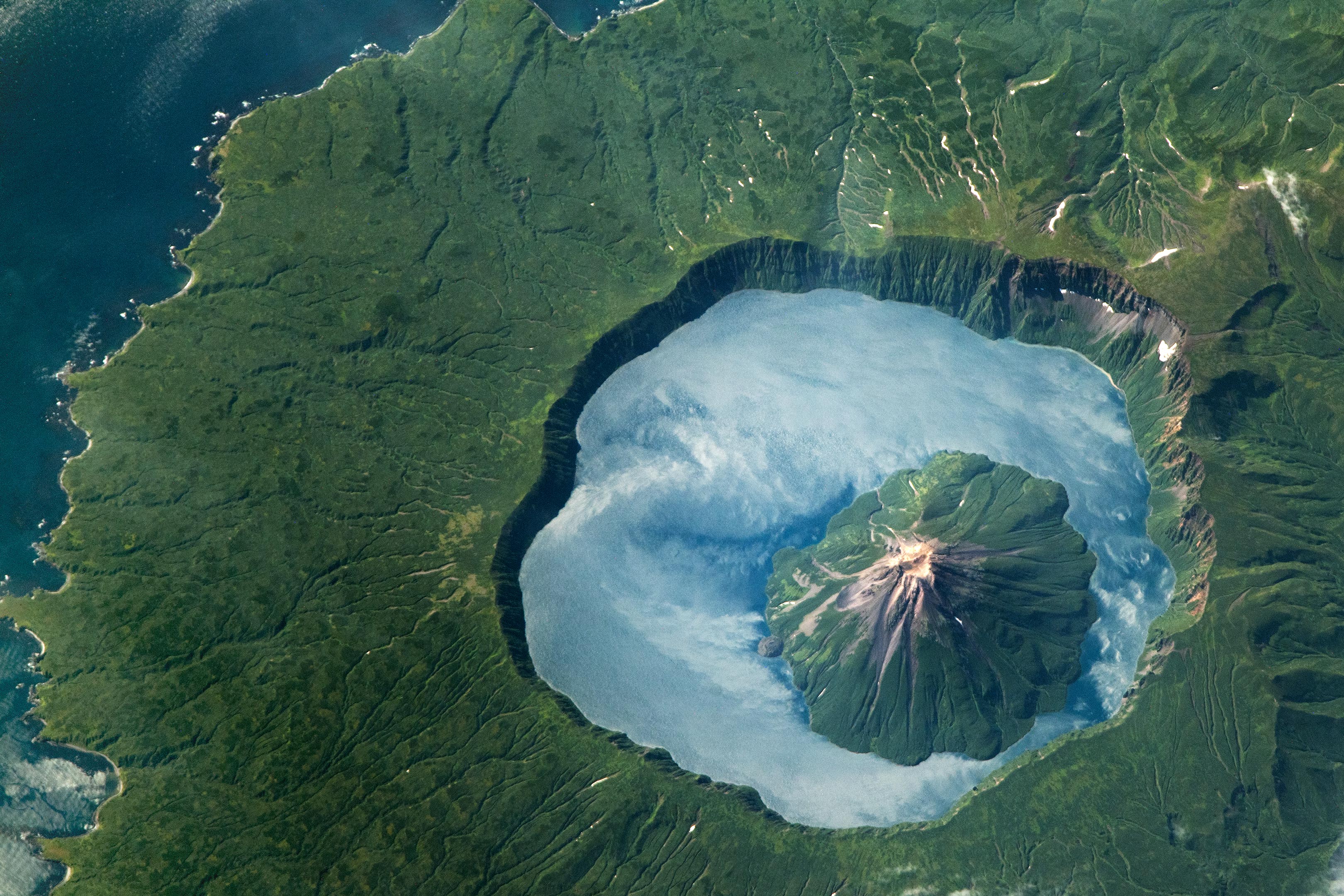
    Astronaut photograph of Onekotan Island captured on August 19, 2023, from the International Space Station.

    An astronaut captured an enthralling image of Onekotan Island from the International Space Station, showcasing the Krenitsyna Volcano of the Kuril Islands chain.

    This remarkable photo highlights geographical features like the Tsar-Rusyr caldera and its deep, reflective Kol’tsevoye Lake, which is among Russia’s deepest. The volcano’s last eruption in 1952 adds a historical layer to the viewing experience, juxtaposing the rugged terrain against the caldera’s lush, vegetated landscape.

    Capturing Onekotan: A Stunning Image From Space

    An astronaut aboard the International Space Station (ISS) captured this photo of Onekotan Island while orbiting over the northwest Pacific Ocean. It is part of the Kuril Islands, an archipelago extending between the Kamchatka Peninsula in Russia and Hokkaido in Japan. The image prominently features Krenitsyna Volcano, located on the island’s southern side.

    The photo, taken at a low-oblique angle, highlights the island’s rugged terrain, including cliffs, coastlines, and mountain formations. To avoid an optical illusion known as relief inversion, the image has been rotated so that north appears at the bottom.

    The Tsar-Rusyr Caldera: A Volcanic Wonder

    The Tsar-Rusyr caldera, a large, crater-like depression formed by ground collapse into a partially emptied magma chamber after an eruption, is clearly visible. Steep 300-meter (1,000-foot) cliffs surround the caldera, casting long shadows along the volcano’s eastern interior.

    The caldera holds the blue waters of Kol’tsevoye Lake, which contrasts with the surrounding vegetated summer landscape. Reaching depths of up to 370 meters (1,200 feet), the lake is one of the deepest in Russia. Its surface reflects sunlight back to the camera, producing sunglint, and it also mirrors the clouds drifting above the central peak.

    Volcanic Majesty: Krenitsyna Peak

    Situated at the center of the caldera is Krenitsyna Peak, which stands approximately 1,300 meters (4,200 feet) above sea level. The slopes of this stratovolcanic peak consist of dark-colored valleys and ridges, caused by volcanic flows and erosive processes, that reach the surface of Kol’tsevoye Lake. The last eruption of this complex occurred in November 1952 and was categorized as “moderate,” with a Volcanic Explosivity Index (VEI) of 3.

    West of the caldera, a mountain system is visible on the right side of the image. This rugged terrain contrasts with the opposite side of the caldera, where the landscape flattens out as it reaches the Pacific Ocean. Small patches of bright snow and ice remain in the valleys between the mountain and the coastline.

    Astronaut photograph ISS069-E-71110 was acquired on August 19, 2023, with a Nikon D5 digital camera using a focal length of 1,150 millimeters. It is provided by the ISS Crew Earth Observations Facility and the Earth Science and Remote Sensing Unit, Johnson Space Center. The image was taken by a member of the Expedition 69 crew. The image has been cropped and enhanced to improve contrast, and lens artifacts have been removed. The International Space Station Program supports the laboratory as part of the ISS National Lab to help astronauts take pictures of Earth that will be of the greatest value to scientists and the public, and to make those images freely available on the Internet.

    Never miss a breakthrough: Join the SciTechDaily newsletter.
    Follow us on Google and Google News.

    Geography NASA NASA Earth Observatory Volcano
    Share. Facebook Twitter Pinterest LinkedIn Email Reddit

    Related Articles

    Island Obliterated: Dramatic Changes at Hunga Tonga-Hunga Ha’apai

    Hunga Tonga Island Obliterated – NASA Satellites Capture Massive Blast

    A Wolf Awakens in the Galápagos Islands at Night

    A Deadly Day on Mount Semeru: Destructive Rivers of Debris on Indonesian Volcano

    Wall of Lava Burns a Path Through La Palma

    Cumbre Vieja Lights Up the Night – Astronaut Photo Captures Volcanic Eruption From Space

    Socked in Stratovolcano: Astronaut on ISS Captures Incredible View of Uninhabited Atlasov Island

    Kilauea’s Lava Lake Returns – Hawaii’s Most Active Volcano Is Erupting Again

    Newberry Volcano Photographed by Astronaut Onboard the International Space Station

    1 Comment

    1. Boba on October 28, 2024 7:01 am

      Looks like the home od King Kong…

      Reply
    Leave A Reply Cancel Reply

    • Facebook
    • Twitter
    • Pinterest
    • YouTube

    Don't Miss a Discovery

    Subscribe for the Latest in Science & Tech!

    Trending News

    Scientists May Have Solved a Long-Standing Melanoma Treatment Mystery

    This Flesh-Eating Fly Is Back in the U.S. – Scientists Are Tracking Where It Could Strike Next

    Scientists Have Uncovered a Troubling New Pattern Hidden in America’s Rivers

    “Entirely Surprising” – Scientists Have Found a Martian Meteorite Unlike Any Known Before

    “Find of the Year” – Archaeologists Discover the Smallest Ice Age Figurines Ever Found

    New Research Challenges Common Exercise Advice for Bone Health

    Avoiding These 3 Health Risks in Midlife Linked to 13 More Years Without Dementia

    Where Were All the Tiny Dinosaurs? Scientists May Finally Have an Answer

    Follow SciTechDaily
    • Facebook
    • Twitter
    • YouTube
    • Pinterest
    • Newsletter
    • RSS
    SciTech News
    • Biology News
    • Chemistry News
    • Earth News
    • Health News
    • Physics News
    • Science News
    • Space News
    • Technology News
    Recent Posts
    • Textbooks May Be Wrong: Satellite Data Challenge the Two-Bulge Tide Model
    • Tiny New “Dragon” Discovered High in Thailand’s Mountain Forests
    • Scientists Uncover a Surprising New Route for Stonehenge’s Most Mysterious Stone
    • NASA’s James Webb Telescope Captures a Dying Star Sculpting a Cosmic Lion
    • A Star Near the Milky Way’s Black Hole Is Losing Mass at an Astonishing Rate
    Copyright © 1998 - 2026 SciTechDaily. All Rights Reserved.
    • Science News
    • About
    • Contact
    • Editorial Board
    • Privacy Policy
    • Terms of Use

    Type above and press Enter to search. Press Esc to cancel.