
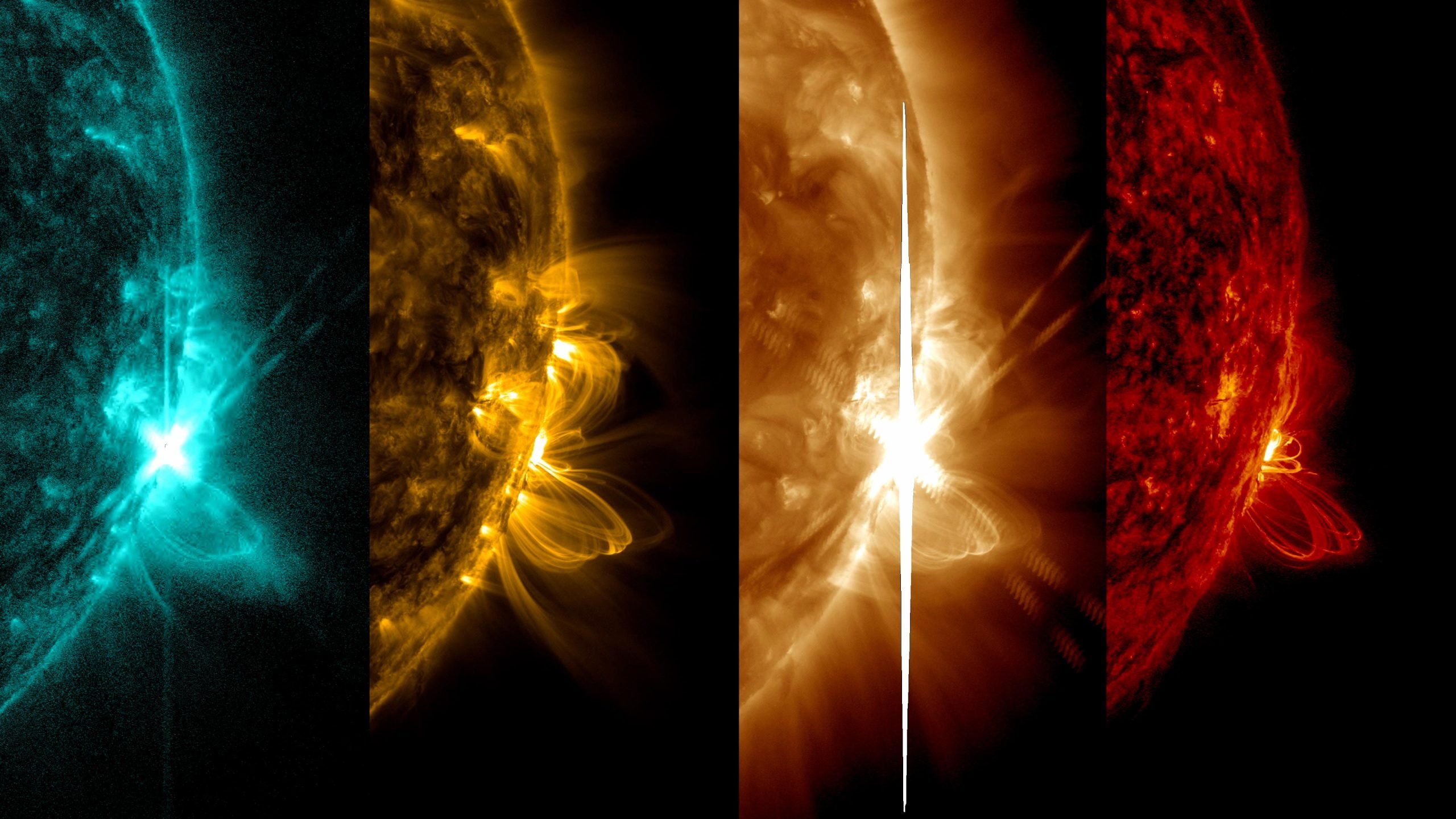
May 2024 witnessed one of the most significant solar storms in decades, featuring a barrage of solar flares and coronal mass ejections that caused historic aurora displays and tested the limits of scientific understanding of solar weather.
May 2024 has already proven to be a particularly stormy month for our Sun. During the first full week of May, a barrage of large solar flares and coronal mass ejections (CMEs) launched clouds of charged particles and magnetic fields toward Earth, creating the strongest solar storm to reach Earth in two decades. It might have been one of the strongest displays of auroras on record in the past 500 years.
“We’ll be studying this event for years. It will help us test the limits of our models and understanding of solar storms.”
Teresa Nieves-Chinchilla, Acting Director of NASA’s Moon to Mars (M2M) Space Weather Analysis Office
“We’ll be studying this event for years,” said Teresa Nieves-Chinchilla, acting director of NASA’s Moon to Mars (M2M) Space Weather Analysis Office. “It will help us test the limits of our models and understanding of solar storms.”
From May 3 through May 9, 2024, NASA’s Solar Dynamics Observatory observed 82 notable solar flares. The flares came mainly from two active regions on the Sun called AR 13663 and AR 13664. This video highlights all flares classified at M5 or higher with nine categorized as X-class solar flares. Credit NASA’s Goddard Space Flight Center
Intense Solar Flares and CMEs
The first signs of the solar storm started late on May 7 with two strong solar flares. From May 7 – 11, multiple strong solar flares and at least seven CMEs stormed toward Earth. Eight of the flares in this period were the most powerful type, known as X-class, with the strongest peaking with a rating of X5.8. (Since then, the same solar region has released many more large flares, including an X8.7 flare — the most powerful flare seen this solar cycle — on May 14.)
On May 14, 2024, the Sun emitted a strong solar flare. This solar flare is the largest of Solar Cycle 25 and is classified as an X8.7 flare. Credit: NASA’s Goddard Space Flight Center
Traveling at speeds up to 3 million mph, the CMEs bunched up in waves that reached Earth starting May 10, creating a long-lasting geomagnetic storm that reached a rating of G5 — the highest level on the geomagnetic storm scale, and one that hasn’t been seen since 2003.
“The CMEs all arrived largely at once, and the conditions were just right to create a really historic storm,” said Elizabeth MacDonald, NASA heliophysics citizen science lead and a space scientist at NASA’s Goddard Space Flight Center in Greenbelt, Maryland.
Global Aurora Displays
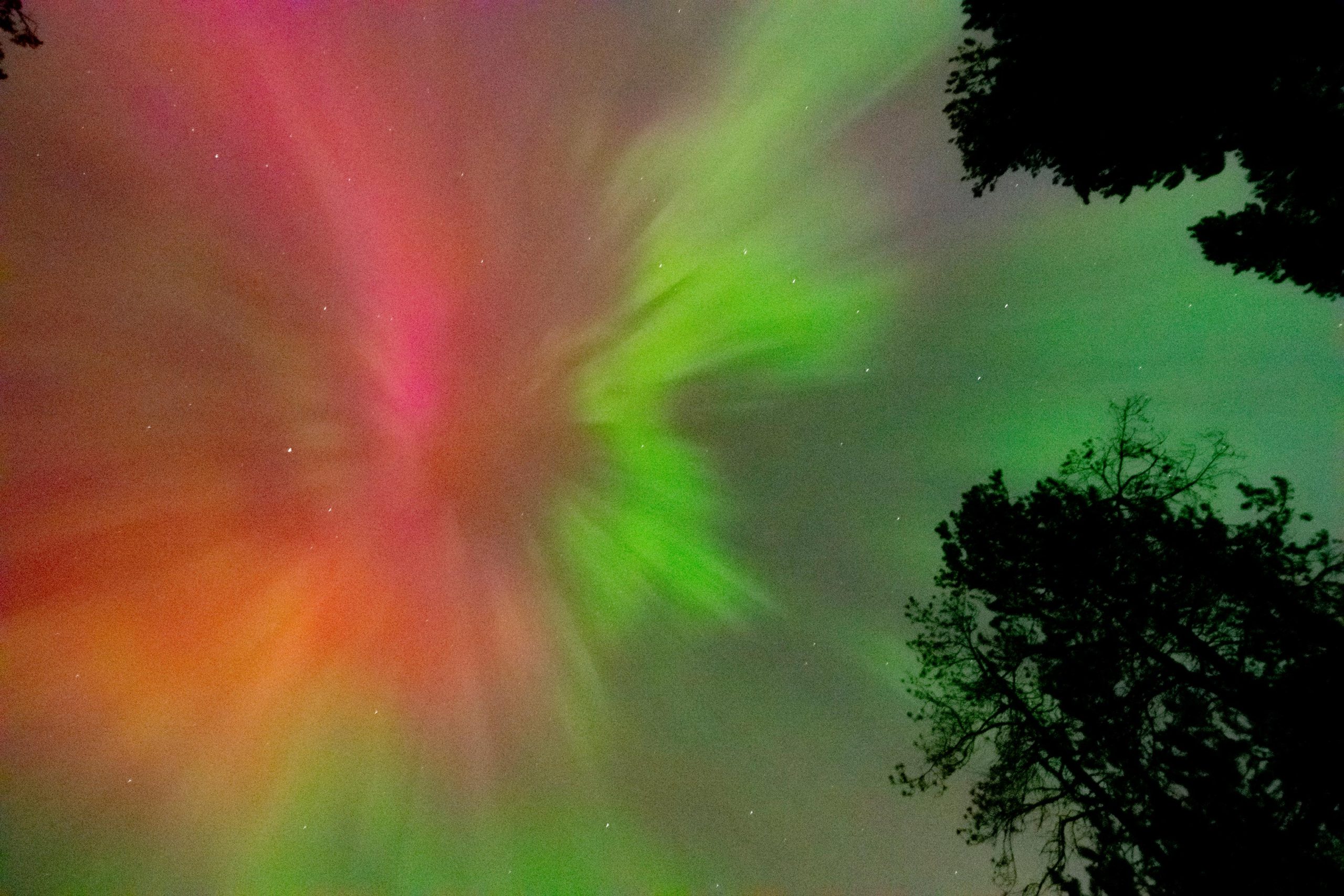
When the storm reached Earth, it created brilliant auroras seen around the globe. Auroras were even visible at unusually low latitudes, including the southern U.S. and northern India. The strongest auroras were seen on the night of May 10, and they continued to illuminate night skies throughout the weekend. Thousands of reports submitted to the NASA-funded Aurorasaurus citizen science site are helping scientists study the event to learn more about auroras.
“Cameras — even standard cell phone cameras — are much more sensitive to the colors of the aurora than they were in the past,” MacDonald said. “By collecting photos from around the world, we have a huge opportunity to learn more about auroras through citizen science.”
Measuring Geomagnetic Storm Strength
By one measure of geomagnetic storm strength, called the disturbance storm time index which dates back to 1957, this storm was similar to historic storms in 1958 and 2003. And with reports of auroras visible to as low as 26 degrees magnetic latitude, this recent storm may compete with some of the lowest-latitude aurora sightings on record over the past five centuries, though scientists are still assessing this ranking.
“It’s a little hard to gauge storms over time because our technology is always changing,” said Delores Knipp, a research professor in the Smead Aerospace Engineering Science Department and a senior research associate at the NCAR High Altitude Observatory, in Boulder, Colorado. “Aurora visibility is not the perfect measure, but it allows us to compare over centuries.”
MacDonald encourages people to continue submitting aurora reports to Aurorasaurus.org, noting that even non-sightings are valuable for helping scientists understand the extent of the event.
Importance of Continued Monitoring and Future Research
Leading up to the storm, the National Oceanic and Atmospheric Administration’s Space Weather Prediction Center, which is responsible for forecasting solar storm impacts, sent notifications to operators of power grids and commercial satellites to help them mitigate potential impacts.
Warnings helped many NASA missions brace for the storm, with some spacecraft preemptively powering down certain instruments or systems to avoid issues. NASA’s ICESat-2 — which studies polar ice sheets — entered safe mode, likely because of increased drag due to the storm.
Looking Forward
Better data on how solar events influence Earth’s upper atmosphere is crucial to understanding space weather’s impact on satellites, crewed missions, and Earth- and space-based infrastructure. To date, only a few limited direct measurements exist in this region. But more are coming. Future missions, such as NASA’s Geospace Dynamics Constellation (GDC) and Dynamical Neutral Atmosphere-Ionosphere Coupling (DYNAMIC), will be able to see and measure exactly how Earth’s atmosphere responds to the energy influxes that occur during solar storms like this one. Such measurements will also be valuable as NASA sends astronauts to the Moon with the Artemis missions and, later, to Mars.
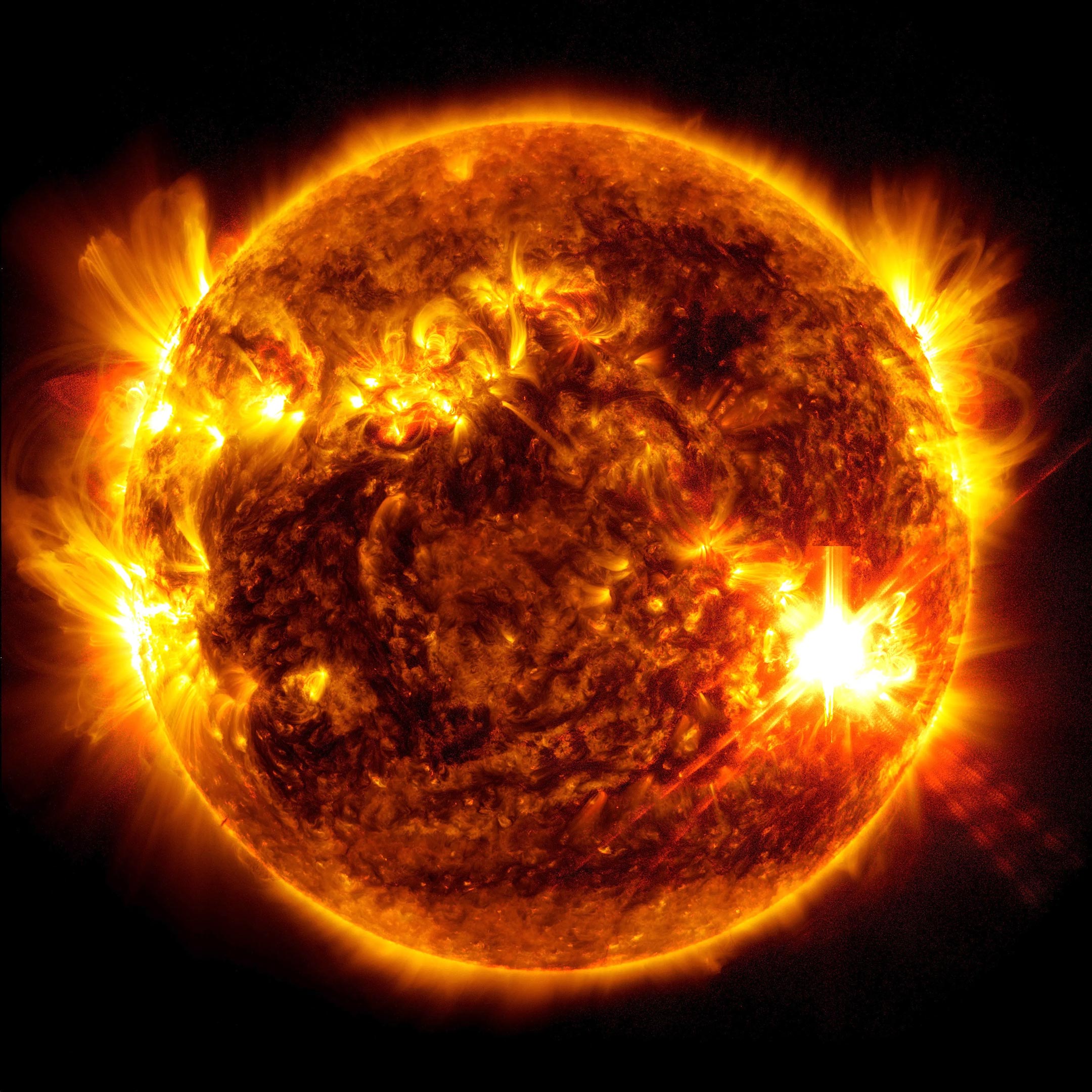
The solar region responsible for the recent stormy weather is now turning around the backside of the Sun, where its impacts can’t reach Earth. However, that doesn’t mean the storm is over. NASA’s Solar TErrestrial RElations Observatory (STEREO), currently located at about 12 degrees ahead of Earth in its orbit, will continue watching the active region an additional day after it is no longer visible from Earth.
“The active region is just starting to come into view of Mars,” said Jamie Favors, director for the NASA Space Weather Program at NASA Headquarters in Washington. “We’re already starting to capture some data at Mars, so this story only continues.”
Never miss a breakthrough: Join the SciTechDaily newsletter.
Follow us on Google and Google News.