
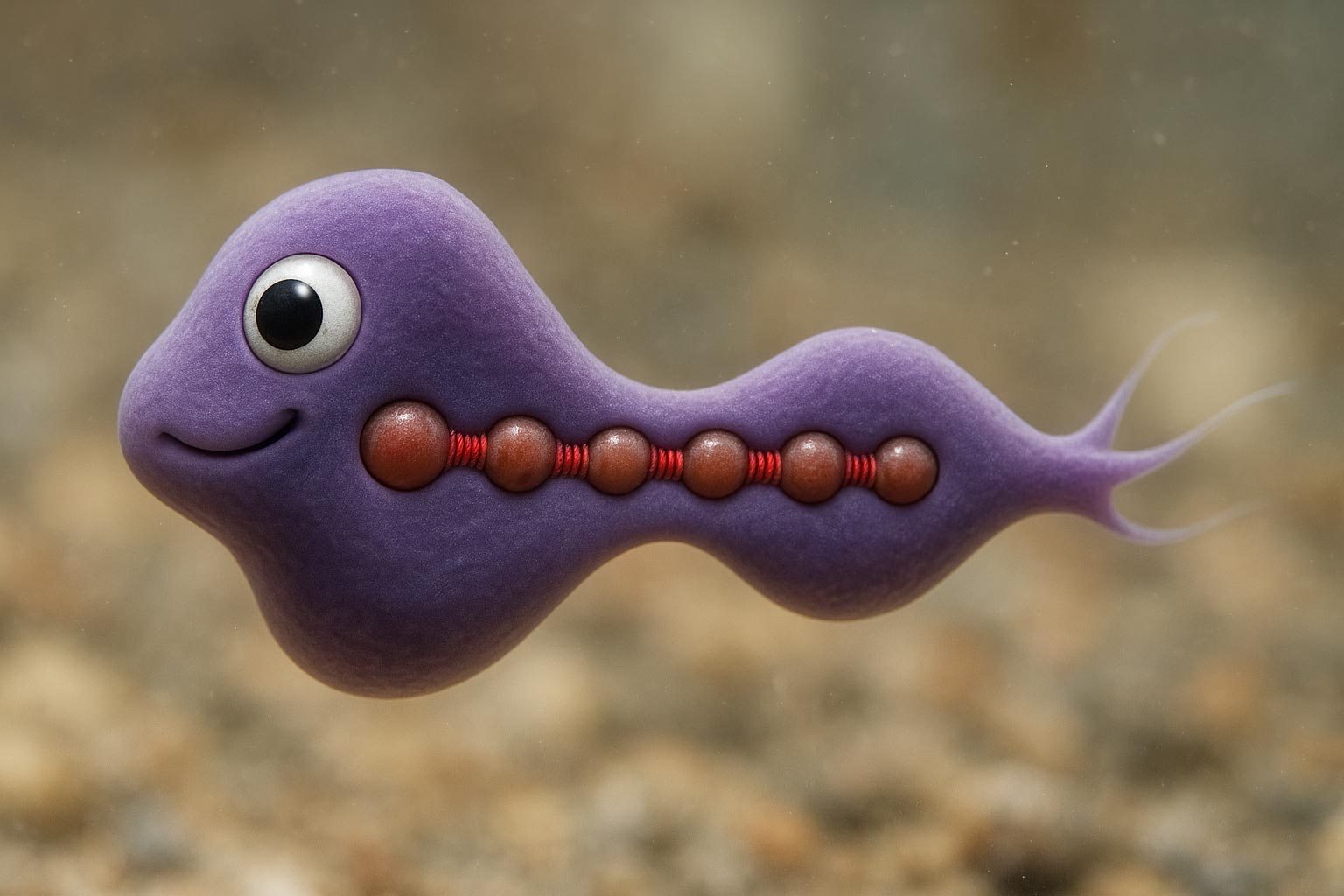
Many microorganisms are capable of purposeful movement through liquids. But how do they achieve this without a complex nervous system? New research from TU Wien offers intriguing insights.
Bacteria can do it. Amoebas can do it. Even your blood cells can do it. All of these tiny life forms have the surprising ability to move with purpose through liquids. What’s even more remarkable is that they manage this without a brain or any central control system.
So how do they do it? Scientists from TU Wien, the University of Vienna, and Tufts University set out to find the answer using computer simulations. Their research shows that simple structures can swim in a coordinated and efficient way by following very basic rules, with no need for a central command.
This discovery not only helps explain how microorganisms move, it also opens the door to exciting possibilities in technology. Imagine tiny nanobots that can navigate your body on their own to deliver medicine exactly where it’s needed.
Success even without a central control system
“Simple microorganisms can be imagined as being composed of several parts, a bit like a string of pearls,” says Benedikt Hartl from the Institute of Theoretical Physics at TU Wien and the Allen Discovery Center at Tufts University, lead author of the current publication. “The individual parts can move relative to each other. We wanted to know: under what circumstances does this result in a movement that causes the entire organism to move in a desired direction?”
This is relatively simple if there is a central control system – something like a brain or at least a nerve center. Such a center can issue specific commands to the individual parts. It is easy to understand how this can result in coordinated movement.
But a single-celled organism naturally has no nerve cells, no central processing system that could issue commands. How is it possible in this case for a coordinated swimming movement to arise? If the individual parts of the microorganism all behave according to very simple rules, can this result in collective behavior that leads to efficient swimming?
Microorganisms simulated on a computer
This question was investigated using computer simulations: the microorganisms were modeled as chains of interconnected beads . Each of these beads can exert a force to the left or right, but each bead only knows the position of its immediate neighbors. There is no knowledge of the overall state of the organism or of beads further away.
“The crucial question now is: Is there a control system, a set of simple rules, a behavioral strategy that each bead can follow individually so that a collective swimming motion emerges – without any central control unit?” says Benedikt Hartl.
On the computer, the individual beads – the simulated parts of the virtual microorganism – were equipped with a very simple form of artificial intelligence, a tiny neural network with only 20 to 50 parameters, explains Hartl: “The term neural network is perhaps somewhat misleading in this context; of course, a single-celled organism has no neurons. But such simple control systems can be implemented within a cell, for example, by means of very simple physical-chemical circuits that cause a specific area of the microorganism to perform a specific movement.”
This simple decentralized control system has now been adapted to the computer in search of the most efficient ‘control code’ possible that produces the best swimming behavior. With each version of this control system, the virtual microorganism was allowed to swim in a simulated viscous fluid.
“We were able to show that this extremely simple approach is sufficient to produce highly robust swimming behavior,” says Benedikt Hartl. “Although our system has no central control and each segment of the virtual microorganism behaves according to very simple rules, the overall result is complex behavior that is sufficient for efficient locomotion.”
Biology and technology
This result is not only interesting because it explains the complex behavior of very simple biological systems, it could also be interesting for artificially produced nanobots: “This means that it would also be possible to create artificial structures that could perform complex tasks with very simple programming,” says Andreas Zöttl (University of Vienna). “It would be conceivable, for example, to build nanobots that actively search for oil pollution in water and help to remove it. Or even medical nanobots that move autonomously to specific locations in the body to release a drug in a targeted manner.”
Reference: “Neuroevolution of decentralized decision-making in N-bead swimmers leads to scalable and robust collective locomotion” by Benedikt Hartl, Michael Levin and Andreas Zöttl, 8 May 2025, Communications Physics.
DOI: 10.1038/s42005-025-02101-5
Never miss a breakthrough: Join the SciTechDaily newsletter.
Follow us on Google and Google News.
4 Comments
How do you know what I think?
Although our system has no central control and each segment of the virtual microorganism behaves according to very simple rules, the overall result is complex behavior that is sufficient for efficient locomotion. With each version of this control system, the virtual microorganism was allowed to swim in a simulated viscous fluid.
VERY GOOD.
Please ask the researchers to think deeply:
Where do things in space come from? How do they adapt to space?
Researchers should deeply contemplate whether entities in space originate from space itself or from divine/demonic beings. Contemporary physics and so-called peer-reviewed publications (including Physical Review Letters, Science, and Nature) stubbornly maintain that two counter-rotating cobalt-60 isotopes are mirror-image counterparts. This constructs a pseudoscientific framework more astonishing than the Ptolemaic model in scientific history.
For nearly a century, this pseudoscientific system has severely impeded scientific and social progress. Physics has been manipulated by vested interest groups behind this framework, wasting vast human resources, funding, and time on pseudoscientific research. Countless flawed papers have inflicted substantial damage on scientific advancement, social development, and humanistic growth.
Fortunately, not all in the public are easily deceived. Topology is reconfiguring modern civilization’s cognitive framework. With the progressive refinement of artificial intelligence (AI), we no longer rely entirely on deception mediated by some so-called peer-reviewed publications (including Physical Review Letters, Science, Nature, PNAS). We now possess means to leverage AI’s efficiency for enhancing scientific rigor and productivity.
If researchers are interested, please browse https://zhuanlan.zhihu.com/p/1906678707730506847.