
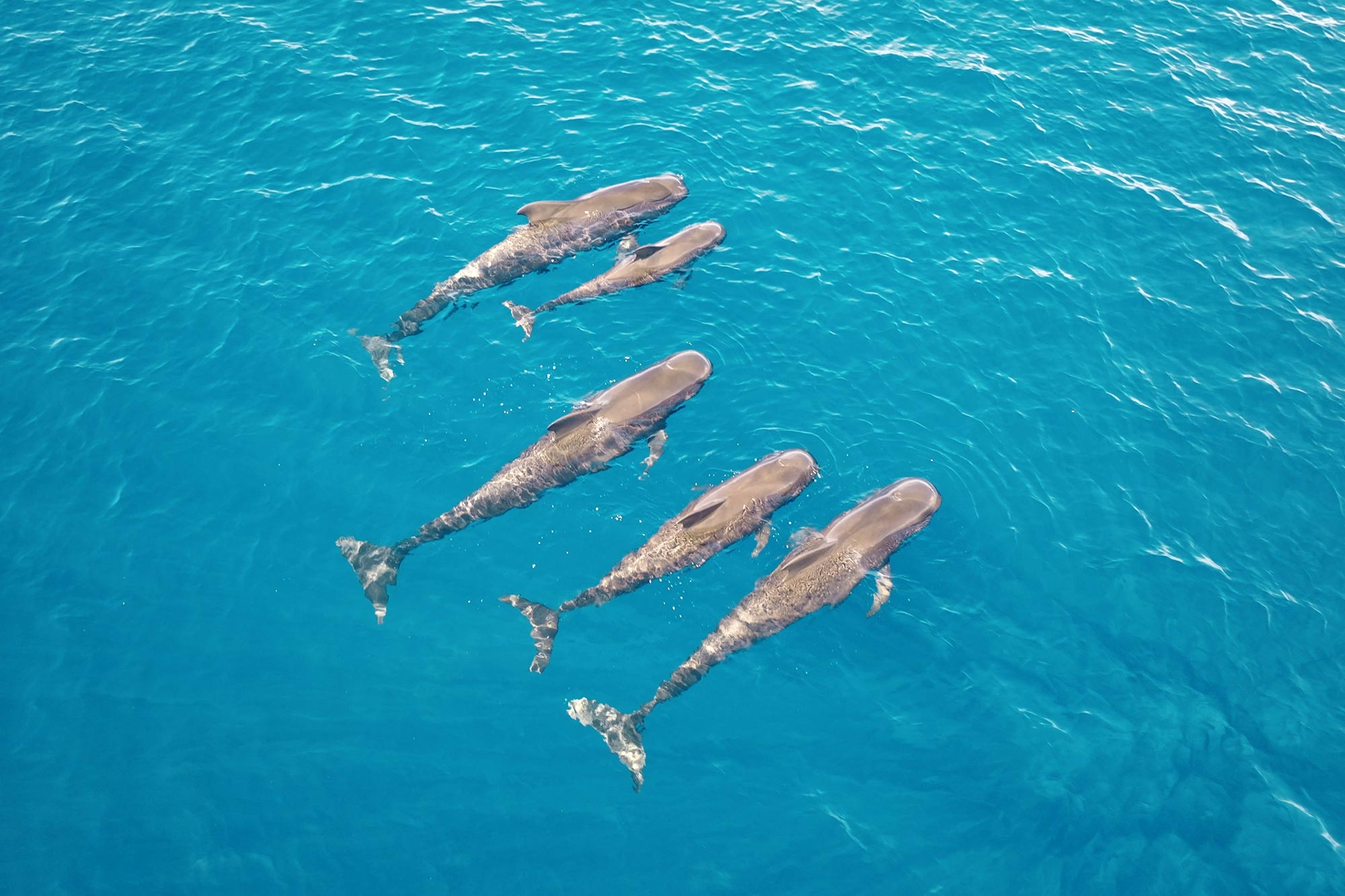
There are plenty more squid in the sea for Hawaiian short-finned pilot whales.
How much squid do short-finned pilot whales (Globicephala macrorhynchus) living off Hawai‘i need each day, and is the local ecosystem able to support their appetite? Understanding these fundamental details is key to protecting the species.
Scientists from the USA, Spain, Australia, and Denmark report in the Journal of Experimental Biology that each whale consumes between 82 and 202 squid daily. When multiplied across the entire Hawaiian population, this comes to roughly 88,000 tonnes of squid per year, which remains a small fraction of the region’s overall squid resources.
Determining an animal’s daily food needs is an essential part of assessing its long-term survival, especially when declining prey could place a species at risk. Pilot whales are a particularly intriguing example, as they routinely descend as far as 1700m in search of squid, their primary food source.
“These animals have been studied in locations around the world, but relatively little is known about them in Hawaiian waters,” says William Gough (University of Hawaiʻi at Mānoa, USA), who teamed up with colleagues to solve the riddle of just how much Hawaiian squid short-finned pilot whales consume.
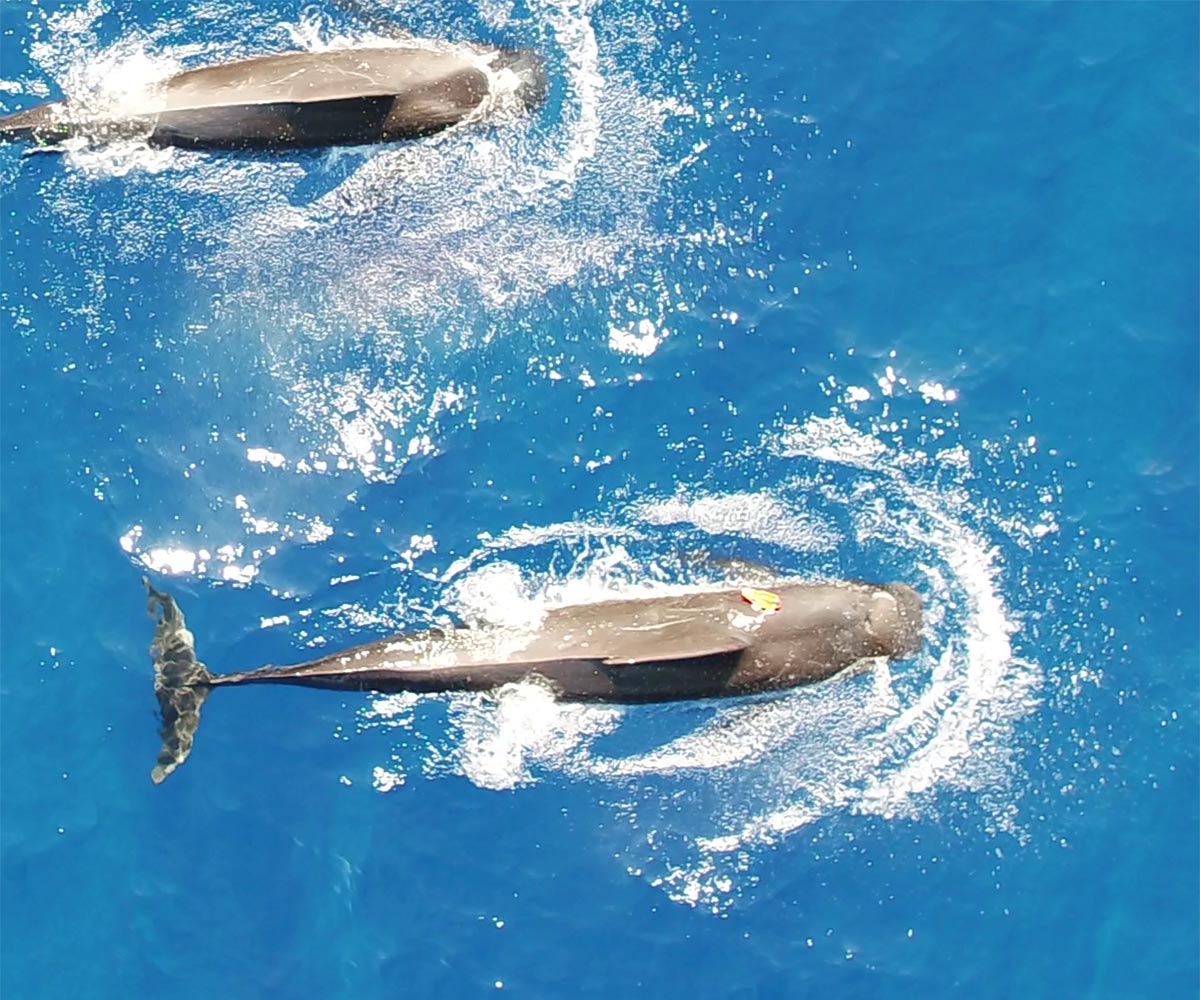
Tagging Whales in the Open Ocean
The researchers began their work by heading into the Pacific Ocean, where they placed data-logging tags held on by detachable suction cups onto eight short-finned pilot whales.
“Short-finned pilot whales are fairly small and quick, so we really have to pick our moment,” recalls Gough, adding that each tag was equipped with motion sensors, a camera with a light, hydrophones to record echolocation clicks, and GPS.
“Ideally, we attached the tag right behind the blowhole facing the head, so we could see any foraging at depth,” says Gough.
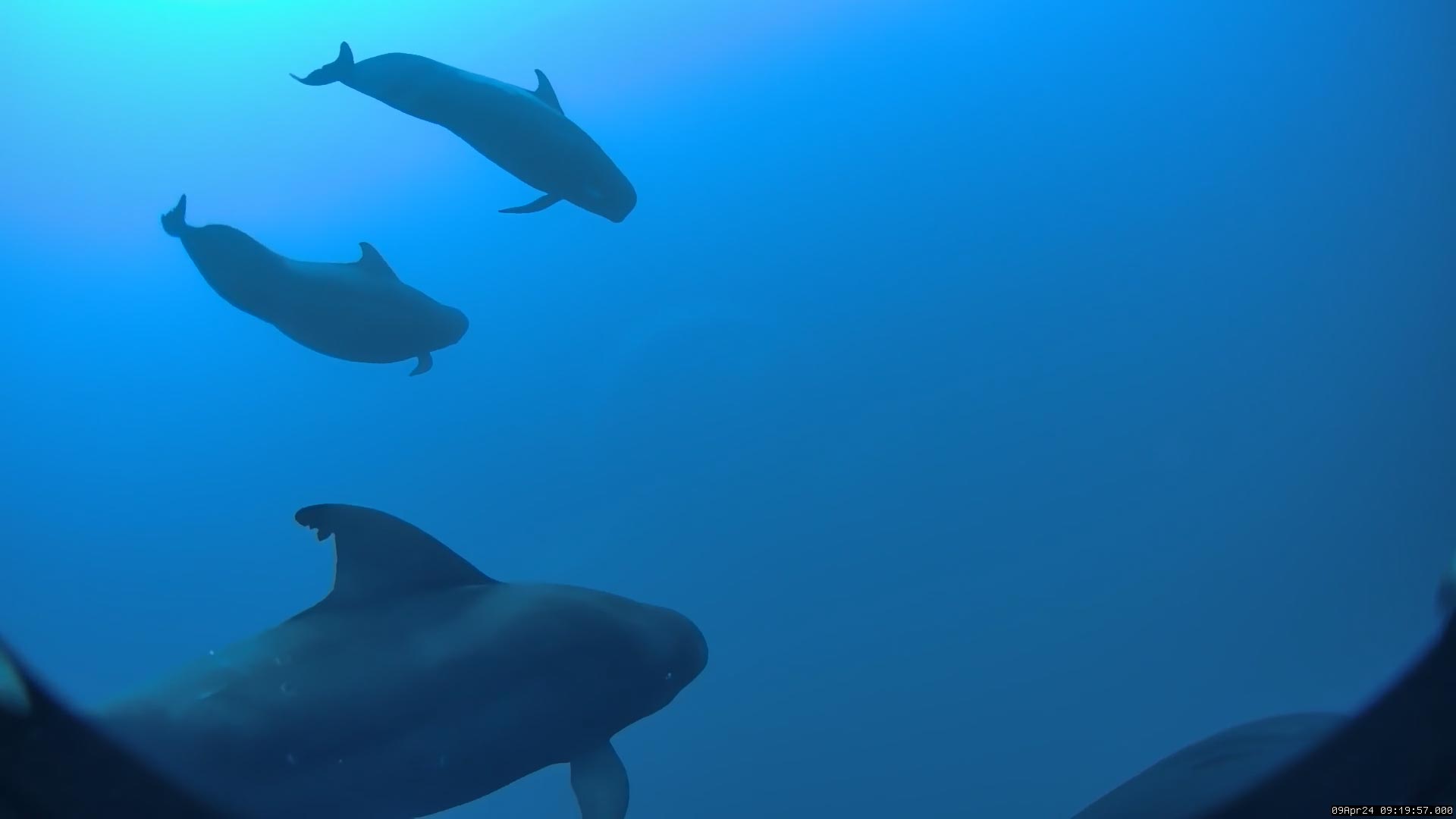
A tagged short-finned pilot whale films other whales in its pod. Credit: HIMB Marine Mammal Research Program and Pacific Whale Foundation
To estimate each animal’s size, the team also flew a drone 25m above the whales and recorded overhead footage.
When the tags later detached and drifted, sometimes traveling as far as 50 miles through rough seas, the researchers retrieved them. The recordings revealed 118 deep dives that reached depths of up to 864m, with each whale averaging about 39 dives per day.
The researchers then analyzed the whales’ tail beats as the animals descend and calculated that short-finned pilot whales use 73.8kJ/min of energy while diving and only 44.4 kJ/min when at the surface. But what would that equate to in terms of the number of squid that the whales would need to consume to survive?
Squid on the Menu
Listening for the tell-tale echolocation clicks on the hydrophone recordings as the whales intercepted a squid, the team estimated that the whales consume approximately 4 squid per dive and that each squid provides around 560kJ of energy when digested.
Gough then calculated that each whale must eat between 82 and 202 squid per day, totalling as many as 73,730 squid per whale per year.
But how many squid does the whole population of short-finned pilot whales around Hawaiʻi actually consume over a year? Based on estimates that the population is up to 8,000 individuals, the team calculated that the pilot whales together consume as many as 88,000 tonnes of squid each year, which is fortunately, a drop in the ocean for the local squid population.
“These results show that short-finned pilot whales are in relatively good shape in Hawaiʻi, having found an abundant and reliable source of food,” says Gough, who is optimistic about the future of Hawaiian pilot whales.
Reference: “Daily energetic expenditure and energy consumption of short-finned pilot whales” by William T. Gough, Brijonnay C. Madrigal, Augusta Hollers, Jens J. Currie, Robin W. Baird, Kristi L. West, Andreas Fahlman, Frank E. Fish, Lewis Evans, Martin van Aswegen, Brian Stirling, Aude Pacini, Grace L. Olson, Stephanie H. Stack, Ashley M. Blawas, William A. Walker and Lars Bejder, 13 November 2025, Journal of Experimental Biology.
DOI: 10.1242/jeb.249821
Funding: Office of Naval Research, United States Pacific Fleet Environmental Readiness Division, NOAA Research, Department of Defence
Never miss a breakthrough: Join the SciTechDaily newsletter.
Follow us on Google and Google News.
2 Comments
202 squid? How about 203?
Why wouldn’t you meantion the species of squid?