
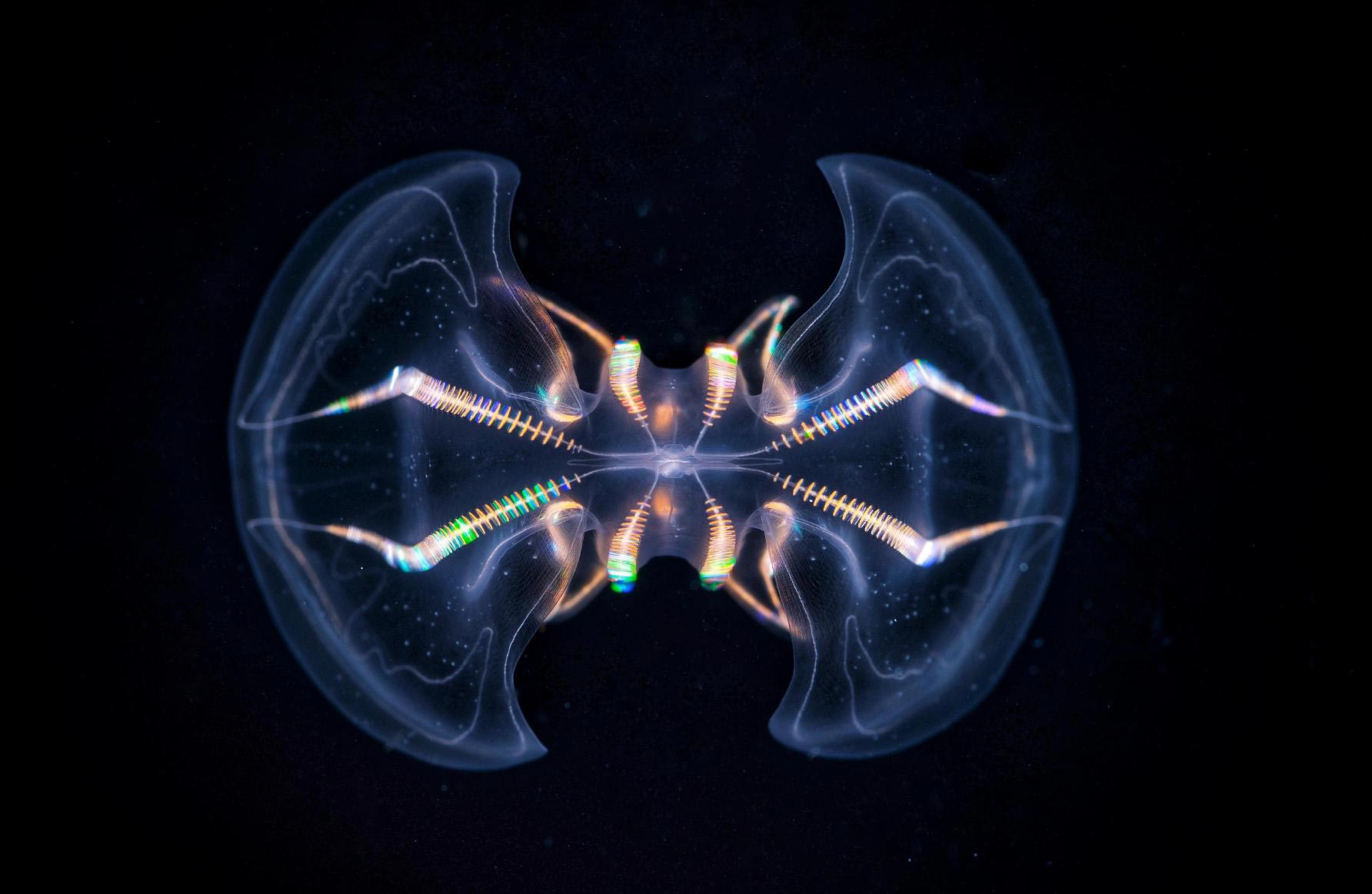
Scientists have uncovered surprising complexity in a tiny sensory structure found in comb jellies, some of the oldest animals on Earth.
New three-dimensional reconstructions of an important sensory organ in comb jellies reveal a level of structural and functional complexity that scientists did not expect. The results suggest that a simple brain-like system may have already existed in some of Earth’s earliest animals, offering new insight into how nervous systems evolved.
Ctenophores, commonly called comb jellies, are gelatinous marine animals that first appeared in the oceans about 550 million years ago. These delicate creatures possess a specialized sensory structure known as the aboral organ (AO). This organ helps them detect gravity, pressure, and light.
A new morphological study published in Science Advances shows that this structure is far more sophisticated than researchers previously realized.
“We show that the AO is a complex and functionally unique sensory system,” said Pawel Burkhardt, group leader at the Michael Sars Centre, University of Bergen. “Our study profoundly enhances our understanding of the evolution of behavioral coordination in animals.”
Mapping ancient neurons
To investigate how the aboral organ is organized internally, the researchers worked with collaborator Maike Kittelmann at Oxford Brookes University. The team used advanced volume electron microscopy to examine the structure in remarkable detail.
By analyzing high-resolution, three-dimensional reconstructions of the AO, the scientists identified 17 different cell types. Among these were 11 secretory and ciliated cell types that had not been described before. This impressive cellular variety confirms that the aboral organ functions as a complex, multimodal sensory system.
“I was amazed almost immediately by the morphological diversity of the aboral organ cells. Working with volume EM data feels like discovering new exciting things every day”, said Anna Ferraioli, a postdoctoral researcher at the Michael Sars Centre and first author of the study. “The AO has a striking complexity when compared to apical organs of cnidarian and bilaterian. It is so unique!”
A hybrid communication system
The researchers also found that the aboral organ is closely connected to the comb jelly’s nervous system, which consists of a continuous network of fused neurons. This neural network forms direct synaptic connections with cells in the aboral organ, creating a clear route for two-way communication.
Many of the cells in the AO also contain large numbers of vesicles. These structures suggest that the cells release chemical signals that spread through surrounding tissue in a process known as volume transmission. Together, the observations indicate that the aboral organ relies on a hybrid communication strategy that includes both synaptic and non-synaptic signaling.
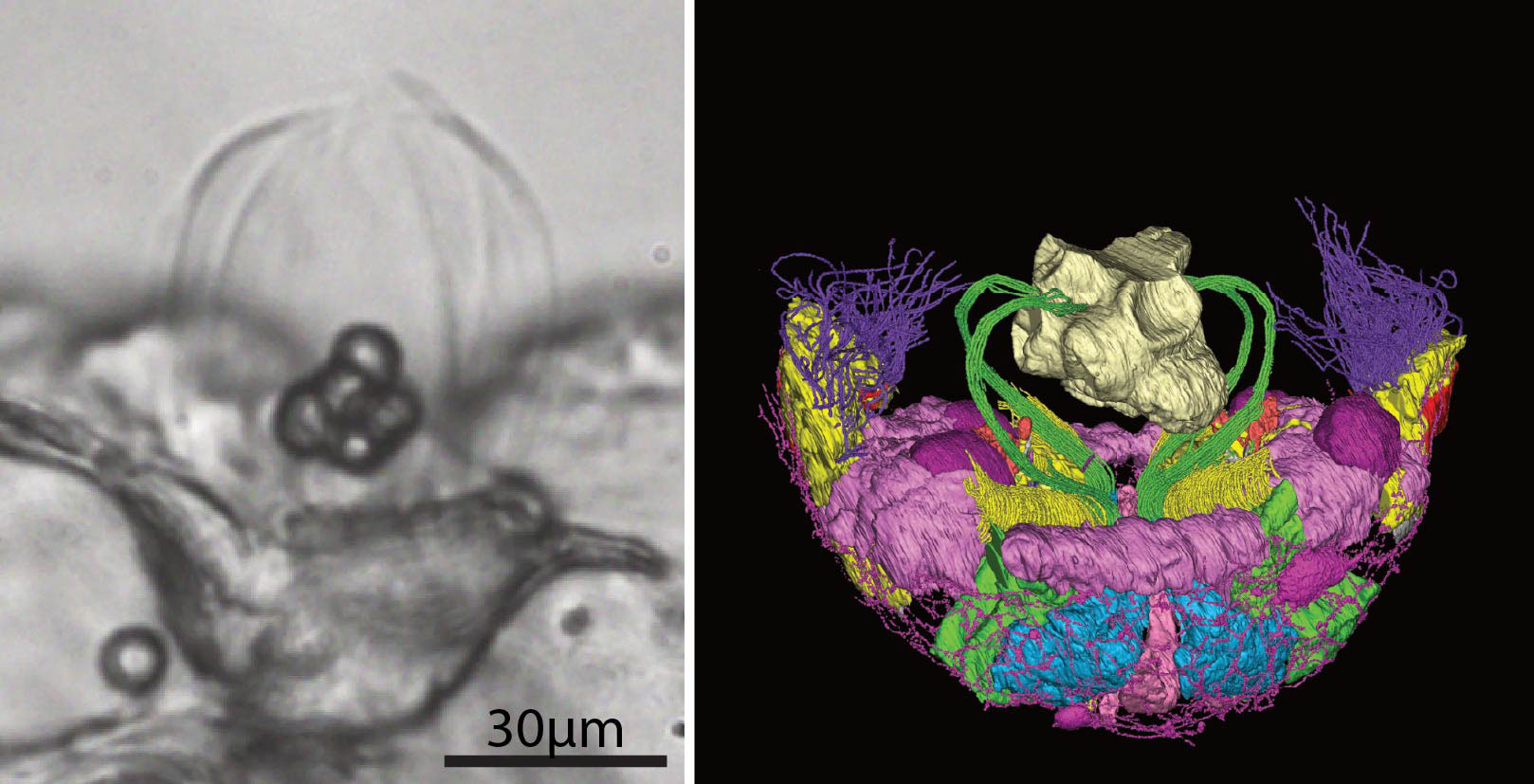
“I think our work provides an important perspective on how much we can learn from studying morphology”, Ferraioli explains. “I would say that the AO is definitely not like our brain, but it could be defined as the organ that ctenophores use as a brain.”
The team also examined how conserved developmental genes are expressed in comb jellies. Although many genes that guide body organization in other animals are present in ctenophores, their patterns of expression are quite different.
This finding suggests that the aboral organ may not be directly related to brains found in other animal groups. “In other words”, Burkhardt added, “evolution seems to have invented centralized nervous systems more than once.”
Linking structure and behavior
Additional support for these conclusions comes from related research led by Kei Jokura at the National Institute for Basic Biology in Japan, together with Prof. Gaspar Jekely from Heidelberg University.
In a separate study that also included Burkhardt, the researchers reconstructed the entire neural wiring of the comb jelly’s gravity-sensing organ.
Using high-speed imaging combined with three-dimensional reconstructions of more than 1,000 cells, the team showed how networks of fused neurons coordinate the beating of cilia on different sides of the animal’s body. This coordinated movement allows comb jellies to maintain their orientation while moving through the water.
“The similarities to neural circuits in other marine organisms suggest that comparable solutions to gravity sensing may have evolved independently in distant animal lineages,” Jokura said.
Rethinking the origins of brains
Together, the two studies provide new evidence that early nervous systems may have been more centralized than scientists once believed.
Ferraioli says the next step will be to identify the molecular characteristics of the newly discovered cell types. Researchers also plan to explore more deeply how the aboral organ influences the behavior of comb jellies.
Reference: “The 3D architecture of the ctenophore aboral organ and the evolution of complex integrative centers in animals” by Anna Ferraioli, Leonid Digel, Daniela Sturm, Jeffrey Colgren, Carine Le Goff, Alexandre Jan, Joan J. Soto-Angel, Benjamin Naumann, Maike Kittelmann and Pawel Burkhardt, 4 March 2026, Science Advances.
DOI: 10.1126/sciadv.aea8399
Never miss a breakthrough: Join the SciTechDaily newsletter.
Follow us on Google and Google News.
1 Comment
thanks