

New insights have emerged into how the human brain develops.
Two genes that are unique to humans work together to influence the development of the cerebrum, according to a recent study by researchers at the German Primate Center – Leibniz Institute for Primate Research and the Max Planck Institute of Molecular Cell Biology and Genetics. The findings provide strong evidence that these genes jointly contribute to the evolutionary expansion of the human brain.
The study reveals a precise interaction between the two genes: one gene increases the proliferation of brain progenitor cells, while the other promotes their transformation into a different type of progenitor cell, one that ultimately gives rise to neurons.
This coordinated mechanism is believed to have played a key role in the evolution of the uniquely large and complex human brain.
Beyond offering new insights into brain evolution, the research may also shed light on the origins of certain developmental brain disorders and neurological diseases.
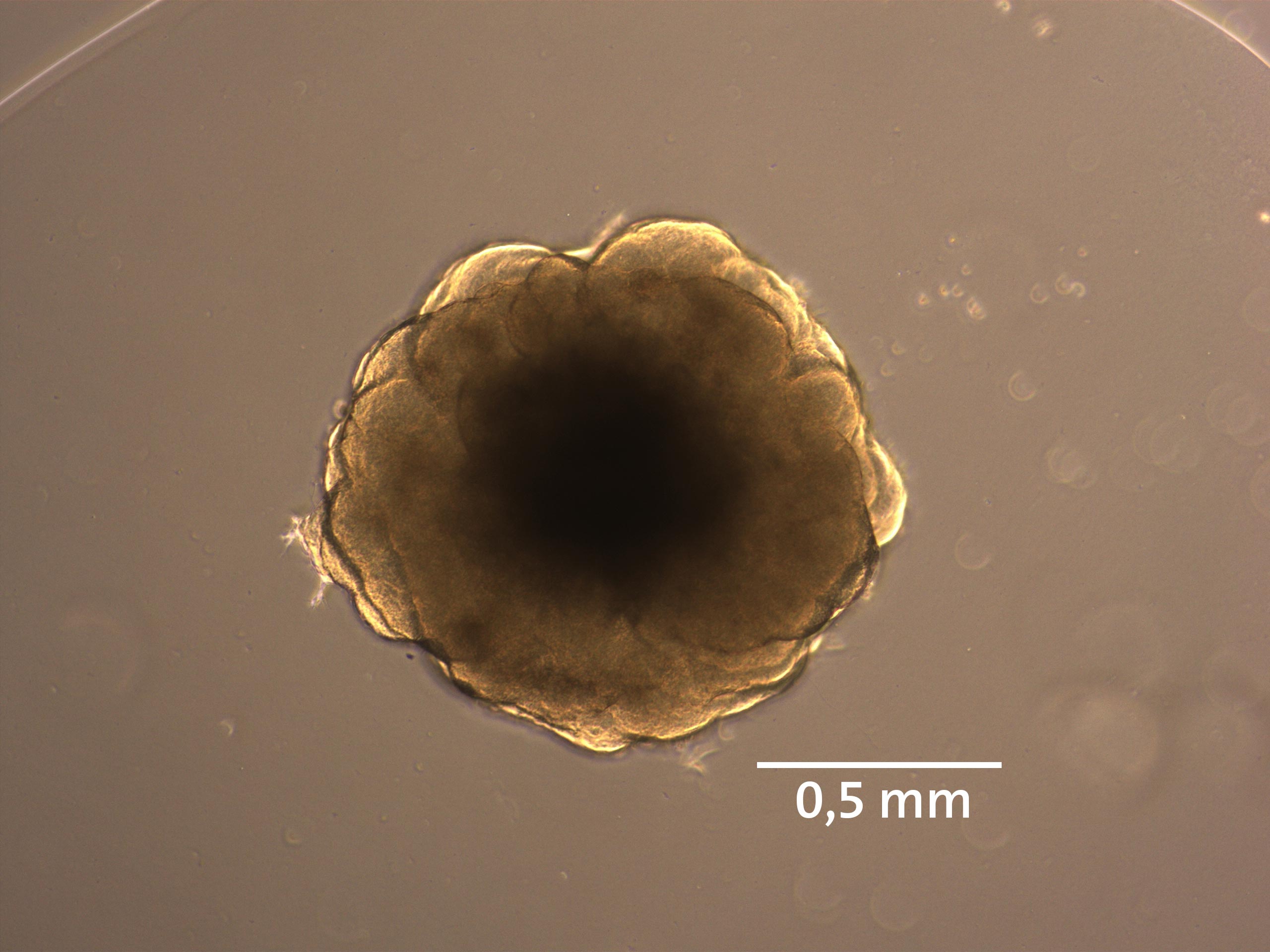
Brain organoid of a chimpanzee grown for 14 days in culture. Credit: Lidiia Tynianskaia”Our findings deepen the fundamental understanding of brain development and provide new insights into the evolutionary origins of our large brain. In the long term, they could contribute to the development of therapeutic approaches for malformations of the brain,” says Nesil Eşiyok, first author of the study.
Combining Traditional and Alternative Research Methods
Various methods were combined for the study: In addition to animal experiments with mice, alternative methods such as chimpanzee brain organoids were also used.
“The remarkable feature of our study is that the results from animal experiments and alternative methods complement each other well and mutually confirm their findings. This not only emphasizes the high significance of our results, but could also help to reduce the need for animal experiments in the future by further developing, refining, and confirming alternative methods,” explains Michael Heide, the study’s lead researcher.
Reference: “A dyad of human-specific NBPF14 and NOTCH2NLB orchestrates cortical progenitor abundance crucial for human neocortex expansion” by Nesil Eşiyok, Neringa Liutikaite, Christiane Haffner, Jula Peters, Sabrina Heide, Christina Eugster Oegema, Wieland B. Huttner and Michael Heide, 26 March 2025, Science Advances.
DOI: 10.1126/sciadv.ads7543
Never miss a breakthrough: Join the SciTechDaily newsletter.
Follow us on Google and Google News.
3 Comments
Ultimate pain death pleasure call bill hughes313 7366555
Save Christine szocik ultimate pain going to us capitol president Trump William Bradley Hughes call 313 736-6555
Is this in modern humans, if not, exactly what type of human. Also, is this a change in the previous brain of this type of human and of what year did this occur approximately and finally, is it related to a specific chromosome(s)?