

Researchers at EPFL have made a breakthrough by storing and manipulating digital data using charge-free spin waves, moving toward greener, faster computing.
Their latest discovery reveals that hematite, a common iron oxide, behaves in a way never before seen in magnetic materials, supporting two distinct magnon modes. This could finally enable repeated data writing and pave the way for sustainable, ultrafast spintronic devices that transform future technologies.
Pioneering Data Storage With Spin Waves
In 2023, researchers at EPFL made a major breakthrough by transmitting and storing data using spin waves, magnetic waves that carry no electrical charge, instead of traditional electron flows. The team, led by Dirk Grundler from the Lab of Nanoscale Magnetic Materials and Magnonics in the School of Engineering, used radiofrequency signals to excite spin waves strongly enough to reverse the magnetization of tiny nanomagnets. This switching between magnetic states, such as from 0 to 1, allows the nanomagnets to store digital information, a fundamental process in computer memory and broader information and communication technologies.
This advance marked a significant step toward more sustainable computing. By encoding data with spin waves, whose quasiparticles are known as magnons, the researchers could potentially eliminate the energy loss, or Joule heating, that plagues electron-based devices. However, at the time, the spin wave signals could only switch the nanomagnets once and could not yet be used to reset them for overwriting existing data.
“Hematite exhibits entirely new spin physics that can be harvested for signal processing at ultrahigh frequencies, which is essential for the development of ultrafast spintronic devices and their applications in next-generation information and communication technology.”
Dirk Grundler
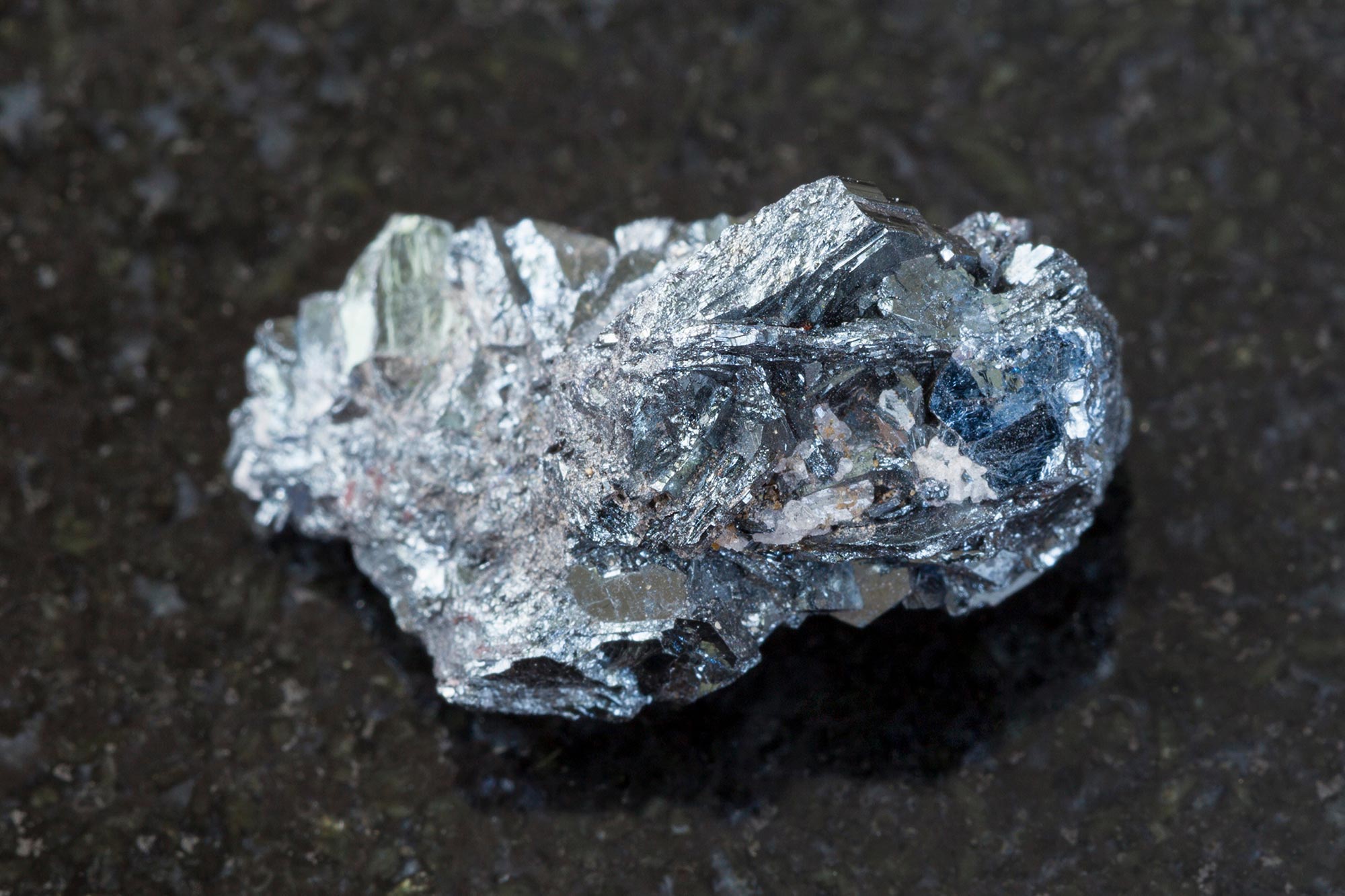
Hematite: A Sustainable Spintronics Material
Now, Grundler’s lab, in collaboration with colleagues at Beihang University in China, has published research in Nature Physics that could make such repeated encoding possible. Specifically, they report unprecedented magnetic behavior in hematite: an iron oxide compound that is earth-abundant and much more environmentally friendly than materials currently used in spintronics.
Grundler explains: “This work demonstrates that hematite is not just a sustainable replacement for established materials like yttrium iron garnet. It exhibits entirely new spin physics that can be harvested for signal processing at ultrahigh frequencies, which is essential for the development of ultrafast spintronic devices, and their applications in next-generation information and communication technology.”
Serendipity in Spintronics: A Strange Discovery
The discovery came unexpectedly when EPFL alumnus Haiming Yu, now a professor at the Fert Beijing Institute in the MIIT Key Laboratory of Spintronics at Beihang University, detected some strange electrical signals coming from a nanostructured platinum stripe on hematite. The signals, measured by researcher Lutong Sheng of the same group, were unlike anything observed on conventional magnetic materials, so Yu’s team sent their device to Grundler’s lab for analysis.
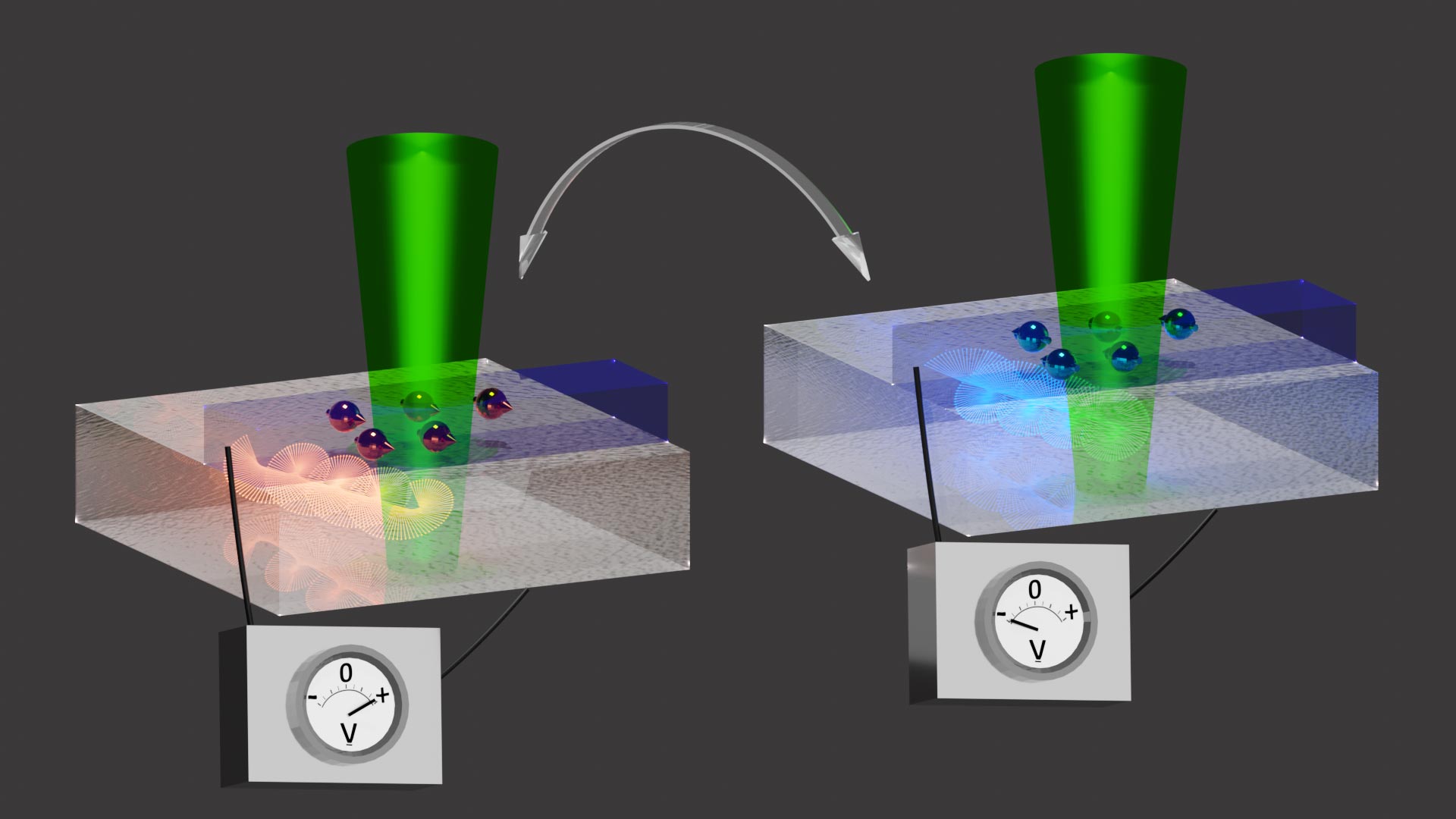
While examining the magnon signals in the sample, Grundler spotted a ‘wiggle’ in their spatial distribution. “This sharp observation eventually led to the discovery of an interference pattern, which was the critical turning point of this research,” Yu says. Indeed, using light scattering microscopy, EPFL PhD student Anna Duvakina determined that the strange electrical signals in the hematite sample were related to patterns of interference between two separate spin wave excitations called magnon modes.
Other magnetic materials like yttrium iron garnet only yield one magnon mode, but having two magnon modes is crucial: it means that spin currents generated from magnons could be made to switch back and forth between opposing polarizations on the same device, which could in turn switch the magnetization state of a nanomagnet in either direction. In theory, this could finally allow repeated encoding and storage of digital data. Next, the researchers hope to test this idea by mounting a nanomagnet onto the hematite device.
Hematite’s Hidden Potential for Future Technologies
“Hematite has been known to man for thousands of years, but its magnetism has been too weak for standard applications. Now, it turns out that it outperforms a material that was optimized for microwave electronics in the 1950s,” Grundler says. “This is the beauty of science: you can take this old, earth-abundant material and find this very timely application for it, which could allow us to have a more efficient and sustainable approach to spintronics.”
Reference: “Control of spin currents by magnon interference in a canted antiferromagnet” by Lutong Sheng, Anna Duvakina, Hanchen Wang, Kei Yamamoto, Rundong Yuan, Jinlong Wang, Peng Chen, Wenqing He, Kanglin Yu, Yuelin Zhang, Jilei Chen, Junfeng Hu, Wenjie Song, Song Liu, Xiufeng Han, Dapeng Yu, Jean-Philippe Ansermet, Sadamichi Maekawa, Dirk Grundler and Haiming Yu, 23 April 2025, Nature Physics.
DOI: 10.1038/s41567-025-02819-7
Never miss a breakthrough: Join the SciTechDaily newsletter.
Follow us on Google and Google News.
5 Comments
Serendipity in Spintronics: A Strange Discovery.
WHY?
The strangeness in physics today is due to being constantly fooled by pseudoscientific theories.
Incompressible spaces with ideal fluid physical characteristics are ubiquitous.
Open Questioning:
1. Why does physics today enjoy the convenience brought by ideal fluids for work, life, and engineering simulations, but reject the existence of ideal fluids?
2. Why does physics today reject the possibility of using time and space as initial conditions, despite the fact that scientific research and physical experiments cannot be separated from space and time?
3. Why is physics today so obsessed with ignoring time and space, searching everywhere for so-called God and Devil particles?
4. Do we live require space?
5. Do physics experiments require space?
Nothing can do without space. Some so-called experts and some so-called peer-reviewed publications (including Physics Review Letters, Nature, Science, etc) never think about it. Physics still has a long way to go in the fight against rampant pseudoscience. Welcome more people to bravely stand up and fight against rampant pseudoscience. If researchers are truly interested in science, please visit https://zhuanlan.zhihu.com/p/1900140514277320438.
Chinese = pseudoscience
VERY GOOD!!!
Your behavior is the greatest contribution of the so-called peer-reviewed publications (including Physics Review Letters, Nature, Science, etc) to society and science. They publicly claimed that two sets of cobalt-60 rotating in opposite directions are two mirror images of each other, and thus won the Nobel Prize. The public should not all be fools.
If you are interested, please witness https://scitechdaily.com/microscope-spacecrafts-most-precise-test-of-key-component-of-the-theory-of-general-relativity/#comment-854286.
Ask the researchers again:
Why do electrons spin in spintronics? Where is spintronic spatiotemporal origin?
If researchers are truly interested in spintronics, please visit https://zhuanlan.zhihu.com/p/15959054249, https://zhuanlan.zhihu.com/p/26435757126 and https://zhuanlan.zhihu.com/p/1897681888174396952.
Fighting against rampant pseudoscience, physics still has a long way to go.
Top picture – uhh, Iron-oxide is black. But does anybody know why? The answer is bigger than physics.