
A multi-strain probiotic blend shows promise for protecting brain function by reducing gut-triggered inflammation linked to Alzheimer’s disease.
Hariom Yadav, PhD, keeps thinking about a particular cocktail — one that could offer meaningful benefits for brain health, especially as the global population continues to age.
This cocktail is a carefully formulated mix of probiotics designed to support the microbiome, the vast and mostly invisible population of microorganisms that thrive in the human gut.
In individuals with balanced gut health, these microbes coexist in a stable ecosystem. However, the gut can also harbor harmful bacteria and viruses that disrupt this balance and trigger changes throughout the body, contributing over time to conditions like dementia and Alzheimer’s disease. This is especially concerning as projections show the number of new dementia cases could reach nearly one million annually by 2060.
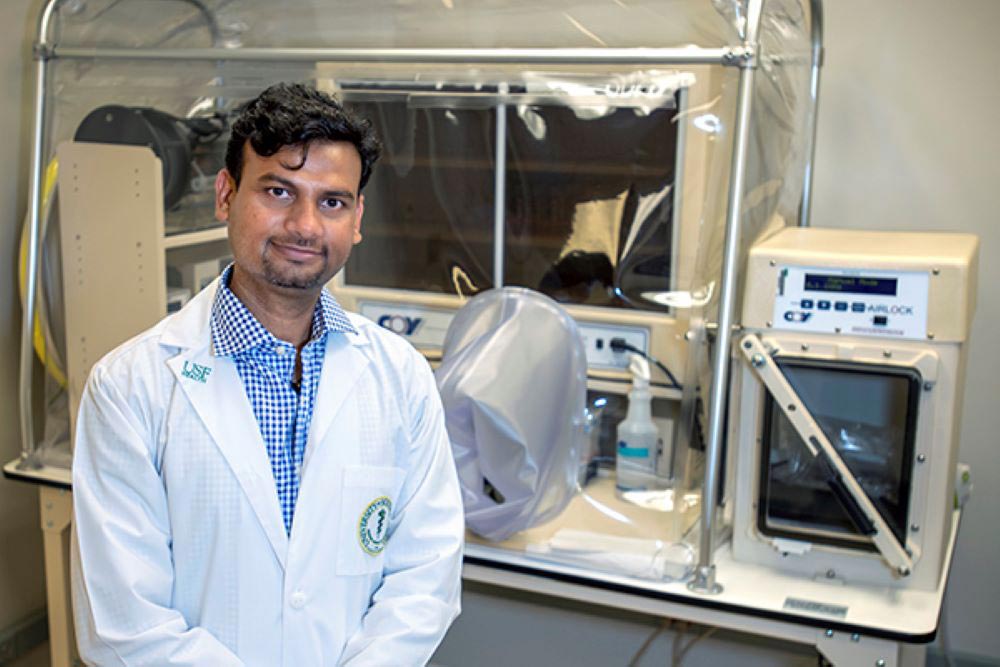
Dr. Yadav, who leads the USF Health Center for Microbiome Research and serves as an associate professor of Neurosurgery and Brain Repair at the USF Health Morsani College of Medicine, is the senior author of two recently published studies conducted by USF Health research teams. His work investigates the connection between gut health and brain function, with a focus on cognitive decline.
A new approach: targeting the gut to help the brain
In findings published in Nature Scientific Reports in January, Dr. Yadav and his team reported that their specially formulated probiotic cocktail may offer a promising new strategy to reduce the risk of Alzheimer’s disease and other types of dementia. Although further testing is needed to fully assess its effectiveness, the research highlights an alternative preventive pathway that focuses on gut health rather than the brain itself—a departure from current treatments, which primarily target neurological mechanisms.
The study details the development of a multi-strain probiotic blend composed of beneficial bacteria known to support healthy gut function. The cocktail was administered to mice through their drinking water over a 16-week period. To evaluate cognitive performance, the mice were tested in a “water maze” where they had to use visual cues to locate a submerged platform. Those that received the probiotic mixture consistently located the platform more quickly than the control group.
Testing the cocktail’s effects on the brain
Dr. Yadav’s team found that the cocktail reduced the levels of proteins that can cause the build-up of sticky plaques in the brain. It also appeared to lower levels of brain inflammation and preserve tight junctions in the blood-brain barrier — preventing leakage of harmful microorganisms into the brain. The results suggest that this probiotics mixture could decrease the progression of cognitive decline and Alzheimer’s disease.
“We actually developed this cocktail a few years back,” Dr. Yadav said. “Normally, people look at some single-strand probiotics. But we discovered that when they are put together as a consortia, they actually have more power for manipulating microbiomes, switching them from the bad side to the good side.”
Dr. Yadav and his team stressed in their study that emerging evidence demonstrates early interventions in Alzheimer’s disease can delay or even prevent the progression of symptoms.
“Therefore,” they concluded, “there is a need to develop novel, disease-modifying treatments that can be implemented early in life, ensuring long-term safety.”
How gut inflammation leads to neurodegeneration
The team systematically explored what is happening both in the gut and the brain, establishing a link between the two in triggering cognitive problems. What they observed was that a condition called “leaky gut,” which allows harmful microorganisms escape from the intestines into the bloodstream, thus contributed systemic inflammation. From there, inflammation traveled to the brain, where they are supposed to be blocked by the blood-brain barrier, but in this case, they penetrate to brain and cause neuroinflammation and neuronal damage causing dementia.
“Think about this: not everything we eat enters our blood — only selected nutrients get absorbed in our gut and enter the blood circulation,” Dr. Yadav said. “But what happens with leaky gut is that many ingredients not supposed to enter our blood start going in, and our immune cells react to them. My analogy is an angry kid who runs off in a fit screaming this way and that way. These inflammatory immune cells are like that. They go everywhere and actually enter the brain, where they are not supposed to go.”
The brain, in turn, recognizes a foreign particle and its own immune system is activated. The result is neuroinflammation, which can increase the chance of dementia.
“Basically, whenever our body’s inflammation rises, the blood-brain barrier’s permeability rises as well,” Dr. Yadav said. “It becomes weaker and allows leakage from the gut in there.”
What comes next for the probiotic treatment
The probiotic cocktail serves to decrease inflammatory bacteria in the gut, effectively suppressing that population. Dr. Yadav and his team are currently working on commercializing the cocktail, in contact with various companies to potentially bring it to market.
“We’re still at the stage of whether we want to have our own start-up to license the technology, but first we need to have a clinical trial done,” he said. “We want to be sure of its clinical efficacy, but we are optimistic about that.”
Santosh K. Prajapati, PhD, first author of the cocktail study, hopes the probiotic mix will prove to have broad potential as an effective early treatment.
“Ultimately, our goal is to develop a safe, simple, effective, and adherent probiotics formulation that can be implemented in our daily dietary habits to slow and/or prevent neurodegenerative conditions,” Dr. Prajapati said.
Reference: “Protection of Alzheimer’s disease progression by a human-origin probiotics cocktail” by Santosh Kumar Prajapati, Shaohua Wang, Sidharth P Mishra, Shalini Jain and Hariom Yadav, 10 January 2025, Scientific Reports.
DOI: 10.1038/s41598-024-84780-8
Never miss a breakthrough: Join the SciTechDaily newsletter.
Follow us on Google and Google News.
5 Comments
I enjoyed reading this article, can you share what is in ” the Cocktail ” that the study participants drank ?
I am a 75 yr old woman who has COPD & heart disease and got a serious candida infection from the steroid medication ( Advair). That took 2 years to clear & heal from.
I have made some significant diet changes & eat many Omega 3’s, vegetarian going vegan, & some Salmon.
I would be interested in learning the ingredients in The Cocktail. Thank you ABJ
If you click on the link to the study which is at the end of the article (DOI etc) under the section Materials and Methods it details the following: “The probiotics cocktail consisted of lactobacillus strains (L. paracasei D3.5, L. rhamnosus D4.4, L. plantarum D6.2, L. rhamnosus D7.5 and L. plantarum D13.4) and enterococcus strains (E. raffinosus D24.1, E. INBio D24.2, E. avium D25.1, E. avium D25.2 and E. avium D26.1)”.
Would love to hear when this probiotic cocktail is available
Sneaky way to get people to read an article and then give us nothing.
This is all you need to know:
“Ethics declarations
Competing interests
Dr. Yadav is a Co-Founder and Chief Scientific Officer of the Postbiotics Inc, and BiomAge Inc, along with Dr. Jain is co-founding MusB LLC and MusB Research LLC; however, there [sic] contribution and the data of this manuscript has no conflict of interest to report currently. Other authors have no conflict to disclose.”
————
Basically the end-goal is to peddle a pro-biotic concoction that will not be able to show any significant improvement over the dozens of brands of multi-strain probiotic supplements kept in the cold-section of your well-stocked supplement store, or over just eating a half-cup of premium multi-strain yogurt found in the supermarket.