
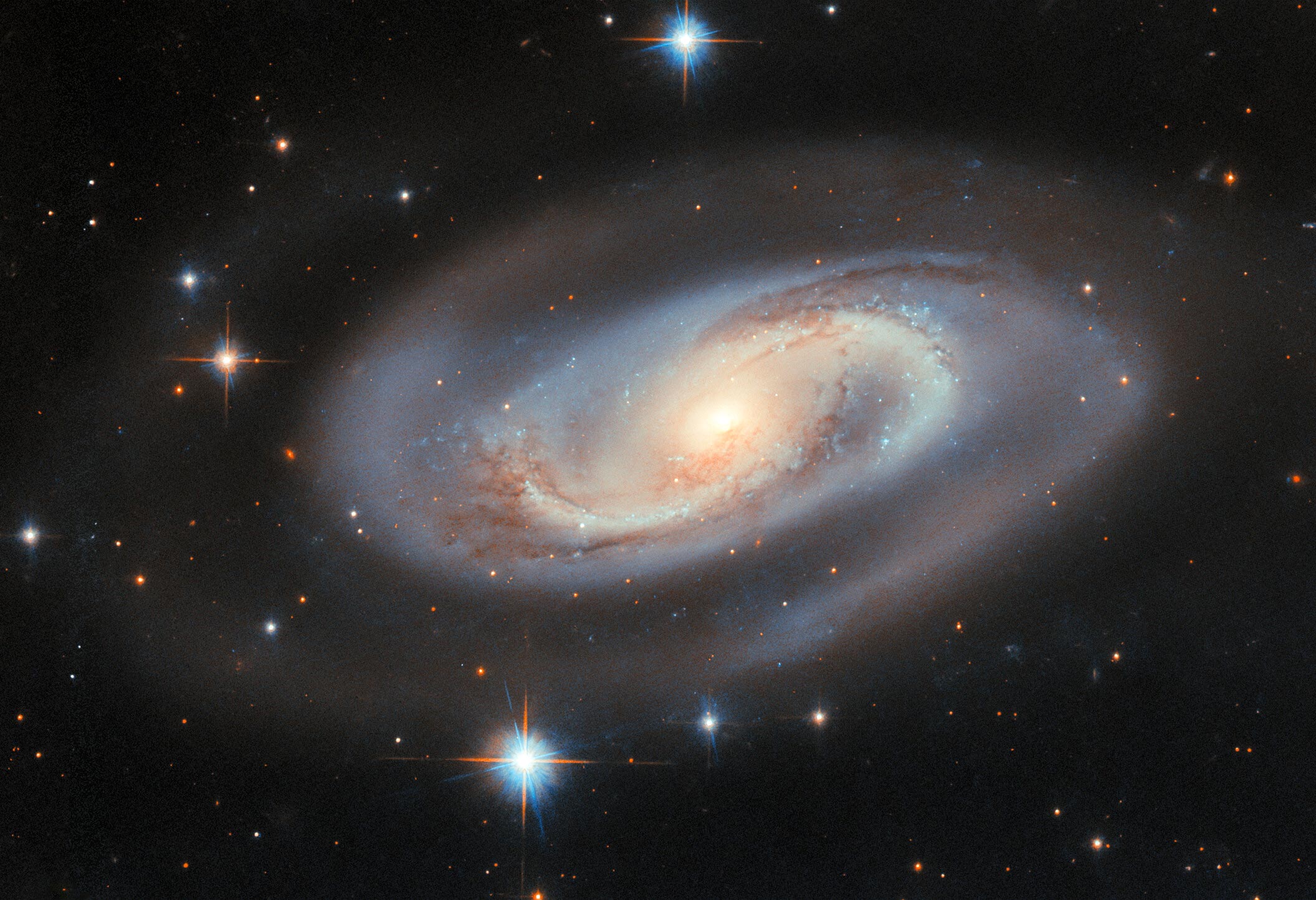
This stunning Hubble view of spiral galaxy UGC 11397 captures more than graceful arms and glowing stars—it hides a ravenous supermassive black hole, cloaked in dust but blazing in X-rays.
Although invisible in regular light, its energetic core revealed itself as a Type 2 Seyfert galaxy, offering astronomers a window into how black holes grow and shape their galaxies.
Ancient Light and Hidden Arms
This stunning Hubble Space Telescope image is formed by light that began its journey 250 million years ago from the spiral galaxy UGC 11397 in the constellation Lyra (The Lyre). At first glance the galaxy looks ordinary. Two sweeping arms glow with starlight and lie threaded with dark, lumpy dust clouds.
UGC 11397’s real drama unfolds at its heart. A supermassive black hole, 174 million times heavier than the Sun, is actively feeding on nearby gas, dust, and even whole stars. As this material falls inward it heats up, shining across the spectrum from gamma rays to radio waves.
Thick dust hides most of that action in visible light, yet powerful X-rays escape the shroud and reveal the frenzy within. This X-ray beacon tells astronomers the galaxy is a Type 2 Seyfert, a category used for active galaxies whose energetic core is concealed by a doughnut-shaped cloud of dust and gas.
Weighing Supermassive Black Holes Across the Cosmos
Using Hubble, researchers will study hundreds of galaxies that, like UGC 11397, harbor a supermassive black hole that is gaining mass. The Hubble observations will help researchers weigh nearby supermassive black holes, understand how black holes grew early in the Universe’s history, and even study how stars form in the extreme environment found at the very center of a galaxy.
Never miss a breakthrough: Join the SciTechDaily newsletter.
Follow us on Google and Google News.
4 Comments
This Seemingly Normal Galaxy Is Hiding a Cosmic Monster.
NO. It’s not a Cosmic Monster. According to Topological Vortex Theory (TVT), spins create everything and shape the world.
If researchers are interested in this, please browse https://zhuanlan.zhihu.com/p/1916783850291466914.
Then question arises, that why they are spinning? Who started their first spin?! If Gravity is responsible for it, then who created gravity and why the nature of gravity is like this.
Note 2506260620_Source1. Analyzing【
1.
[There is a huge space monster hidden inside the seemingly ordinary galaxy.
The image of UGC 11397 taken by Hubble shows a still spiral structure, but deep there is a brightly growing black hole that is only revealed through high-energy X-rays
_[1]A seemingly insignificant number pile is msbase.galaxy. View 1.msbase4 mass pile is a black hole representing a neutron star in the early universe. Of course, the images of 672 early galaxies were introduced graphically more than 40 years ago. I don’t know if you know…jungoolee style. Good girl. Uh-oh.
View 1.msbase4
04110613
14051203
15080902
01100716
ㅡㅡㅡㅡㅡ
View 1-1.oms
00000100_vixx.neutron star
00010000-vix.blackhole
00000001_
01000000-
anyway,
They rapidly expanded and evolved to the size of the 13.7 billion-year-old universe as we know it. Hundreds of billions of black holes have a chiral structure like Sample 1. At the same time, a dark galaxy was created, caught in the multiverse, and part of the dark energy was generated as particles through qcell. The domain of this non-astronomical attribute (*) is the basic concept of my msbase.qpeoms cosmology. Huh.
A giant pile of numbers ≈ = A pile of ≈ mass governs the space-time of the universe. There are electromagnetic and gravitational fields, and their forces spread out to sample 4.msoss.dark_matter.system. Haha.
1-1.
The Hubble Telescope’s stunning image of the spiral galaxy UGC 11397 captures more than just elegant arms and glowing stars. Hidden in the dust are the greedy supermassive black holes that burn with X-rays.
[Invisible from normal light, the powerful core is a type 2 Seifert galaxy] which provides astronomers with a window into how black holes grow and shape galaxies.
_[1-1】
Seyfert Galaxy is one of two large classifications concerning active galaxies, such as quasars. They have four types of mononuclei (*msbase4,3,5,6) similar to quasars (very bright, distant, and bright electron undulating sources). Galactic nuclei have very high surface brightness, showing intense high ionization emission lines in their spectra. Unlike quasars, however, their host galaxy nkbase.galaxy can be clearly observed. Hmm.
Sample 1.
msbase12.qpeoms.2square.vector
oms.vix.a’6,vixx.a(b1,g3,k3,o5,n6)
b0acfd|0000e0
000ac0|f00bde
0c0fab|000e0d
e00d0c|0b0fa0
f000e0|b0dac0
d0f000|cae0b0
0b000f|0ead0c
0deb00|ac000f
ced0ba|00f000
a0b00e|0dc0f0
0ace00|df000b
0f00d0|e0bc0a
Sample 2.
sample qoms (standard)
0000000011=2,0
0000001100
0000001100
0000010010
0001100000
0101000000
0010010000
0100100000
2000000000
0010000001
2506060925
dark_energy
.qms.qvix.qcell
.c3.proton(neutron).xyz/3
.quark.uud(ddu)
0d000000uu
000d00uu00
00000duu00
0000du00u0
000uu0000d
0u0u000d00
00u00ud000
0ud0u00000
c000000000
00u00000du
Sample 3.
sample pms (standard)
q0000000000
00q00000000
0000q000000
000000q0000
00000000q00
0000000000q
0q000000000
000q0000000
00000q00000
0000000q000
000000000q0
Sample 4.
sample msoss
zxdxybzyz
zxdzxezxz
xxbyyxzz
zybzzfxzy
cadccbcdc
cdbdcbdbb
xzezxdyyx
zxezybzyy
bddbcbdca
≈≈=========
Source 1.
https://scitechdaily.com/this-seemingly-normal-galaxy-is-hiding-a-cosmic-monster/
2. Ancient Light and Hidden Arms
This stunning image taken by the Hubble Space Telescope is made of light that originates from the spiral galaxy UGC 11397 in the constellation Lyra 250 million years ago. At first glance, the galaxy looks normal. The two broad arms are lit by the stars, and dark, bumpy clouds of dust are intertwined.
The real drama of UGC 11397 unfolds in its heart. [A supermassive black hole 174 million times heavier than the sun] is actively sucking up gas, dust, and even the entire star. As this material heats up as it falls inward, it emits light in a wide spectrum from gamma rays to radio waves.
The bulk of the activity is blocked by visible light, but the powerful X-rays penetrate the shroud and reveal a frenzy inside. This X-ray signal tells astronomers that this is a Type 2 Seyfert galaxy. The Seyfert galaxy is a classification of an active galaxy with a cloud of donut-shaped dust and gas covered with energy.
Measurement of the weight of supermassive black holes across the universe
Using Hubble, researchers will study hundreds of galaxies that contain supermassive black holes that are gaining mass, like UGC 11397. Hubble observations will help researchers measure the mass of nearby supermassive black holes, understand how they grew early in cosmic history, and even study how stars form in the extreme environments of the Milky Way’s core.
Psst – there are no particles