
Researchers identify a shared RNA-protein interaction that could lead to broad-spectrum antiviral treatments for enteroviruses
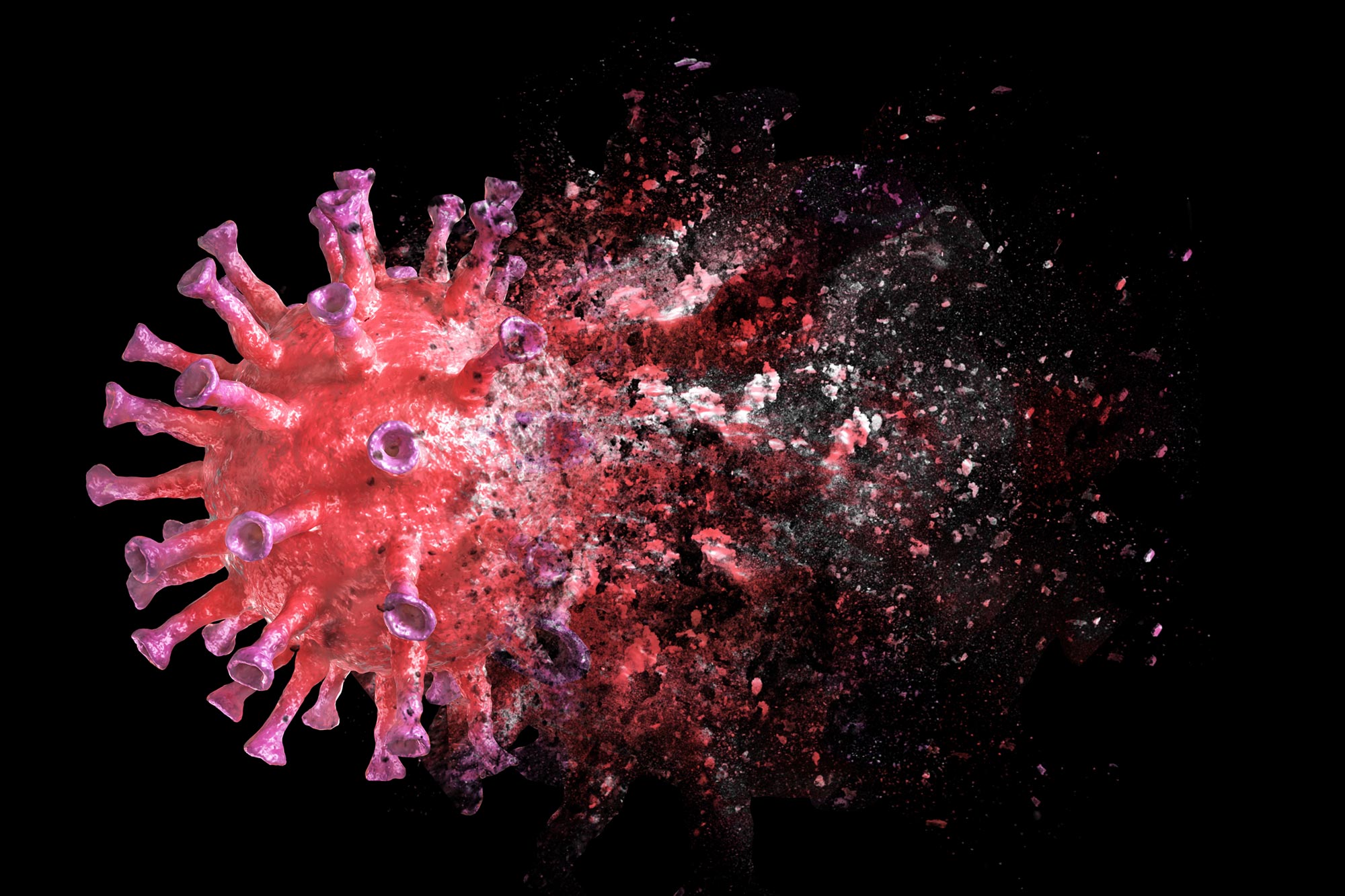
A new study from the University of Maryland, Baltimore County (UMBC), published in Nature Communications, explains how enteroviruses begin reproducing inside human cells. These viruses include those responsible for polio, encephalitis, myocarditis, and the common cold, and they start infection by taking over the cell’s own molecular machinery.
The research was led by senior author Deepak Koirala, associate professor of chemistry and biochemistry, along with recent Ph.D. graduate Naba Krishna Das, and it addresses a long-standing gap in understanding this early stage of viral replication. The findings could also help guide the development of antiviral drugs that work against multiple enteroviruses.
“My lab has been really motivated to understand how RNA viruses produce their proteins inside the cell and multiply their genome to make more virus particles,” Koirala says. Building on their discovery of a crucial cloverleaf structure in the viral RNA, Koirala’s group has now shown how it recruits proteins to assemble the replication complex.
Seeing the bigger picture
Enteroviruses carry a very small RNA genome that must perform two essential tasks. It serves as instructions for making viral proteins and also acts as the template for copying itself to create new virus particles. While most of this compact genome codes for structural components, it also produces a limited set of proteins that are crucial for replication and not found in human cells.
One of these proteins is a combined molecule known as 3CD. One portion (3C) functions like molecular scissors, cutting the long chain of amino acids produced from the viral RNA into separate working proteins. The other portion (3D) acts as an RNA polymerase, the enzyme responsible for copying the viral RNA. Because human cells do not contain this type of polymerase, the virus must supply it on its own.
“We previously determined the structure of the RNA alone, and other groups determined the structure of 3C and 3D, but now we’ve captured the structure of the RNA and proteins together, so we know how they are interacting,” Koirala explains. “We found that it’s the 3C domain of 3CD that binds to the RNA in the viral genome, and then it recruits the other components, such as host protein PCBP2, to assemble the replication complex.”
The same complex also works as an on-off switch: when 3CD is attached, the virus copies its RNA; when it lets go, the RNA can be read to make proteins instead.
Resolving a debate
Koirala’s team used X-ray crystallography to visualize the interactions between the RNA cloverleaf and 3CD. They augmented those observations with isothermal titration calorimetry (ITC), a technique that quantifies the strength of an interaction by measuring the heat released when molecules bind, and biolayer interferometry (BLI), which tracks light interference to gauge binding duration.
The team also settled a debate by showing that two complete 3CD molecules (bringing two RNA polymerases) bind side-by-side on the RNA, rather than forming a single fused pair, as research from another group had suggested. Why two are needed is still a mystery, but the picture is now clear.
New therapeutic targets
Perhaps most exciting, the seven types of enteroviruses the paper investigated all employed a very similar binding mechanism and RNA cloverleaf structure. The extent of this conservation implies the RNA cloverleaf is very important for replication, and any mutations would likely derail it. That means the RNA and RNA-protein interface is likely to be stable over time and across enteroviruses, making it an even more promising drug target—and opening the door to the tantalizing prospect of a “universal” drug targeting all enteroviruses.
Drugs disrupting 3C and 3D activity are already in development, but “now we have another layer to test,” Koirala says. “What if we target the RNA, or the RNA-protein interface, so that we break the interaction? That is another opportunity. Now that we have high-resolution structures, you can precisely design drug molecules to target them.”
“Viruses are so, so clever. Their entire genome is equivalent to about one mRNA sequence in humans, yet they are so effective,” Koirala says. His latest work demonstrates “why we need to investigate this basic science—so that it can be translated into developing drugs targeting pathogens that cause so many harmful diseases.”
Reference: “Structural basis for 3C and 3CD recruitment by enteroviral genomes during negative-strand RNA synthesis” by Naba Krishna Das, Alisha Patel, Reem Abdelghani and Deepak Koirala, 21 October 2025, Nature Communications.
DOI: 10.1038/s41467-025-64376-0
Funding: U.S. National Science Foundation, NIH/National Institutes of Health
Never miss a breakthrough: Join the SciTechDaily newsletter.
Follow us on Google and Google News.
6 Comments
Lets hope an AI will help this
But I don’t think there will be a single solution – a mutation will find another way. Nature always does
The fact that this replication pathway has been conserved across several viral families implies that it is a very stable (read hundreds of thousands or millions of generations of viral replication cycles) replication solution across those families. *If* this solution can be interrupted or slowed, that will give the immune system valuable tome to identify and clear each viral particle, ending an infection. the mote integral such s process, the longer it will take for each viral family to evolve a new replication solution.
Maher is correct that sny quasi-biotic life firm capable of evolving thru mutation will do so, given enough time. It is also true that most therapies slow an infectious agent’s life cycle enough for the human immune system to neutralize and clear it. Any and all advanced that give humans a competitive advantage in this truly “biological warfare” skews the odds of surviving the infection and minimizing any collateral damage.
The fact that this replication pathway has been conserved across several viral families implies that it is a very stable (read hundreds of thousands or millions of generations of viral replication cycles) replication solution across those families. *If* this solution can be interrupted or slowed, that will give the immune system valuable tome to identify and clear each viral particle, ending an infection. the mote integral such s process, the longer it will take for each viral family to evolve a new replication solution.
Maher is correct that any quasi-biotic life form capable of evolving thru mutation will do so, given enough time. It is also true that most therapies slow an infectious agent’s life cycle enough for the human immune system to neutralize and clear it. Any and all advanced that give humans a competitive advantage in this truly “biological warfare” skews the odds of surviving the infection and minimizing any collateral damage.
The AI won’t help anything. It’s just there to ruin things for us.
Anything ‘universal’ means a likelihood of the universally unforeseen. I think we might have laws and specification for AI use where any genetic R&D must undergo an examination regime to reveal the many possibilities human focus will overlook.
They said the same thing about the mRNA vaccines, yet, apart from the covid vaccine hoax, they came up with no mRNA vaccine for any known ilnesses whatsoever.