
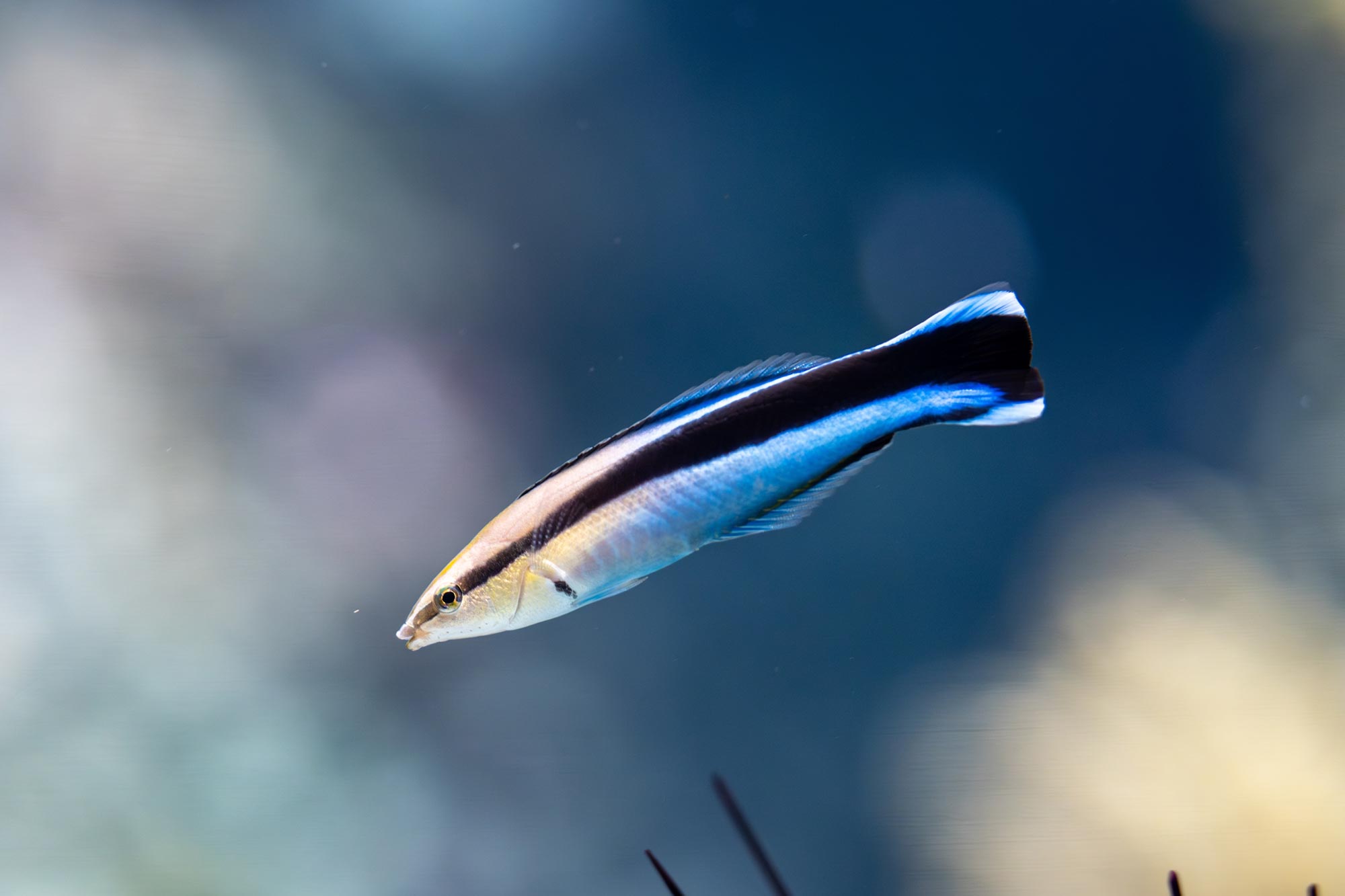
Cleaner wrasse may be far more cognitively sophisticated than previously thought.
Scientists at Osaka Metropolitan University in Japan have identified a new and unexpected behavior in cleaner wrasse (Labroides dimidiatus). When shown a mirror, these small reef fish did more than appear to recognize their reflections. They also began interacting with the mirror using a piece of food, suggesting a level of cognitive sophistication not typically associated with fish. The findings indicate that cleaner wrasse may be capable of “contingency testing,” a complex mental process most often observed in highly intelligent marine mammals such as dolphins.
The research team was led by Specially Appointed Researcher Shumpei Sogawa and Specially Appointed Professor Masanori Kohda at the Graduate School of Science. In earlier work, the group demonstrated that cleaner wrasse can identify themselves in photographs.
In the current study, the scientists observed new behaviors during a series of mirror test experiments, a widely used method for evaluating self-recognition and animal cognition. Previous research had already shown that cleaner wrasse respond to their reflections in ways consistent with self-recognition.
Rapid Responses in Modified Mirror Tests
To begin the experiment, researchers placed marks on the fish that resembled parasites. Even individuals that had never encountered a mirror before quickly used their reflections to locate and attempt to remove the mark.
The speed of this response surprised the researchers. Some fish tried to scrape off the mark within the first hour of seeing the mirror. On average, mark-directed rubbing occurred after about 82 minutes. In earlier experiments, similar behavior took between 4 to 6 days to appear.
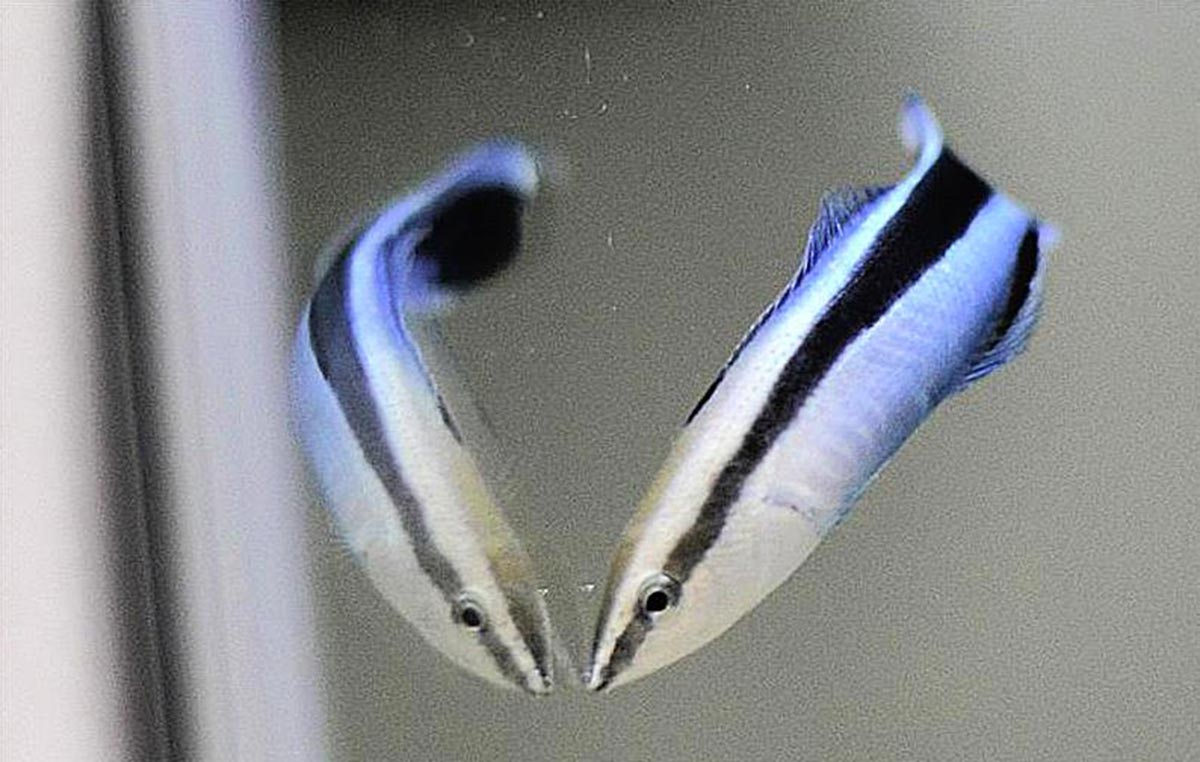
“In earlier cleaner wrasse mirror studies, the procedure was typically the fish see a mirror for several days, they habituate to it and stop reacting socially, and a mark is added,” Dr. Sogawa explained. “In this study, the order was reversed, the fish were marked first, then the mirror was introduced for the first time. The fish were likely aware of something unusual on their body, but they couldn’t see it. When the mirror appeared, it immediately provided visual information that matched an existing bodily expectation, hence scraping occurred much faster.”
Evidence of ‘Contingency Testing’
An even more intriguing behavior appeared after several days of mirror exposure. Some fish picked up a small piece of shrimp from the tank floor, swam upward, and intentionally released it in front of the mirror. As the shrimp drifted downward, the fish closely tracked its movement along the mirror’s surface. They repeatedly touched the glass with their mouths while watching the shrimp fall in the reflection.
The cleaner wrasse picks up a piece of shrimp and drops it in front of the mirror. As the food falls, the fish repeatedly touches the glass of their tank with their mouths seeming to explore the mirror itself. Credit: Shumpei Sogawa, Osaka Metropolitan University
The researchers describe this behavior as “contingency testing.” Rather than using their own bodies to probe the reflection, the fish appeared to examine how an external object behaved within the mirror image. By dropping the shrimp and observing how its real movement matched what they saw in the reflection, the wrasse seemed to be investigating how the mirror worked. Similar actions have been documented in manta rays and dolphins, which release bubbles and watch their reflections as the bubbles rise.
This type of exploration strengthens the argument that the fish’s mirror-related behaviors are not simply the result of confusion or conditioning. Instead, the findings support the idea that cleaner wrasse may engage in flexible, self-referential thinking.
Implications for the Evolution of Self-Awareness
“These findings in cleaner wrasse suggest that self-awareness may not have evolved only in the limited number of species that passed the mirror test but may be more widely prevalent across a broader range of taxonomic groups, including fish,” Dr. Sogawa said. “It is highly likely that mirror self-recognition will be observed in many species where mirror tool use has been reported.”
The researchers believe that expanding the study of self-awareness across a wider range of animals, including invertebrates, will become increasingly important. “The findings from this research will likely influence not only academic issues, such as revising evolutionary theory and constructing concepts of self, but also directly impact matters relevant to our lives, including animal welfare, medical research, and even AI studies,” Professor Kohda added.
Reference: “Rapid self-recognition ability in the cleaner fish” by Shumpei Sogawa, Taiga Kobayashi, Redouan Bshary, Will Sowersby, Satoshi Awata, Naoki Kubo, Yuta Nakai and Masanori Kohda, 25 November 2025, Scientific Reports.
DOI: 10.1038/s41598-025-25837-0
Never miss a breakthrough: Join the SciTechDaily newsletter.
Follow us on Google and Google News.
4 Comments
Well that’s not to surprising. Most animals are smarter than humans that’s for sure. Heck most mammals are smarter than the average so called college or university graduate.
I used to have a yellow lab African cichlid that I adopted from someone who had to rehome him. Named him Milo. He would let me pet him (gently with one finger) and he would chase a laser pointer light around if I shined it into the back of the fish tank. He would make these little noises like he was grinding his teeth and I could see his jaw moving. I’d never witnessed a fish make sounds before and never knew they could even do that. He was about the same size as these wrasse fish are. I wonder if he was self-aware, too. I never thought to test it out.
When I adopted him, the prior owner had badly neglected the water quality and Milo was sick from it. I did the best I could and he improved but I think he had organ damage from the toxins in the water. The previous owner was clueless about water changes, and said she had never done a water change. Poor Milo was living in toxins for years. I’m glad I was able to make the last years of his life better even though I don’t think he ever fully recovered. I had him for 5 years and when he died I ended up getting him cremated just like my other pets (cats and dogs). I still have his ashes. I think he died from the organ damage from the toxins, but not sure. There didn’t seem to be any other reason for him to stop eating like he did. Incredibly he didn’t eat anything for 9 months before he died. I could not figure out how he lived for 9 months without eating anything. One day I noticed he wasn’t swimming and was resting on the floor, on the gravel. His breathing was sporadic and I figured this was the end. I was with him, right next to the tank when I watched him take his last breath of water. I miss him. RIP Milo.
Thank you for sharing this fish tale (pun intended) about Milo the cichlid. Your tenderness toward him/her is beautiful. All species are intelligent, self aware and fully capable of learning/adapting/interacting with other species. Wow!
Yeah fish make sounds, you should hear parrot fish clicking and grinding coral;
I heard them loudly while diving and observing them in neutral buoyancy. Loud!
I’m pretty sure that they could see their reflections in the walls of the glass tank. They can observe themselves stopping and going, however faintly. Adding the mirror makes it go from 2-D to 3-D. I really love seeing intelligence and curiosity in other creatures.