
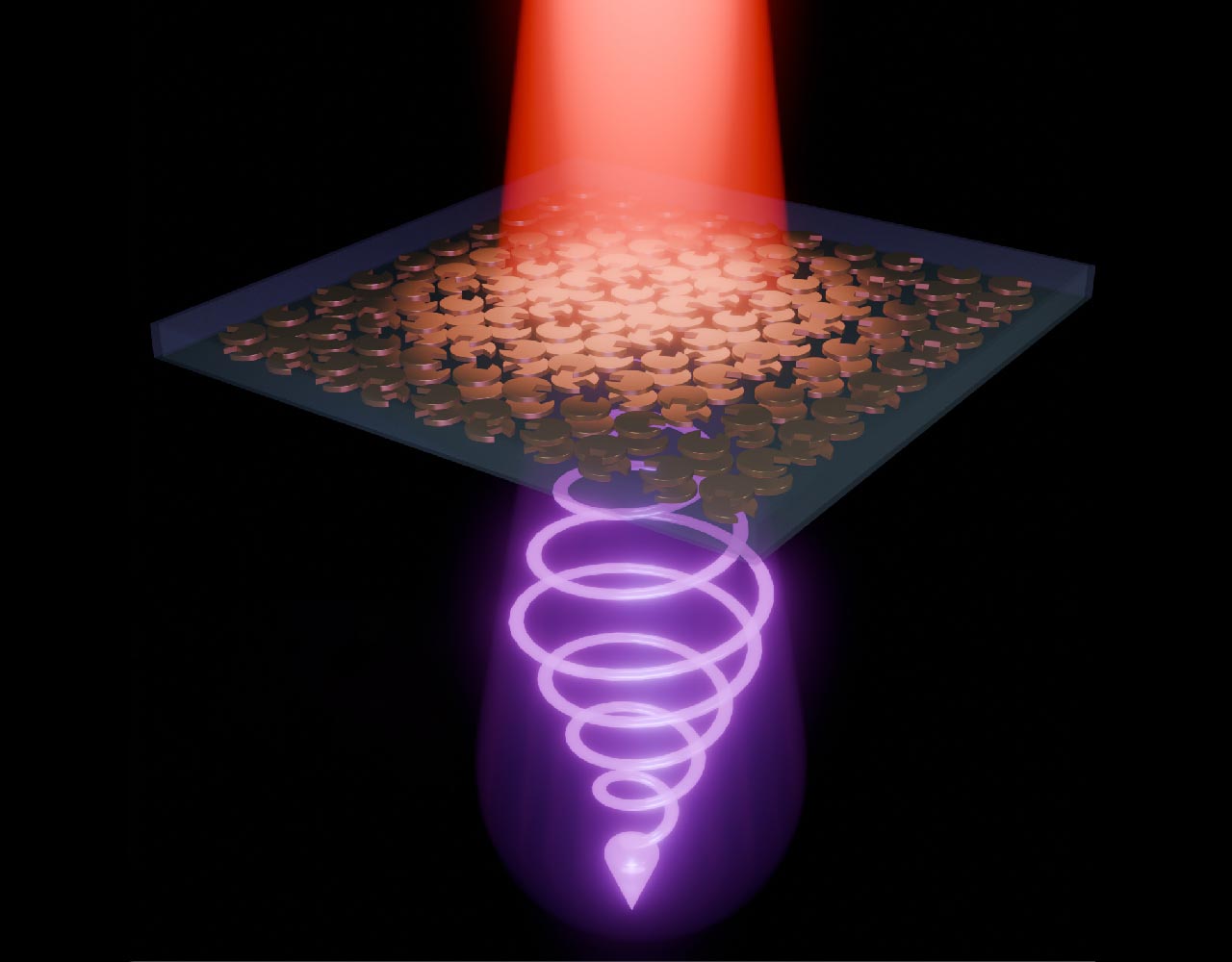
Researchers have developed a revolutionary ultra-thin metasurface that can generate circularly polarized light with remarkable efficiency.
By leveraging the unique properties of chirality and rotational symmetry, this breakthrough eliminates the need for bulky optical setups, enabling more compact and efficient optical devices. This innovation has far-reaching implications for fields such as medical imaging, communications, and quantum physics.
Advancing Optical Technology with Metasurfaces
Circularly polarized light, where electromagnetic waves spiral either clockwise or counterclockwise as they travel, is essential in many applications, including medical imaging and advanced communication technologies. However, producing this type of light typically requires large, complex optical systems that are difficult to integrate into compact devices.
To overcome this limitation, a research team from Singapore, led by Associate Professor Wu Lin of the Singapore University of Technology and Design (SUTD), has developed a groundbreaking metasurface — an ultra-thin material with unique properties not found in nature. This innovation has the potential to replace traditional bulky optical setups. Their findings were published in Physical Review Letters in a paper titled “Enabling all-to-circular polarization up-conversion by nonlinear chiral metasurfaces with rotational symmetry.”
Chirality and Nonlinearity: Enhancing Light Manipulation
The team’s proposed metasurface exhibits chirality, which makes it different from materials used in traditional set-ups. Chirality of an object means that it cannot be superimposed onto its mirror image. Like our left and right hands, chiral objects exist in two distinct forms that are mirror images of each other. The key feature of chiral optical nanostructures, such as metasurfaces, is their remarkably different response to the left and right circular polarizations of light.
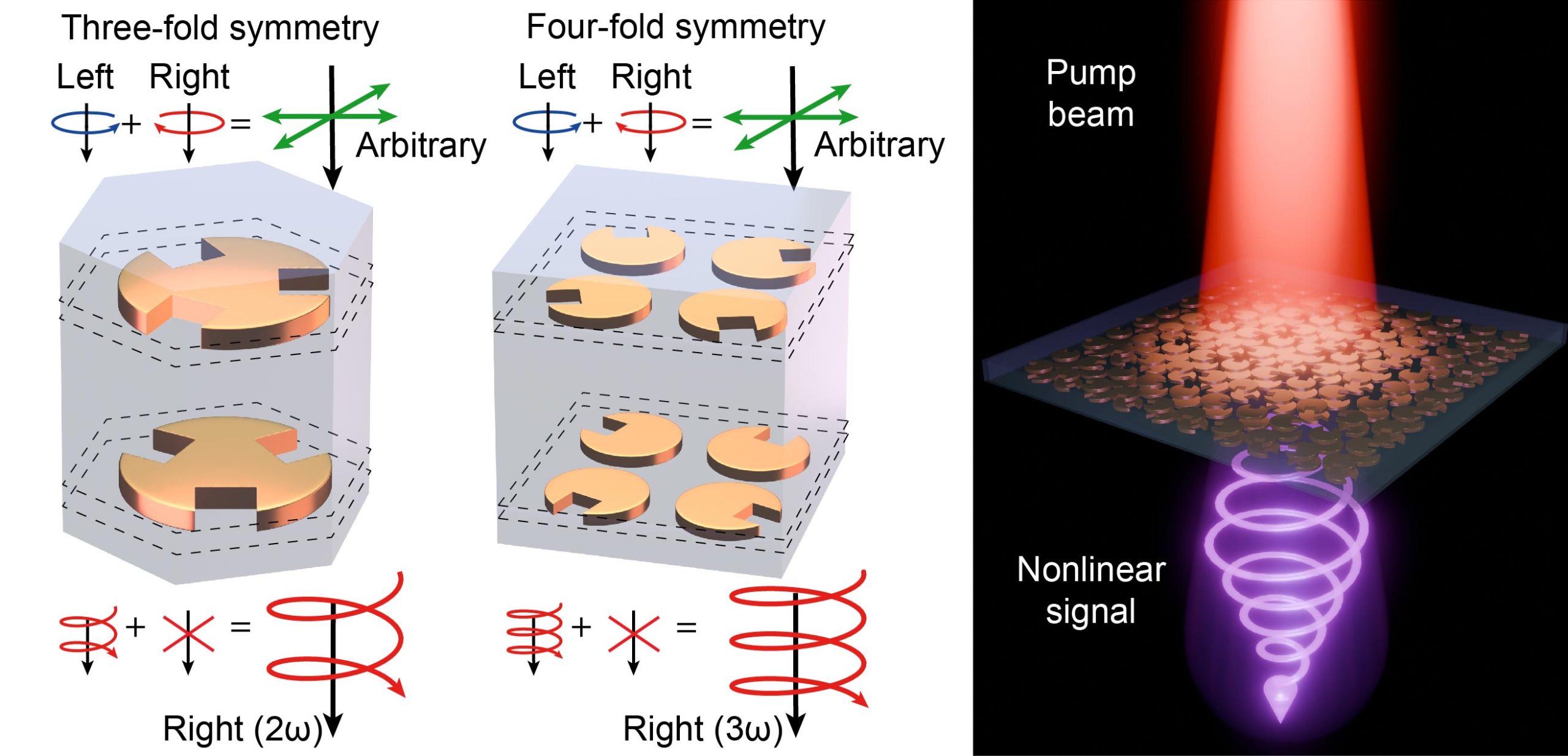
Assoc Prof Wu’s team has shown that a combination of two peculiar geometrical properties, namely, chirality and rotational symmetry, within a nonlinear metasurface enables an interesting mechanism of generating circularly polarized light from an arbitrary optical excitation.
Innovations in Frequency Conversion
The nonlinearity of the metasurface is essential in this transformation of light. A linear metasurface would filter the incoming light and allow only the specific polarization of the light to pass through. On the other hand, a nonlinear metasurface not only selects and amplifies a specific circular polarization but also converts it into circularly polarized light at an entirely different frequency.
For example, a nonlinear material can turn visible light into ultraviolet radiation, which is of a different frequency range. This frequency upconversion capability, combined with the inherent chirality of the metasurface, allows the metasurface to effectively produce circularly polarized light at specific frequency ranges.
Compact Design, Broad Applications
“All this happens within an exceptionally thin layer of just one micron,” said Assoc Prof Wu. This is a far cry from the typically bulky optical setups for creating circularly polarized light.
“In our design, we incorporate a twist between the periodically arranged elements within the layers of the metasurface, creating geometries that subtly mimic the threads on screws,” she continued, attributing the compactness of the proposed metasurface to a unique stacking strategy devised by her team.
Future Prospects and Interdisciplinary Research
Through mathematical elucidations, the team demonstrated that the stacking of layers leads to the chiral response of the metasurface. “Just two stacked layers can yield a maximally chiral response,” she added.
This opens doors to a wide range of exciting applications, holding immense potential for the future miniaturization of optical devices. This could also find applications in chiral sensing, circular dichroism spectroscopy of novel materials and biomolecules, which have far-reaching implications on fields as diverse as medicine and quantum physics.
“We envision that such metasurfaces can be used as compact sources of circularly polarized radiation emitting in hard-to-reach wavelength ranges,” Assoc Prof Wu said.
Bridging Design and Technology
The ingenuity of the metasurface’s design is also clear evidence of SUTD’s commitment to intersecting technology and design in research. In designing the metasurface, the team first had to make clear the mechanism for the upconversion of light into circularly polarized light. By then incorporating this technology into the design of the metasurface, the team effectively translated their theoretical understanding into a functional and compact device. This seamless use of design and technology is a hallmark of SUTD’s interdisciplinary approach to research.
Together with fellow SUTD colleague Professor Joel Yang and his team, Assoc Prof Wu’s team is now working to verify their work experimentally. “Our primary objective is to observe the effect of all-to-circular upconversion. We aim to ‘excite’ the structure with unpolarized light and achieve a nonlinear signal characterized by a high degree of circular polarization,” she said. “We are optimistic that this endeavor will contribute another significant piece of research to the portfolio of SUTD scientists.”
Reference: “Enabling All-to-Circular Polarization Up-Conversion by Nonlinear Chiral Metasurfaces with Rotational Symmetry” by Dmitrii Gromyko, Jun Siang Loh, Jiangang Feng, Cheng-Wei Qiu and Lin Wu, 16 January 2025, Physical Review Letters.
DOI: 10.1103/PhysRevLett.134.023804
Never miss a breakthrough: Join the SciTechDaily newsletter.
Follow us on Google and Google News.
2 Comments
Through mathematical elucidations, the team demonstrated that the stacking of layers leads to the chiral response of the metasurface.
VERY GOOD.
Ask the researchers:
1. How do you understand the chiral response?
2. Is the universe algebra, formula, or fraction?
3. What is the difference between the universe and algebra, formulas, or fractions?
4. Is Physical Review Letters a rigorous scientific publication?
5. What is the value and significance of Physical Review Letters for physical science?
6. What is the spacetime background of light?
Scientific research guided by correct theories can enable researchers to think more.
According to the Topological Vortex Theory (TVT), spins create everything, spins shape the world. There are substantial distinctions between Topological Vortex Theory (TVT) and traditional physical theories. Grounded in the inviscid and absolutely incompressible spaces, TVT introduces the concept of topological phase transitions and employs topological principles to elucidate the formation and evolution of matter in the universe, as well as the impact of interactions between topological vortices and anti-vortices on spacetime dynamics and thermodynamics.
Within TVT, low-dimensional spacetime matter serves as the foundation for high-dimensional spacetime matter, and the hierarchical structure of matter and its interaction mechanisms challenge conventional macroscopic and microscopic interpretations. The conflict between Quantum Physics and Classical Physics can be attributed to their differing focuses: Quantum Physics emphasizes low-dimensional spacetime matter, whereas Classical Physics centers on high-dimensional spacetime matter.
Subatomic particles in the quantum world often defy the familiar rules of the physical world. The fact repeatedly suggests that the familiar rules of the physical world are pseudoscience. In the familiar rules of the physical world, two sets of cobalt-60 can form the mirror image of each other by rotating in opposite directions, and can receive heavy rewards.
Please witness the grand performance of physics today. https://scitechdaily.com/microscope-spacecrafts-most-precise-test-of-key-component-of-the-theory-of-general-relativity/#comment-854286.
If the researchers are truly interested in science, please read: The Application of Inviscid and Absolutely Incompressible Spaces in Engineering Simulation (https://scitechdaily.com/microscope-spacecrafts-most-precise-test-of-key-component-of-the-theory-of-general-relativity/#comment-870077).
thank you