
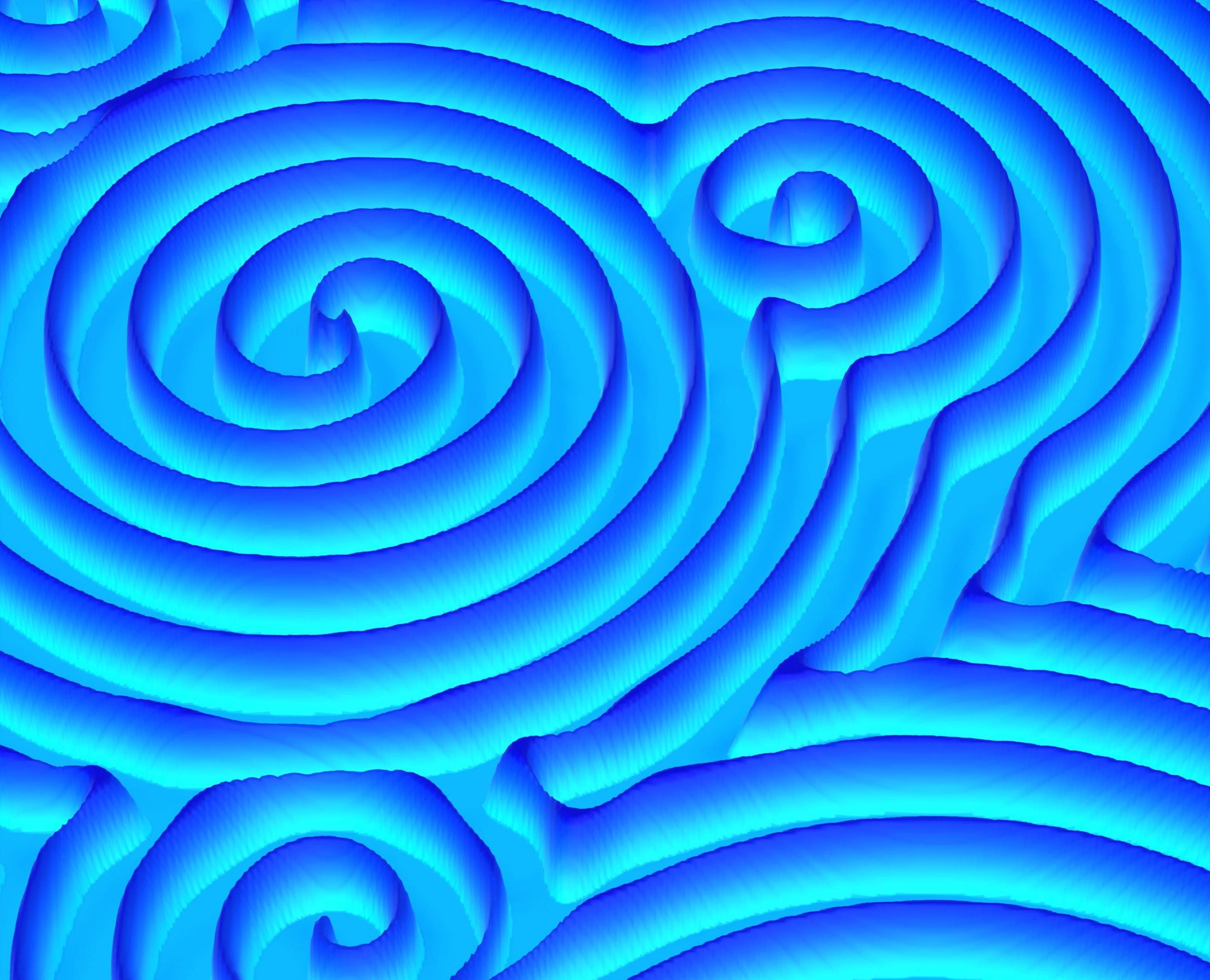
A new model reveals how molecular interactions drive order in active systems.
Scientists from the Department of Living Matter Physics at the Max Planck Institute for Dynamics and Self-Organization (MPI-DS) have found that non-reciprocal interactions can enhance order in active systems. Using a newly developed model, they demonstrated how the degree of non-reciprocity influences the formation of patterns, providing deeper insight into the organization of complex, dynamic systems.
Non-Reciprocal Interactions in Living Matter
Living matter exhibits unique characteristics not found in simpler physical systems. One striking example is the uneven interaction between different types of particles. For instance, one molecule may be attracted to another, while the second is repelled — similar to how a predator pursues its prey, which instinctively tries to escape. This phenomenon, known as non-reciprocal interaction, can produce complex, large-scale patterns, as has been shown previously. These patterns often resemble essential structures found in living systems, such as the organization within a cell.
Exploring Non-Reciprocity and Pattern Formation
In a new study, Navdeep Rana and Ramin Golestanian explored the interplay between non-reciprocity and the formation of defects, which influences the resulting patterns.
“Typically, stronger non-reciprocity causes higher activity and is thus associated with less order in the system,” explains Rana. “However, we found that in fact the opposite is true, and well-ordered wave patterns are formed when non-reciprocity exceeds a certain level.”
Thus, the new study highlights the importance of non-reciprocity in eliminating defects in active systems to create ordered structures.
Simulation Insights into Defect Dynamics
The scientists used simulations to probe the physical properties of the naturally occurring defects that disrupt order, just like the dislocations in the metal that is used to make spoons.
“While a non-equilibrium drive in the form of repeated bending of a spoon creates more entangled defects and weakens its strength until it breaks, non-reciprocal interactions drive the system towards the path of eliminating the defects and creating perfect order.” adds Golestanian.
“This remarkable property opens many avenues for applications of non-reciprocal active matter systems,” he concludes.
Concluding Remarks on Active Matter Organization
Overall, the study reveals fundamental physical principles underlying the organization of active matter – which are important for the formation of life.
References:
“Defect interactions in the non-reciprocal Cahn–Hilliard model” by Navdeep Rana and Ramin Golestanian, 9 December 2024, New Journal of Physics.
DOI: 10.1088/1367-2630/ad9859
“Defect Solutions of the Nonreciprocal Cahn-Hilliard Model: Spirals and Targets” by Navdeep Rana and Ramin Golestanian, 15 August 2024, Physical Review Letters.
DOI: 10.1103/PhysRevLett.133.078301
Never miss a breakthrough: Join the SciTechDaily newsletter.
Follow us on Google and Google News.
4 Comments
Active matter organisations? You mean like a grain crop?
When space undergoes a topological phase transition, a series of vortex structures are formed. These vortices are not only physical vortices, but also geometric changes in the spatial structure itself, manifested as certain forms of spatial distortion or rotation. Well-ordered wave patterns are formed when non-reciprocity exceeds a certain level.
The double spiral resembles a discrete version of galaxy because both forms share a property of line growth/contraction maintaining a constant spacing from previous growth as much as it can. The essential idea of seeing it as a quantum wave requires that it expresses a rolling (or pitching) vector field with a galactic-sized vector rotation rate. Portions the spiral line radiate sidewards for growing/contracting spiral concentrations of matter, as matter initializes the field to point inward toward it.
The picture lacks a quantum gravity stationary radial/concentric wave field pattern effect to superimpose on the field-based spiral arm spacing. Galactic arms usually end with a fly-off effect as they thin out and lose strength and coherence as an ordering input to the pattern.
Meant to say the double spiral resembles a discrete version of a grand design spiral galaxy.
The “stationary radial/concentric wave field pattern effect” I suggest is usually largely swamped out, especially by large/spread-out arm mass and expanded cores or unorganized energetic debris from collisions with other galaxies.