
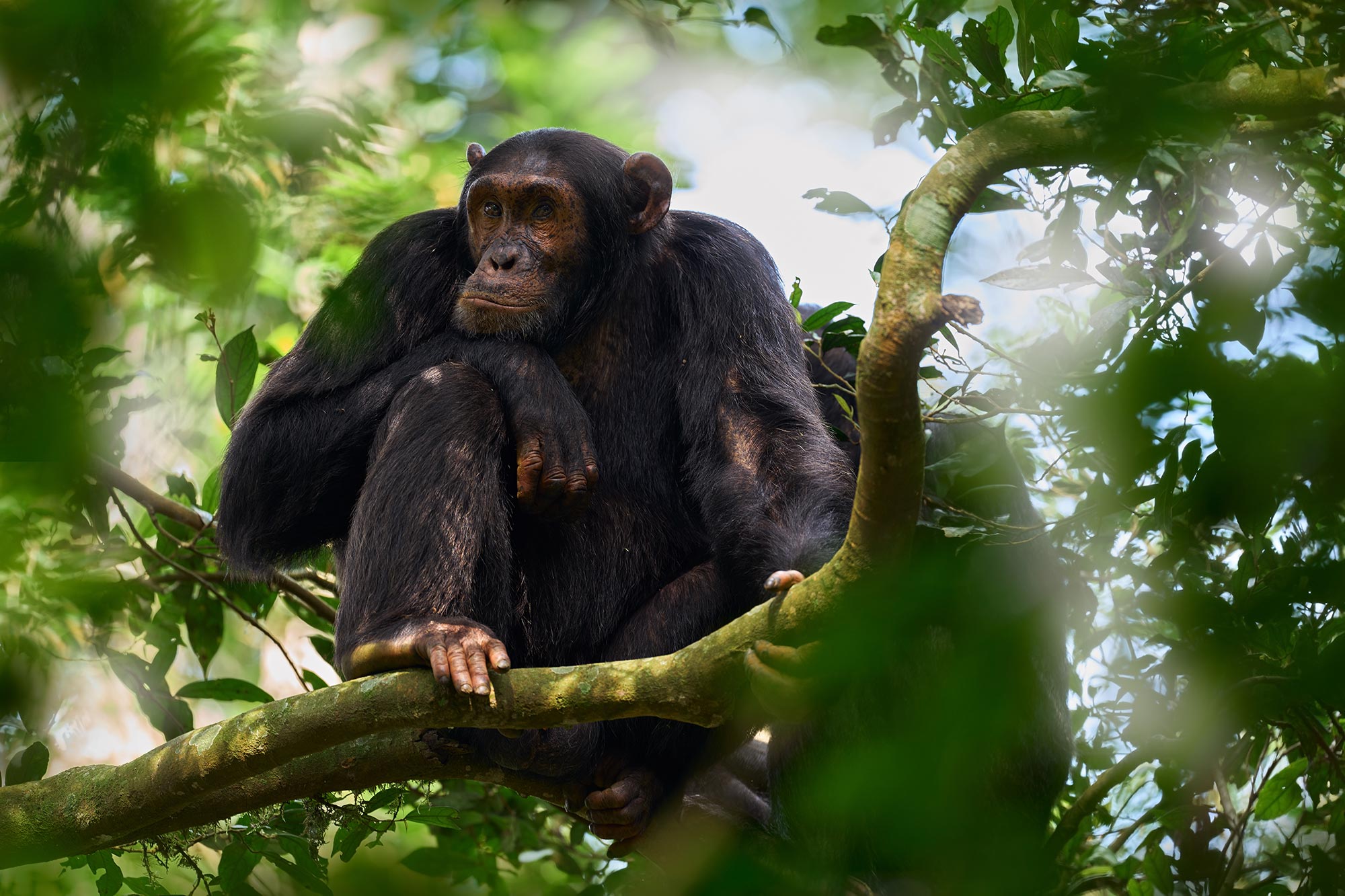
New research on chimpanzees living in the open woodlands of Tanzania suggests that the story of how humans learned to walk on two legs may need a rewrite.
Despite their dry, savannah-mosaic environment, these chimpanzees still climb trees regularly to forage—especially when the food is abundant and harder to reach. Their behavior hints that bipedalism could have evolved in the trees rather than solely as a ground-based adaptation. This challenges the long-held idea that walking upright emerged only after our ancestors left the trees behind and moved into open grasslands.
Climbing or Walking? Chimpanzees Offer Clues to Our Past
Pinpointing when and why our ancestors stopped living in trees and began walking upright has long been a challenge. Although many early human relatives could walk on two legs, they also had strong climbing abilities. Unfortunately, there is little fossil evidence from the crucial time period when shifts in climate transformed dense forests into a more open, drier habitat known as savannah-mosaic. This change may have played a role in moving early hominins to the ground.
But new research on modern chimpanzees may help fill in some of the missing details. Scientists studying chimpanzees in Tanzania’s Issa Valley have found that, even in a savannah-mosaic landscape, these animals still climb trees often to reach important food sources. This behavior could explain why early hominins retained features suited for tree-dwelling life.

Rethinking the Bipedal Origin Story
“For decades it was assumed that bipedalism arose because we came down from the trees and needed to walk across an open savannah,” said Dr Rhianna Drummond-Clarke of the Max Planck Institute for Evolutionary Anthropology, lead author of the article in Frontiers in Ecology and Evolution. “Here we show that safely and effectively navigating the canopy can remain very important for a large, semi-arboreal ape, even in open habitat. Adaptations to arboreal, rather than terrestrial, living may have been key in shaping the early evolution of the human lineage.”
Foraging in the Savannah-Mosaic
The Issa Valley environment includes small pockets of dense forest near rivers, surrounded by open woodland. During the dry season, chimpanzees tend to forage more in the open areas, where food becomes more plentiful. Their surroundings and diet are similar in some ways to those of early hominins, which makes their behavior a useful window into our evolutionary past.
“Our previous research found that, compared to chimpanzees living in forests, Issa Valley chimpanzees spent just as much time moving in the trees,” said Drummond-Clarke. “We wanted to test if something about how they foraged could explain their unexpectedly high arboreality. Savannah-mosaics are characterized by more sparsely distributed trees, so we hypothesized that adapting behavior to forage efficiently in a tree would be especially beneficial when the next tree is further away.”

Tree Behavior and Nutritional Strategy
Researchers monitored the adults of the Issa community during the dry season, watching how they foraged in trees and what they ate there. The size, height, and shape of the trees were recorded, as well as the number and size of branches.
Issa chimpanzees mostly ate fruit, followed by leaves and flowers — foods found at the ends of branches, so the chimpanzees needed to be capable climbers to reach them safely. They spent longer foraging in trees that were larger and offered more food. The longest foraging sessions, and the most specialized behaviors to navigate thinner terminal branches, were seen in trees with large open crowns offering lots of food: perhaps abundant food justified the extra time and effort. A similar trade-off between the nutritional benefits of specific foods and the effort of acquiring them could also explain why chimpanzees spent longer in trees while eating nutritionally-rich, hard-to-access seeds.

Bipedalism in the Canopy
Because they are relatively large, chimpanzees move within trees not by climbing on thin branches but by hanging under them, or standing upright and holding on to nearby branches with their hands. Although these ‘safe’ behaviors are traditionally associated with foraging in dense forest, these findings show they’re also important for chimpanzees foraging in a savannah-mosaic.
“We suggest our bipedal gait continued to evolve in the trees even after the shift to an open habitat,” said Drummond-Clarke. “Observational studies of great apes demonstrate they can walk on the ground for a few steps, but most often use bipedalism in the trees. It’s logical that our early hominin relatives also engaged in this kind of bipedalism, where they can hold onto branches for extra balance. If Issa Valley chimpanzees can be considered suitable models, suspensory and bipedal behaviors were likely vital for a large-bodied, fruit-eating, semi-terrestrial hominin to survive in an open habitat.”
However, the researchers say that we need more fossil evidence and more studies on different aspects of chimpanzee foraging to test this idea.
Open Questions and Future Research
“This study only looked at foraging behavior during the dry season,” cautioned Drummond-Clarke. “It would be interesting to investigate if these patterns remain during the wet season. Analyses of the nutritional value of foods and overall food availability are also needed to test our hypothesis that a strategy of foraging for longer in large trees on certain foods is energy-efficient in an open habitat.
“Importantly, this is also only one community of chimpanzees. Future studies of other chimpanzees living in such dry, open habitats will be vital to see if these patterns are truly a savannah-mosaic signal or unique to Issa.”
Reference: “Foraging strategy and tree structure as drivers of arboreality and suspensory behaviour in savannah-dwelling chimpanzees” by Rhianna C. Drummond-Clarke, Susan Chege Reuben, Fiona A. Stewart, Alex K. Piel and Tracy L. Kivell, 20 June 2025, Frontiers in Ecology and Evolution.
DOI: 10.3389/fevo.2025.1561078
Never miss a breakthrough: Join the SciTechDaily newsletter.
Follow us on Google and Google News.
1 Comment
The nonsense is stubborn. All “hominines” turned to be extinct human tribes or extinct apes. Neandertals and denisovans to be homo sapiens. No traces of evolutionary changes in the generations of observed modern apes (or any other species of plants or animals, for that matter). Sapienti sat.