

Newly discovered exoplanets contribute to the development of a novel model that offers potential explanations for the origin of some of Earth’s signature features, such as its abundance of water.
New research from Carnegie Science’s Anat Shahar, along with UCLA’s Edward Young and Hilke Schlichting, suggests that the water found on our planet may have originated from the interplay between the hydrogen-rich atmospheres and molten lava seas of the early planetary bodies that constituted the early stages of Earth’s formation. Their research, which could shed light on the origin of some of Earth’s defining characteristics, was recently published in the journal Nature.
Historically, our understanding of planetary formation was largely influenced by the example of our own Solar System. Even though the genesis of gas giants such as Jupiter and Saturn still sparks discussions among scientists, there is a broad consensus that Earth and other terrestrial planets were formed from the accumulation of dust and gas that once orbited around our Sun in its youth.
As increasingly larger objects crashed into each other, the baby planetesimals that eventually formed Earth grew both larger and hotter, melting into a vast magma ocean due to the heat of collisions and radioactive elements. Over time, as the planet cooled, the densest material sank inward, separating Earth into three distinct layers—the metallic core, and the rocky, silicate mantle and crust.
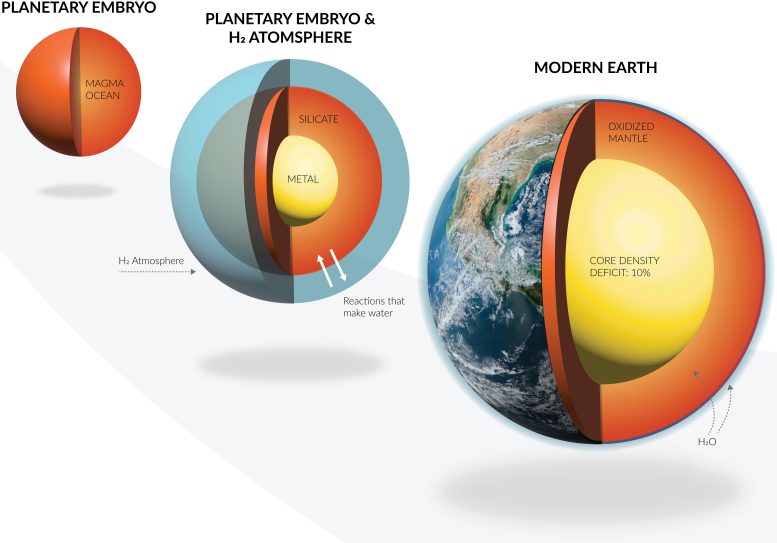
However, the explosion of exoplanet research over the past decade informed a new approach to modeling the Earth’s embryonic state.
“Exoplanet discoveries have given us a much greater appreciation of how common it is for just-formed planets to be surrounded by atmospheres that are rich in molecular hydrogen, H2, during their first several million years of growth,” Shahar explained. “Eventually these hydrogen envelopes dissipate, but they leave their fingerprints on the young planet’s composition.”
Magma Oceans and Molecular Hydrogen Interactions
Using this information, the researchers developed new models for Earth’s formation and evolution to see if our home planet’s distinct chemical traits could be replicated.
Using a newly developed model, the Carnegie and UCLA researchers were able to demonstrate that early in Earth’s existence, interactions between the magma ocean and a molecular hydrogen proto-atmosphere could have given rise to some of Earth’s signature features, such as its abundance of water and its overall oxidized state.
The researchers used mathematical modeling to explore the exchange of materials between molecular hydrogen atmospheres and magma oceans by looking at 25 different compounds and 18 different types of reactions—complex enough to yield valuable data about Earth’s possible formative history, but simple enough to interpret fully.
Interactions between the magma ocean and the atmosphere in their simulated baby Earth resulted in the movement of large masses of hydrogen into the metallic core, the oxidation of the mantle, and the production of large quantities of water.
Even if all of the rocky material that collided to form the growing planet was completely dry, these interactions between the molecular hydrogen atmosphere and the magma ocean would generate copious amounts of water, the researchers revealed. Other water sources are possible, they say, but not necessary to explain Earth’s current state.
Implications for Exoplanets and Signs of Life
“This is just one possible explanation for our planet’s evolution, but one that would establish an important link between Earth’s formation history and the most common exoplanets that have been discovered orbiting distant stars, which are called Super-Earths and sub-Neptunes,” Shahar concluded.
This project was part of the interdisciplinary, multi-institution AEThER project, initiated and led by Shahar, which seeks to reveal the chemical makeup of the Milky Way galaxy’s most common planets—Super-Earths and sub-Neptunes—and to develop a framework for detecting signatures of life on distant worlds. Funded by the Alfred P. Sloan Foundation, this effort was developed to understand how the formation and evolution of these planets shape their atmospheres. This could—in turn—enable scientists to differentiate true biosignatures, which could only be produced by the presence of life, from atmospheric molecules of non-biological origin.
“Increasingly powerful telescopes are enabling astronomers to understand the compositions of exoplanet atmospheres in never-before-seen detail,” Shahar said. “AEThER’s work will inform their observations with experimental and modeling data that, we hope, will lead to a foolproof method for detecting signs of life on other worlds.”
Reference: “Earth shaped by primordial H2 atmospheres” by Edward D. Young, Anat Shahar and Hilke E. Schlichting, 12 April 2023, Nature.
DOI: 10.1038/s41586-023-05823-0
The study was funded, in part, by the Alfred P. Sloan Foundation.
Never miss a breakthrough: Join the SciTechDaily newsletter.
Follow us on Google and Google News.