
Researchers are leveraging troves of data collected by animal-borne sensors to complement satellite observations, expand weather measurements, and better understand wildlife ecology in a changing climate.
Designing Earth observation systems is an exercise in tradeoffs. A satellite may be good at collecting data in fine spatial resolution, at high temporal frequency, or across a broad range of wavelengths, but not all three at once. Ground-based systems, such as weather stations, can collect a variety of data frequently, but they sample only one location and their distribution is uneven across the planet.
Animal Kingdom: A Resource for Earth Observations
There is another vehicle for collecting Earth observations, one that can fill gaps in weather and climate data: the animal kingdom. Over several decades, tens of thousands of creatures—from storks and caribou to elephants and elephant seals—have been tagged with sensors to gather data about their habitats. These include places that are too dark, cloudy, icy, or forested for satellites to see, or are too rugged, remote, or inhospitable for humans to access.
Integrating Animal Data in Climate Monitoring
Increasingly, scientists are realizing the power of animal observations to improve climate monitoring and reveal Earth processes in finer detail. “Animals are an integral component of Earth observation,” said ecologist Diego Ellis Soto, a graduate student at Yale University and NASA FINESST (Future Investigators in NASA Earth and Space Science and Technology) fellow. In a recent paper in Nature Climate Change, Ellis Soto and colleagues lay out their case and a vision for making animal tracking data part of the standard toolkit for studying our planet.
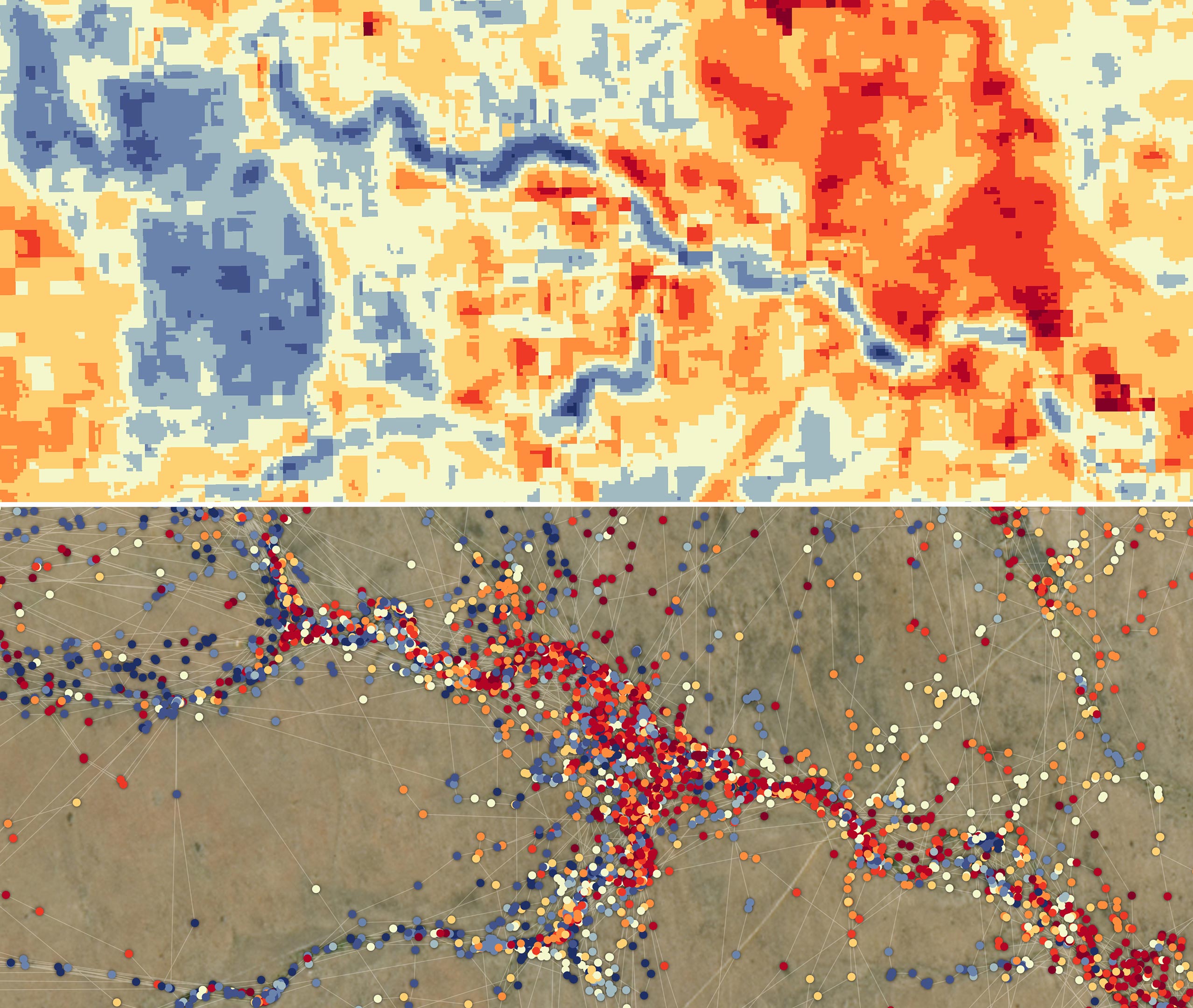
To start, consider how just one species in one part of the world can collect data with unique spatial and temporal coverage. The maps above compare temperature data acquisition by satellite and by elephant-borne sensors in a portion of South Africa’s Kruger National Park. The land surface temperature map (top) displays a yearly average of morning temperatures collected by the Landsat 5 satellite. The other map (bottom) shows air temperatures from the same location and year, recorded multiple times per day by elephants fitted with sensors. A cluster of data points appears along the Myamvubu River.
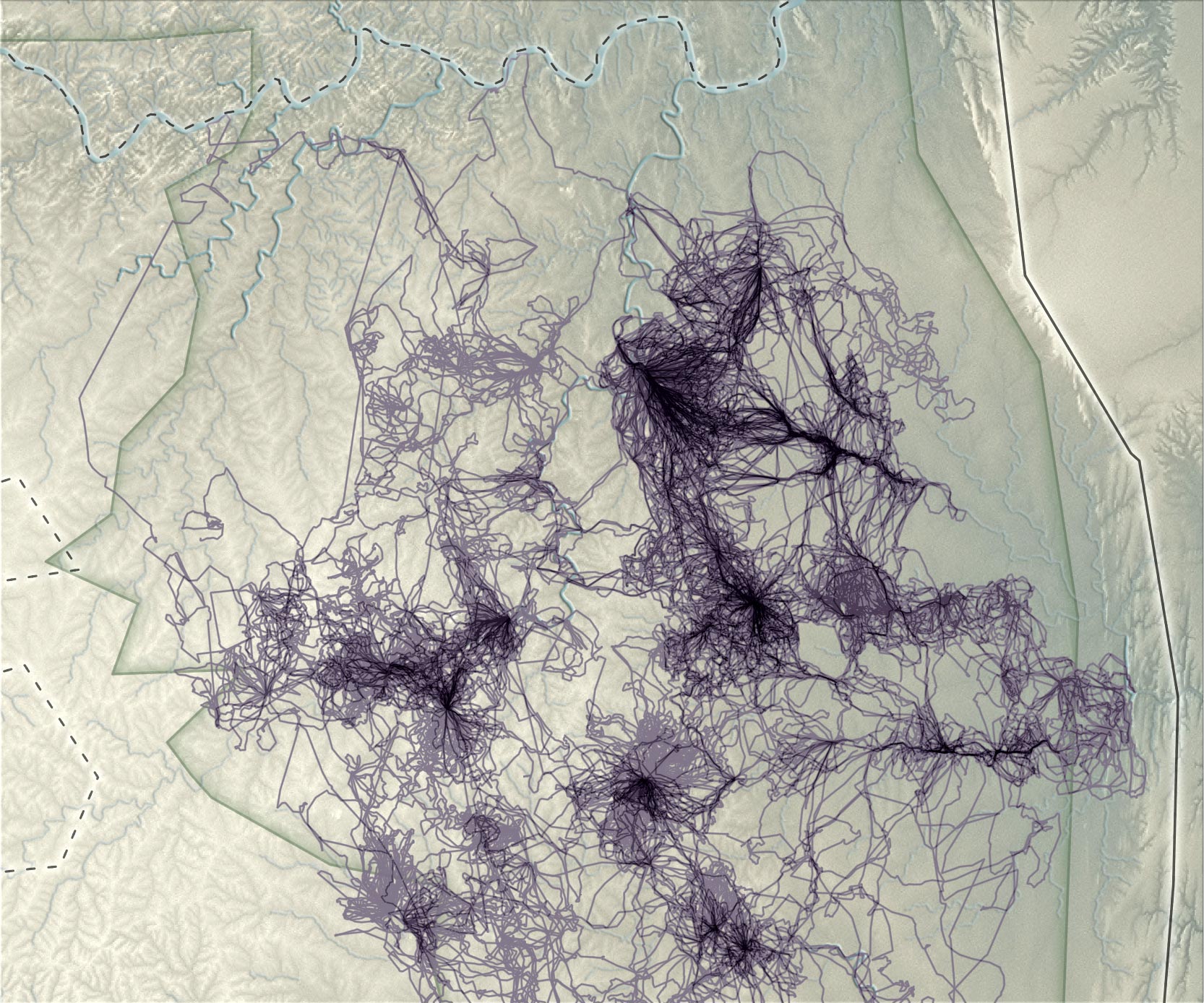
Here, satellite data covers the entire area but is limited by spatial resolution, revisit time (16 days in the case of Landsat 5), and other factors such as cloud cover. Additionally, ground-based weather stations collected data at high temporal frequencies but from static points far away from the elephants’ locations. The elephant-borne sensors logged data at high frequency but sampled different territories along the animals’ voyages. The map below shows the patterns and extent of elephant movement across Kruger National Park for one year.
Animals As Environmental Sensors
More than serving as walking weather stations, animals and their movement patterns can tell scientists about how wildlife interacts with the environment and how conditions influence behavior. In a 2019 study, researchers analyzed the elephant data to learn when the animals visited water sources, which says something about their strategies for managing thermal stress.
“These animals are extremely biased sensors, and this bias is called animal ecology and behavior,” said Ellis Soto.
Animal biases as to where and when they sample certain areas may be a feature rather than a bug. For example, they might reveal how animals respond to extreme temperatures, which is of particular interest when it comes to rare or threatened species in a changing climate.
Advancements in Animal Tracking and Ecological Insights
This sampling bias can also fill in details about the environment that satellites cannot resolve. “We can use animal movement to tell us about other Earth processes going on,” said Keith Gaddis, program manager for NASA’s Ecological Conservation program. NASA has been in the animal tracking game for decades, he noted, citing the agency’s role in developing radio collar and satellite tracking technology. (It has come a long way since the tracking of Monique the Space Elk with the Nimbus III weather satellite in 1970.)
Satellites can use measurements such as NDVI, a measure of vegetation greenness, to see when plants leaf out, but they cannot detect other seasonal changes such as the emergence of seed pods. Wildlife foraging for seeds, however, could fill in this seasonal information and tell scientists about an ecosystem’s response to climate change, Gaddis said. Similarly, creatures living in snowy environments might offer details into snow coverage and melt timing through their movement patterns.
“Our natural history understanding of animals will help us select which animal sensor we would use [to make these types of measurements],” said Ellis Soto. In his recent paper, he compared animal movement patterns to different satellite systems. The wandering albatross covers large areas, but infrequently—similar to Landsat. In contrast, the white stork is a central-place forager, meaning it revisits certain areas frequently during breeding season. The pattern is analogous to a geostationary satellite such as GOES.
Importantly, Ellis Soto does not advocate tracking animals for the sole purpose of climate monitoring, but rather views it as a win-win scenario that also requires balancing ethical considerations. The endeavor adds value to ongoing biodiversity conservation efforts, and he sees the additional information about the environment as a “massive byproduct” of our current technology.
The marine world has appreciated the value of animal observers for some time. Tiger shark “observations” have augmented remote sensing data and diver surveys in mapping the world’s largest seagrass ecosystem. And tagged elephant seals swimming in icy Antarctic waters have helped reveal how heat moves through the ocean depths. Data streams provided by marine animals have proved valuable and robust enough to become integrated into the UNESCO-led Global Ocean Observing System for long-term monitoring.
Future Directions in Animal-Sensed Data Integration
The task now is to compile, standardize, and provide access to the full canon of animal-sensed information. A movement is afoot to create a set of essential biodiversity variables (EBVs), along the lines of the existing essential climate variables (ECVs). ECVs are datasets that contribute to the characterization of Earth’s climate and include variables such as ozone, sea ice, above-ground biomass, soil moisture, and ocean color. “The dream is that we have these [biological] products that are systematically generated in the same way we do for climate variables,” said Gaddis.
Ellis Soto and colleagues also believe the pieces are in place for land- and air-based animal sensor data to become standard in Earth system and climate monitoring. Tens of thousands of animals are already being tracked, and the data, tracking technology, and analytical tools have all become more sophisticated. What’s left is more proof of concept—more examples like pigeons improving air quality forecasts—that weather and climate models are better with data from animals than without. According to Ellis Soto: “We’re in the age of fusing data sources.”
NASA Earth Observatory images by Michala Garrison, using Landsat data from the U.S. Geological Survey, and elephant-borne sensor data from Thaker, M., et al. (2019).
Never miss a breakthrough: Join the SciTechDaily newsletter.
Follow us on Google and Google News.