
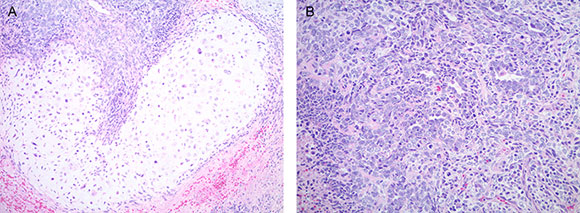
Researchers from Yale University have defined the genetic landscape of rare, highly aggressive tumors called carcinosarcomas, pointing the way to possible new treatments.
The findings are published in the early edition of Proceedings of the National Academy of Sciences.
Endometrial and ovarian cancers are the most prevalent gynecologic tumors in women, with over 76,160 newly diagnosed cases and about 14,270 deaths in 2015 in the United States alone. Although CSs comprise only 2%-5% of all uterine malignancies and 1%-2% of all ovarian tumors, they are responsible for a disproportionate number of deaths due to their high biologic aggressiveness and resistance to standard treatments, such as radiation and chemotherapy.
The collaborative research team — which included experts in gynecological cancer, genomics, pathology, and computational biology— performed a comprehensive genetic analysis of ovarian and endometrial CSs. The team collected tumors from 68 women affected with ovarian and uterine CSs to try to determine the molecular basis of the tumor’s aggressive behavior. They sequenced all the genes from the tumors and identified mutations that are crucial for these tumors to grow. The team also studied the copy number variations — genes that are not mutated but are amplified in the tumors to give them a growth advantage over normal tissues.
“We identified a number of new genes that are frequently mutated in CS,” said senior author Dr. Alessandro Santin, professor of obstetrics, gynecology, and reproductive sciences at Yale School of Medicine, and program leader of the gynecological cancers research program at Smilow Cancer Hospital at Yale-New Haven and a member of Yale Cancer Center.
“In addition to mutations in cancer genes previously identified in uterine and ovarian carcinomas, we found an excess of mutations in genes encoding specific groups of proteins, which may potentially explain their mixed tissue characteristics,” said Santin.
“We’ve established unequivocally the common genetic origin of these tumors as epithelial tumors,” he added. “Importantly, by studying the genetics of both the carcinomatous and sarcomatous elements of these tumors, we demonstrated that the transition from carcinoma to sarcoma, which represents one of the main characteristics of these tumors, may happen at different times during the evolution of these cancers.”
Other authors on the study include first author Siming Zhao, Stefania Bellone, Salvatore Lopez, Durga Thakral, Carlton Schwab, Diana P. English, Jonathan Black, Emiliano Cocco, Jungmin Choi, Luca Zammataro, Federica Predolini, Elena Bonazzoli, Mark Bi, Natalia Buza, Pei Hui, Serena Wong, Maysa Abu-Khalaf, Antonella Ravaggi, Eliana Bignotti, Elisabetta Bandiera, Chiara Romani, Paola Todeschini, Renata Tassi, Laura Zanotti, Franco Odicino, Sergio Pecorelli, Carla Donzelli, Laura Ardighieri, Fabio Facchetti, Marcella Falchetti, Dan-Arin Silasi, Elena Ratner, Masoud Azodi, Peter E. Schwartz, Shrikant Mane, Roberto Angioli, Corrado Terranova, Matthew Quick, Baback Edraki, Kaya Bilguvar, Moses Lee, Murim Choi, Amy L. Stiegler, Titus J. Boggon, Richard P. Lifton, and Joseph Schlessinger.
The research was supported as part of a collaborative program with Gilead Sciences, Inc. The study was also funded in part by grants from the National Institutes of Health, the National Cancer Institute, and the Howard Hughes Medical Institute.
Reference: “Mutational landscape of uterine and ovarian carcinosarcomas implicates histone genes in epithelial–mesenchymal transition” by Siming Zhao, Stefania Bellone, Salvatore Lopez, Durga Thakral, Carlton Schwab, Diana P. English, Jonathan Black, Emiliano Cocco, Jungmin Choi, Luca Zammataro, Federica Predolini, Elena Bonazzoli, Mark Bi, Natalia Buza, Pei Hui, Serena Wong, Maysa Abu-Khalaf, Antonella Ravaggi, Eliana Bignotti, Elisabetta Bandiera, Chiara Romani, Paola Todeschini, Renata Tassi, Laura Zanotti, Franco Odicino, Sergio Pecorelli, Carla Donzelli, Laura Ardighieri, Fabio Facchetti, Marcella Falchetti, Dan-Arin Silasi, Elena Ratner, Masoud Azodi, Peter E. Schwartz, Shrikant Mane, Roberto Angioli, Corrado Terranova, Charles Matthew Quick, Babak Edraki, Kaya Bilgüvar, Moses Lee, Murim Choi, Amy L. Stiegler, Titus J. Boggon, Joseph Schlessinger, Richard P. Lifton, and Alessandro D. Santin, 10 October 2016, PNAS.
DOI: 10.1073/pnas.1614120113
Never miss a breakthrough: Join the SciTechDaily newsletter.
Follow us on Google and Google News.