

Meet “Zangenite,” a hollow crystal structure named in honor of the NYU graduate student who discovered it.
Crystals, whether found in sugar, table salt, snowflakes, or diamonds, do not always grow in a simple or predictable manner. Researchers at New York University have documented the transformation from a amorphous blob to an organized structure in a new study published in Nature Communications.
While investigating how crystals form, the researchers discovered an unusual rod-shaped crystal that had not been identified before. They named it “Zangenite” after the NYU graduate student who made the discovery.
Order from chaos
Crystals are solids composed of particles that arrange themselves into repeating patterns. This process of self-assembly, described by the researchers as “orchestrating order from chaos,” was once believed to follow a straightforward, classical growth model. However, scientists are now finding that crystal growth can occur through more intricate and varied pathways.
To study the formation of crystals, some researchers use crystals made up of little spheres called colloidal particles, which are tiny but much larger than the atoms that make up other crystals.
“The advantage of studying colloidal particles is that we can observe crystallization processes at a single-particle level, which is very hard to do with atoms because they’re too small and fast. With colloids, we can watch crystals form with our microscope,” said Stefano Sacanna, professor of chemistry at NYU.
A two-step process
To shed light on how colloidal crystals form, the researchers conducted experiments to carefully observe how charged colloidal particles behave in different growth conditions as they transition from salt water suspensions to fully formed crystals. The team also ran thousands of computer simulations—led by Glen Hocky, assistant professor of chemistry at NYU—to model how crystals grow and help explain what they observed in the experiments.
Using experiments and computer simulations, NYU researchers study how crystals form from amorphous blobs into highly organized structures. Credit: Shihao Zang/NYU
The researchers determined that colloidal crystals form through a two-step process: amorphous blobs of particles first condense before transforming into ordered crystal structures, resulting in a diverse array of crystal types and shapes.
An unexpected find
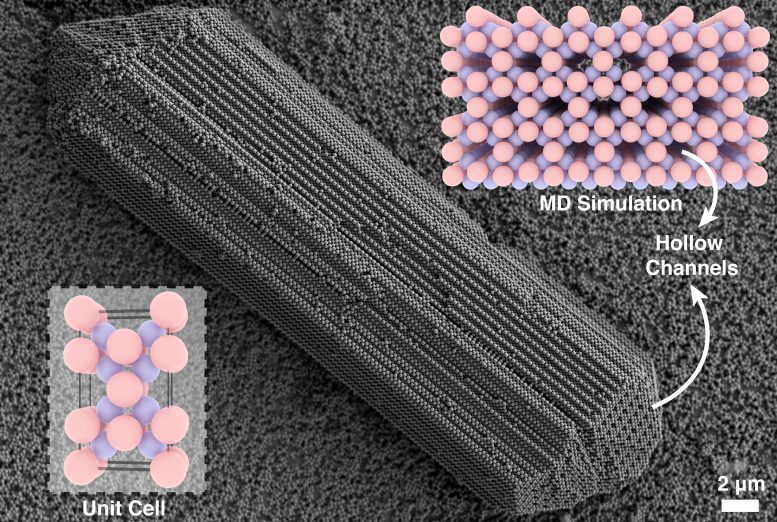
During these experiments, PhD student Shihao Zang came across a rod-shaped crystal that he couldn’t identify. To the naked eye, it looked like a crystal previously discovered in the lab, but upon closer examination, the combination of particles was different and the tips of this crystal contained hollow channels. Zang compared the unknown structure with more than a thousand crystals found in the natural world and still couldn’t find a match.
Turning to Hocky’s computer modeling, the researchers simulated a crystal that was exactly the same, enabling them to study its elongated, hollow shape in even greater detail.
“This was puzzling because usually crystals are dense, but this one had empty channels that ran the length of the crystal,” said Hocky, who is also a faculty member in the Simons Center for Computational Physical Chemistry at NYU.
NYU researchers discovered a new crystal—a rod-shaped, hollow, low-density structure, shown here in experiments and simulations—naming it “Zangenite” for the NYU graduate student who found it. Credit: Shihao Zang/NYU
“Through this synergy of experiments and simulation, we realized that this crystal structure had never been observed before,” added Sacanna.
They named the newly discovered crystal L3S4 based on its composition, but began informally calling it “Zangenite” at lab meetings, given that Zang discovered it. The name stuck.
“We study colloidal crystals to mimic the real world of atomic crystals, but we never imagined that we would discover a crystal that we cannot find in the real world,” said Zang.
The discovery of Zangenite creates an opportunity to explore uses for hollow, low-density crystals, and may pave the way for finding additional new crystals.
“The channels inside Zangenite are analogous to features in other materials that are useful for filtering or enclosing things inside them,” said Hocky.
“Before, we thought it would be rare to observe a new crystal structure, but we may be able to discover additional new structures that haven’t yet been characterized,” said Sacanna.
More broadly, a deeper understanding of how crystals form holds promise for developing new materials, including photonic bandgap materials that are foundational for lasers, fiber-optic cables, solar panels, and other technologies that transmit or harvest light.
Reference: “Direct observation and control of non-classical crystallization pathways in binary colloidal systems” by Shihao Zang, Sanjib Paul, Cheuk W. Leung, Michael S. Chen, Theodore Hueckel, Glen M. Hocky and Stefano Sacanna, 17 April 2025, Nature Communications.
DOI: 10.1038/s41467-025-58959-0
The research was supported by the US Army Research Office (W911NF-21-1-0011), the Simons Center for Computational Physical Chemistry at NYU (Simons Foundation 839534), and the National Institutes of Health (R35GM138312).
Never miss a breakthrough: Join the SciTechDaily newsletter.
Follow us on Google and Google News.
1 Comment
This also happens in nature. Opal is composed of small spheres organized in layers. The dimensions of these layers cause them to act as diffraction gratings which produces all the colors these gems produce.