
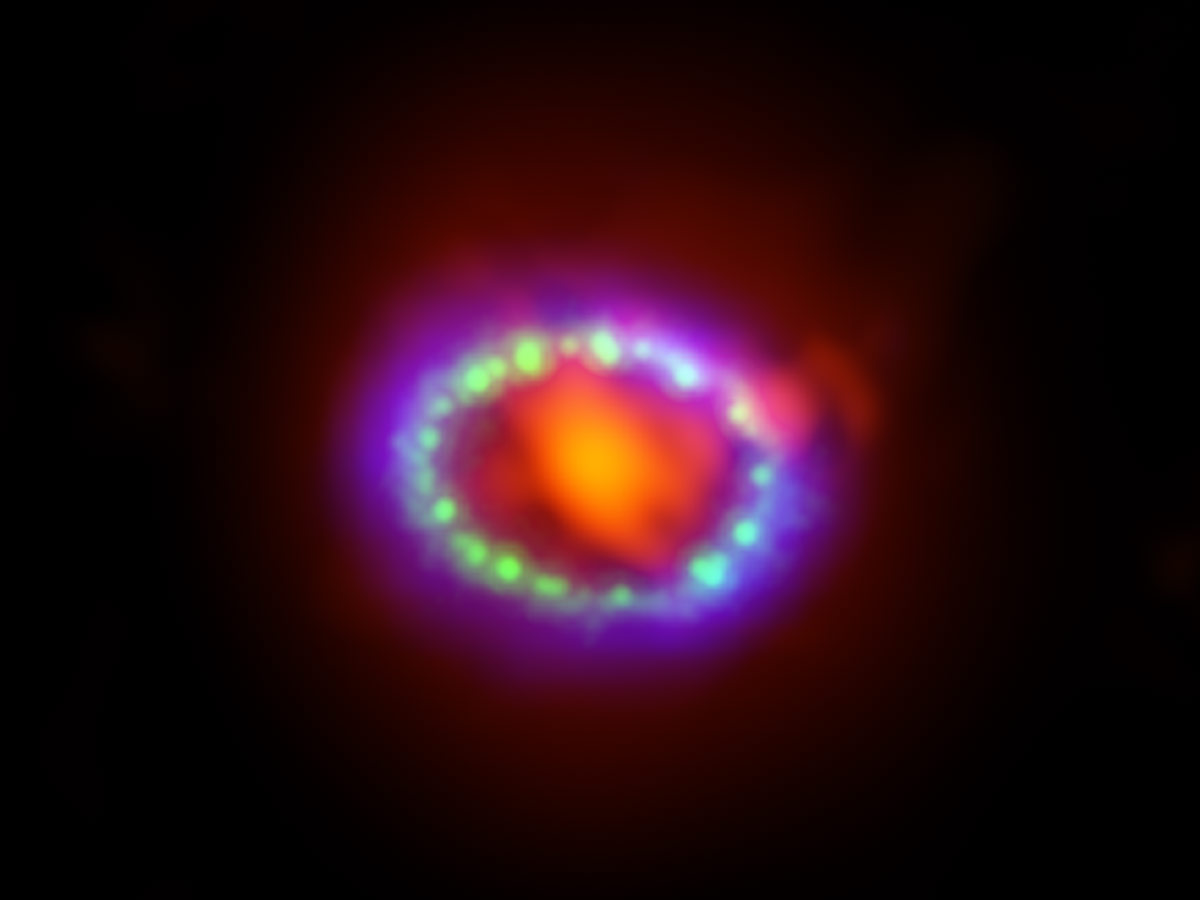
Astronomers used ALMA to observe the remains of Supernova 1987A, seeing for the first time the remains of a recent supernova brimming with freshly formed dust.
Striking new observations with the Atacama Large Millimeter/submillimeter Array (ALMA) telescope capture, for the first time, the remains of a recent supernova brimming with freshly formed dust. If enough of this dust makes the perilous transition into interstellar space, it could explain how many galaxies acquired their dusty, dusky appearance.
Galaxies can be remarkably dusty places[1] and supernovae are thought to be a primary source of that dust, especially in the early Universe. But direct evidence of a supernova’s dust‐making capabilities has been slim up to now, and could not account for the copious amount of dust detected in young, distant galaxies. But now observations with ALMA are changing that.
“We have found a remarkably large dust mass concentrated in the central part of the ejecta from a relatively young and nearby supernova,” said Remy Indebetouw, an astronomer at the National Radio Astronomy Observatory (NRAO) and the University of Virginia, both in Charlottesville, USA. “This is the first time we’ve been able to really image where the dust has formed, which is important in understanding the evolution of galaxies.”
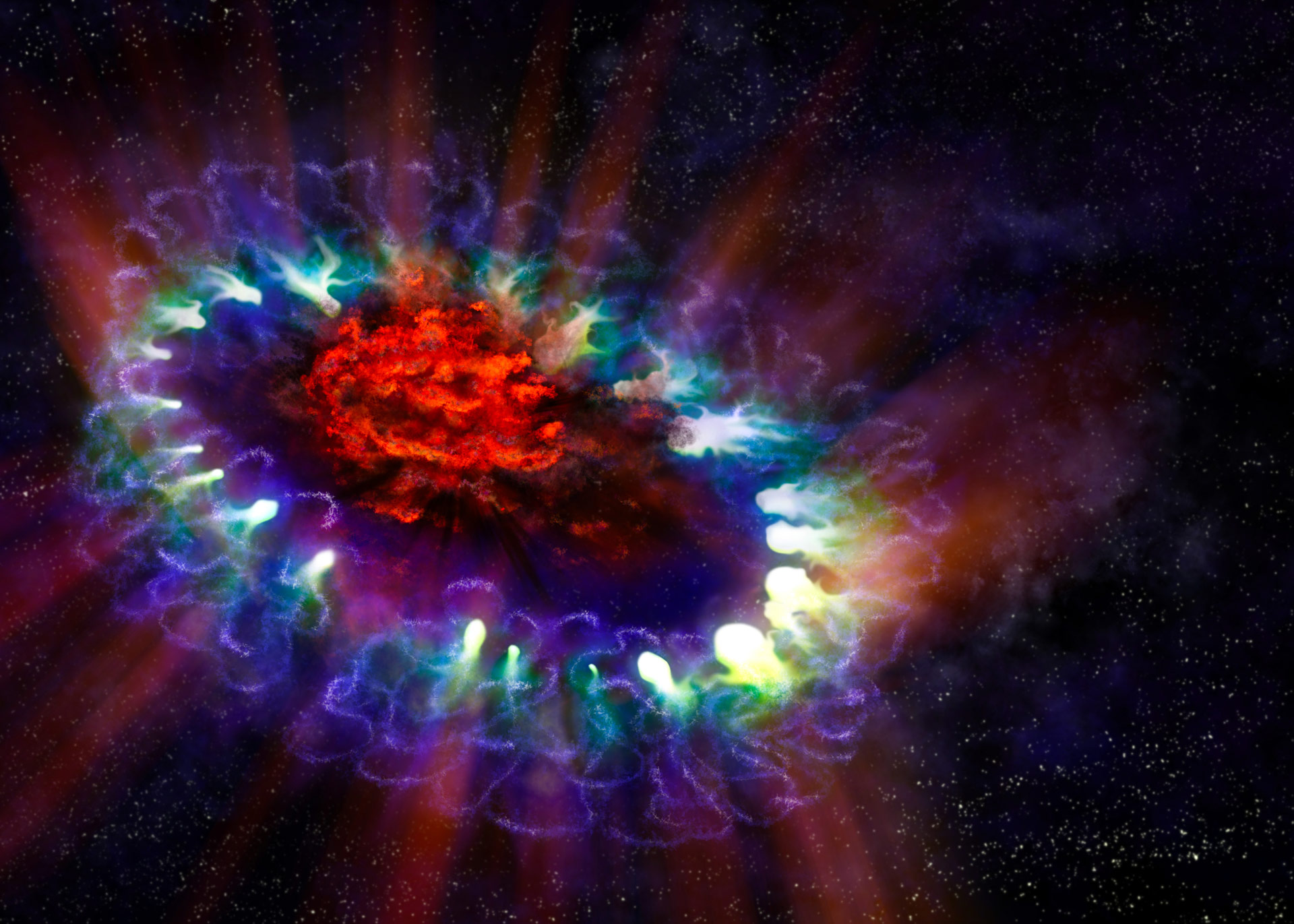
An international team of astronomers used ALMA to observe the glowing remains of Supernova 1987A,[2] which is in the Large Magellanic Cloud, a dwarf galaxy orbiting the Milky Way about 160,000 light‐years from Earth. SN 1987A is the closest observed supernova explosion since Johannes Kepler’s observation of a supernova inside the Milky Way in 1604.
Astronomers predicted that as the gas cooled after the explosion, large amounts of dust would form as atoms of oxygen, carbon, and silicon bonded together in the cold central regions of the remnant. However, earlier observations of SN 1987A with infrared telescopes, made during the first 500 days after the explosion, detected only a small amount of hot dust.
With ALMA’s unprecedented resolution and sensitivity, the research team was able to image the far more abundant cold dust, which glows brightly in millimeter and submillimeter light. The astronomers estimate that the remnant now contains about 25 percent of the mass of the Sun in newly formed dust. They also found that significant amounts of carbon monoxide and silicon monoxide have formed.
“SN 1987A is a special place since it hasn’t mixed with the surrounding environment, so what we see there was made there,” said Indebetouw. “The new ALMA results, which are the first of their kind, reveal a supernova remnant chock full of material that simply did not exist a few decades ago.”
Supernovae, however, can both create and destroy dust grains.
As the shockwave from the initial explosion radiated out into space, it produced bright glowing rings of material, as seen in earlier observations with the NASA/ESA Hubble Space Telescope. After hitting this envelope of gas, which was sloughed off by the progenitor red giant star as it neared the end of its life, a portion of this powerful explosion rebounded back towards the center of the remnant. “At some point, this rebound shockwave will slam into these billowing clumps of freshly minted dust,” said Indebetouw. “It’s likely that some fraction of the dust will be blasted apart at that point. It’s hard to predict exactly how much — maybe only a little, possibly a half or two-thirds.” If a good fraction survives and makes it into interstellar space, it could account for the copious dust astronomers detect in the early Universe.
“Really early galaxies are incredibly dusty and this dust plays a major role in the evolution of galaxies,” said Mikako Matsuura of University College London, UK. “Today we know dust can be created in several ways, but in the early Universe most of it must have come from supernovae. We finally have direct evidence to support that theory.”
Notes
- Cosmic dust consists of silicate and graphite grains — minerals also abundant on Earth. The soot from a candle is very similar to cosmic graphite dust, although the size of the grains in the soot are ten or more times bigger than typical grain sizes of cosmic graphite grains.
- Light from this supernova arrived at Earth in 1987, as is reflected in the name.
Reference: “Dust Production and Particle Acceleration in Supernova 1987A Revealed with ALMA” by R. Indebetouw, M. Matsuura, E. Dwek, G. Zanardo, M. J. Barlow, M. Baes, P. Bouchet, D. N. Burrows, R. Chevalier, G. C. Clayton, C. Fransson, B. Gaensler, R. Kirshner, M. Lakićević, K. S. Long, P. Lundqvist, I. Martí-Vidal, J. Marcaide, R. McCray, M. Meixner, C.-Y. Ng, S. Park, G. Sonneborn, L. Staveley-Smith, C. Vlahakis and J. van Loon, 17 January 2014, The Astrophysical Journal Letters.
DOI: 10.1088/2041-8205/782/1/L2
Never miss a breakthrough: Join the SciTechDaily newsletter.
Follow us on Google and Google News.