
Close Menu
    Facebook X (Twitter) Instagram
    SciTechDaily
    • Biology
    • Chemistry
    • Earth
    • Health
    • Physics
    • Science
    • Space
    • Technology
    Facebook X (Twitter) Pinterest YouTube RSS
    SciTechDaily
    Home»Biology»Molecular Analysis of Dinosaur Osteocytes Indicates Presence of Endogenous Molecules
    Biology

    Molecular Analysis of Dinosaur Osteocytes Indicates Presence of Endogenous Molecules

    By SciTechDailyOctober 22, 20121 Comment3 Mins Read
    Facebook Twitter Pinterest Telegram LinkedIn WhatsApp Email Reddit
    Share
    Facebook Twitter LinkedIn Pinterest Telegram Email Reddit
    blood-cells-reacting-dinosaur
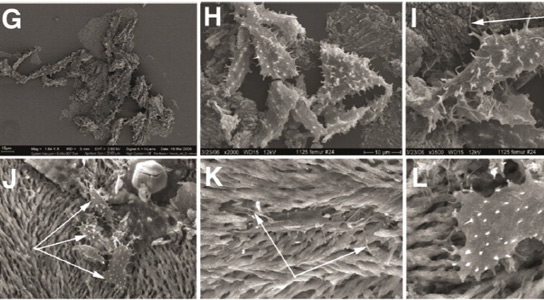
    G: Under SEM, a mass of cells from MOR 1125 is seen to be closely associated with demineralized matrix. H: Higher magnification shows that all cells have remnants of filipodia, and demonstrate wide variation in shape. I: Single osteocyte from T.rex showing elongate morphology and longer filipodia in some areas of the cell (arrows). J: Three clustered osteocytes (arrows) on fibrous matrix of MOR 2958. K: Single osteocyte within lacunae of fibrous matrix. Filipodia can be seen entwining with fibrous matrix (arrows). L: Large osteocyte and matrix. Image: Schweitzer et al.

    20 years ago, Mary Schweitzer discovered that she spotted the effects of what could only be described as a red blood cell in a slice of dinosaur bone. This seemed impossible, since organic remains weren’t supposed to be able to survive the fossilization process. Numerous tests indicated that the spherical structures were blood cells from a 67-million-year-old Tyrannosaurus rex.

    In the following years, Schweitzer and her colleagues discovered more soft tissues, which could be either blood vessels or feather fibers. However, skeptics have been arguing that the organic tissues were simply microbes that had invaded the fossilized bone.
    more-reactants-dinosaur
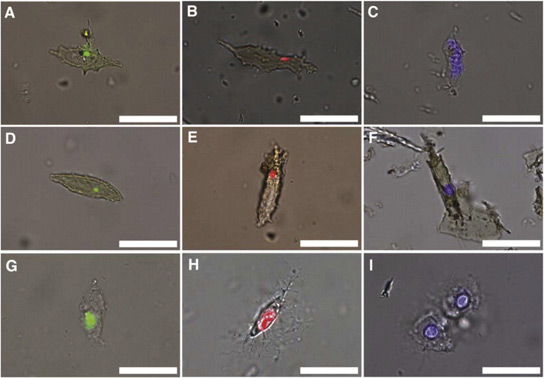
    A: T.rex; D, B. canadensis; G: Ostrich cells showing small localized region of binding of anti-DNA antibodies interior to the cell membrane. Reactivity of antibodies to ostrich cells is enhanced, consistent with the presence of a greater quantity of immunoreactive material in these extant cells. B: Trex; E: B. canadensis; and H, ostrich osteocytes showing positive response to propidium iodide (PI), a DNA intercalating dye, to a similar small region of material internal to cell. C: T.rex; F: B. canadensis; and I, ostrich cellular response to 4′,6′-diamidino-2-phenylindole dihydrochloride (DAPI), another DNA-specific stain.

    Schweitzer and her colleagues have continued to amass support and the latest evidence comes from a molecular analysis of osteocytes from T. rex and Brachylophosaurus canadensis. The cells were isolated and when exposed to an antibody that targets a protein, the cells reacted as expected. And when the dinosaur cells were subjected to more tests involving other antibodies that target DNA, the antibodies bound to material in small, specific regions inside the apparent cell membrane.

    Mass spectrometry uncovered amino acid sequences of proteins in the extracts of dinosaur bones that matched the sequences from actin, tubulin and histone4 that are present in the cells of all animals. Some microbes have similar proteins, but tests showed that soil-derived E. coli as well as sediments surrounding the two dinosaur specimens failed to bind actin and tubulin antibodies, which bound to the extract containing the osteocytes. Schweitzer and her collaborators published their findings in the journal Bone and also presented them in Raleigh, at the annual meeting of the Society of Vertebrate Paleontology.

    Reference: “Molecular analyses of dinosaur osteocytes support the presence of endogenous molecules” by Mary Higby Schweitzer, Wenxia Zheng, Timothy P. Cleland and Marshall Bern, 16 October 2012, Bone.
    DOI: 10.1016/j.bone.2012.10.010

    Never miss a breakthrough: Join the SciTechDaily newsletter.
    Follow us on Google and Google News.

    Blood Cells Dinosaurs Genetics Paleontology
    Share. Facebook Twitter Pinterest LinkedIn Email Reddit

    Related Articles

    Scientists Discover New Species of Horned Dinosaur – Mercuriceratops Gemini

    Paleontologists Announce the Discovery of Bird-Like Dinosaur Anzu Wyliei

    Discovery of ‘Bird-Dinosaur’ Eosinopteryx Challenges Bird Evolution Theory

    Geneticists Grow Fish with Limbs to Duplicate Evolutionary Pressure

    Nyasasaurus, Oldest Dinosaur Believed to Be 243 Million Years Old

    Researchers Calculate That DNA Has a 521 Year Half-Life

    Pegomastax Africanus, A Miniature Dinosaur That Thrived in Southern Africa

    Evidence Shows that Birds are Essentially Living Dinosaurs

    Pikaia Gracilens Revealed as Possible Genetic Ancestors to All Vertebrates

    1 Comment

    1. Madanagopal.V.C. on October 22, 2012 1:19 pm

      A good work indeed to rule out the microbial impregnation of the fossils of Dinosaurs that existed some 67 million years ago. Mass spectrometry had established that they are common amino acids found in other animals of the day. The progress in the “stone dyes” made by dinosaurs through fossils has gone from identifying bones and going until identifying their endogenous tissues.Thank YOu.

      Reply
    Leave A Reply Cancel Reply

    • Facebook
    • Twitter
    • Pinterest
    • YouTube

    Don't Miss a Discovery

    Subscribe for the Latest in Science & Tech!

    Trending News

    Millions of People Have Osteopenia Without Realizing It – Here’s What You Need To Know

    Researchers Discover Boosting a Single Protein Helps the Brain Fight Alzheimer’s

    World-First Study Reveals Human Hearts Can Regenerate After a Heart Attack

    Why Your Dreams Feel So Real Sometimes and So Strange Other Times

    This Simple Home Device May Boost Brain Power in Adults Over 40

    Enormous Prehistoric Insects Puzzle Scientists

    Scientists Develop Bioengineered Chewing Gum That Could Help Fight Oral Cancer

    After 37 Years, the World’s Longest-Running Soil Warming Experiment Uncovers a Startling Climate Secret

    Follow SciTechDaily
    • Facebook
    • Twitter
    • YouTube
    • Pinterest
    • Newsletter
    • RSS
    SciTech News
    • Biology News
    • Chemistry News
    • Earth News
    • Health News
    • Physics News
    • Science News
    • Space News
    • Technology News
    Recent Posts
    • After 100 Years, Scientists Uncover Hidden Rule Governing Cosmic Rays
    • The Milky Way Has a Hidden Edge and Scientists Finally Mapped It
    • Scientists Stunned by New Organic Molecules Found on Mars
    • Scientists Discover Evolution’s 120-Million-Year-Old “Cheat Sheet”
    • This New “Sound Laser” Could Measure Gravity With Stunning Precision
    Copyright © 1998 - 2026 SciTechDaily. All Rights Reserved.
    • Science News
    • About
    • Contact
    • Editorial Board
    • Privacy Policy
    • Terms of Use

    Type above and press Enter to search. Press Esc to cancel.