
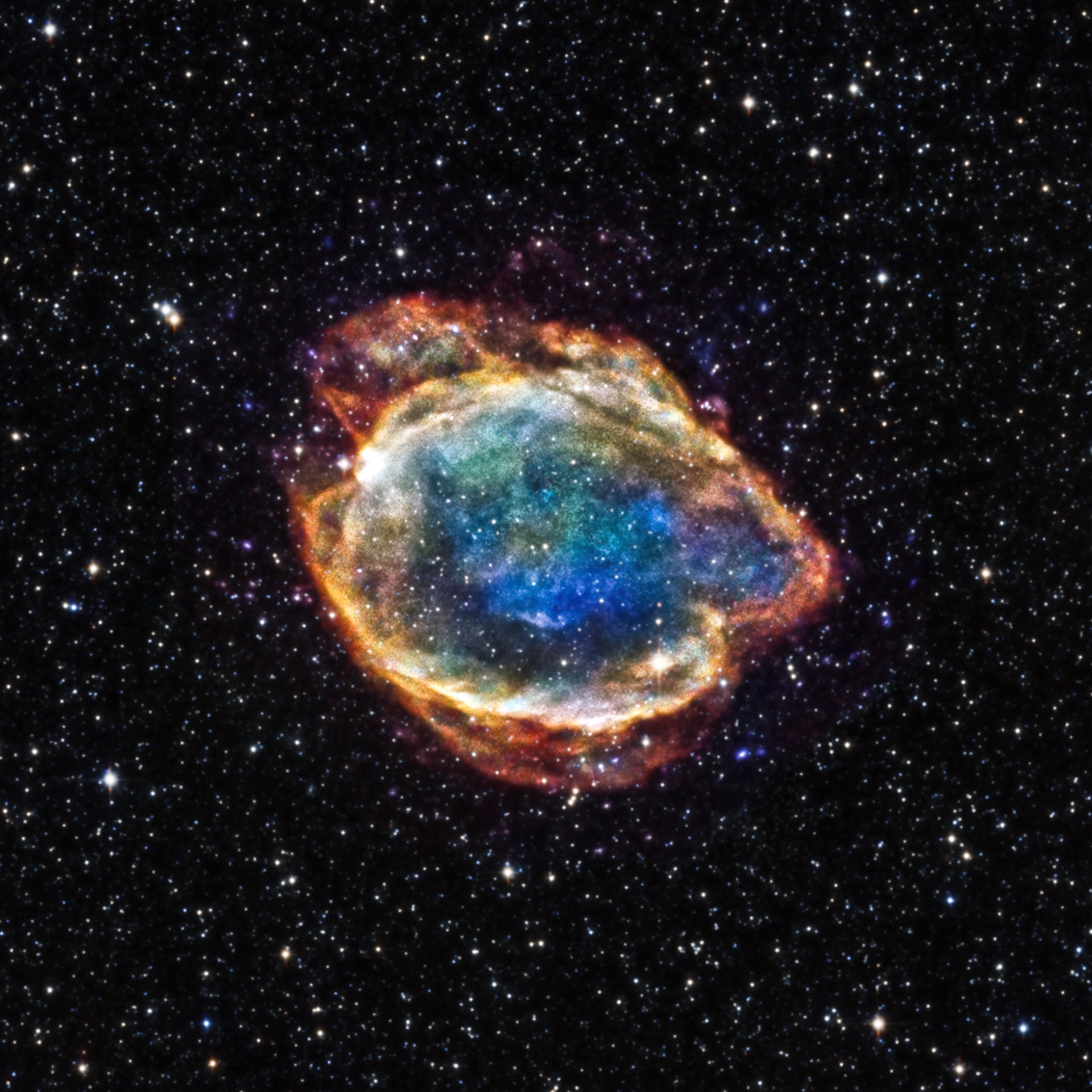
This new image from NASA’s Chandra X-ray Observatory shows supernova remnant G299.2-2.9.
Because the debris fields of exploded stars, known as supernova remnants, are very hot, energetic, and glow brightly in X-ray light, NASA’s Chandra X-ray Observatory has proven to be a valuable tool in studying them. The supernova remnant called G299.2-2.9 (or G299 for short) is located within our Milky Way galaxy, but Chandra’s new image of it is reminiscent of a beautiful flower here on Earth.
G299 was left over by a particular class of supernovas called Type Ia. Astronomers think that a Type Ia supernova is a thermonuclear explosion – involving the fusion of elements and release of vast amounts of energy − of a white dwarf star in a tight orbit with a companion star. If the white dwarf’s partner is a typical, Sun-like star, the white dwarf can become unstable and explode as it draws material from its companion. Alternatively, the white dwarf is in orbit with another white dwarf, the two may merge and can trigger an explosion.
Regardless of their triggering mechanism, Type Ia supernovas have long been known to be uniform in their extreme brightness, usually outshining the entire galaxy where they are found. This is important because scientists use these objects as cosmic mileposts, allowing them to accurately measure the distances of galaxies billions of light years away, and to determine the rate of expansion of the Universe.
Traditional theoretical models of Type Ia supernovas generally predict that these explosions would be symmetric, creating a near-perfect sphere as they expand. These models have been supported by results showing that remnants of Type Ia supernovas are more symmetric than remnants of supernovas involving the collapse of massive stars.
However, astronomers are discovering that some Type Ia supernova explosions may not be as symmetric as previously thought. G299 could be an example of such an “unusual” Type Ia supernova. Using a long observation from Chandra, researchers discovered the shell of debris from the exploded star is expanding differently in various directions.
In this new Chandra image, red, green, and blue represent low, medium, and high-energy X-rays, respectively, detected by the telescope. The medium-energy X-rays include emission from iron and the hard-energy X-rays include emission from silicon and sulfur. The X-ray data have been combined with infrared data from a ground-based 2MASS survey that shows the stars in the field of view.
By performing a detailed analysis of the X-rays, researchers found several clear examples of asymmetry in G299. For example, the ratio between the amounts of iron and silicon in the part of the remnant just above the center is larger than in the part of the remnant just below the center. This difference can be seen in the greener color of the upper region compared to the bluer color of the lower region. Also, there is a strongly elongated portion of the remnant extending to the right. In this region, the relative amount of iron to silicon is similar to that found in the southern region of the remnant.
The patterns seen in the Chandra data suggest that a very lopsided explosion may have produced this Type Ia supernova. It might also be that the remnant has been expanding into an environment where the medium it encountered was uneven. Regardless of the ultimate explanation, observations of G299 and others like it are showing astronomers just how varied such beautiful cosmic flowers can be.
A paper describing these results was published in The Astrophysical Journal.
Reference: “Asymmetry in The Observed Metal-Rich Ejecta of Galactic Type Ia Supernova Remnant G299.2-2.9” by Seth Post, Sangwook Park, Carles Badenes, David N. Burrows, John P. Hughes, Jae-Joon Lee, Koji Mori and Patrick O. Slane, 20 August 2014, The Astrophysical Journal.
DOI: 10.1088/2041-8205/792/1/L20
The authors are Seth Post and Sangwook Park from the University of Texas at Arlington in Texas; Carles Badenes from the University of Pittsburgh, in Pittsburgh, Pennsylvania; David Burrows from Pennsylvania State University in University Park, Pennsylvania; John Hughes from Rutgers University in Piscataway, New Jersey; Jae-Joon Lee from the Korea Astronomy and Space Science Institute; Koji Mori from the University of Miyazaki in Japan and Patrick Slane from the Harvard-Smithsonian Center of Astrophysics in Cambridge, Massachusetts.
NASA’s Marshall Space Flight Center in Huntsville, Alabama, manages the Chandra program for NASA’s Science Mission Directorate in Washington. The Smithsonian Astrophysical Observatory in Cambridge, Massachusetts, controls Chandra’s science and flight operations.
Never miss a breakthrough: Join the SciTechDaily newsletter.
Follow us on Google and Google News.