
Close Menu
    Facebook X (Twitter) Instagram
    SciTechDaily
    • Biology
    • Chemistry
    • Earth
    • Health
    • Physics
    • Science
    • Space
    • Technology
    Facebook X (Twitter) Pinterest YouTube RSS
    SciTechDaily
    Home»Space»Philae Lander Makes Soft Landing on Comet 67P
    Space

    Philae Lander Makes Soft Landing on Comet 67P

    By NASANovember 12, 2014No Comments3 Mins Read
    Facebook Twitter Pinterest Telegram LinkedIn WhatsApp Email Reddit
    Share
    Facebook Twitter LinkedIn Pinterest Telegram Email Reddit
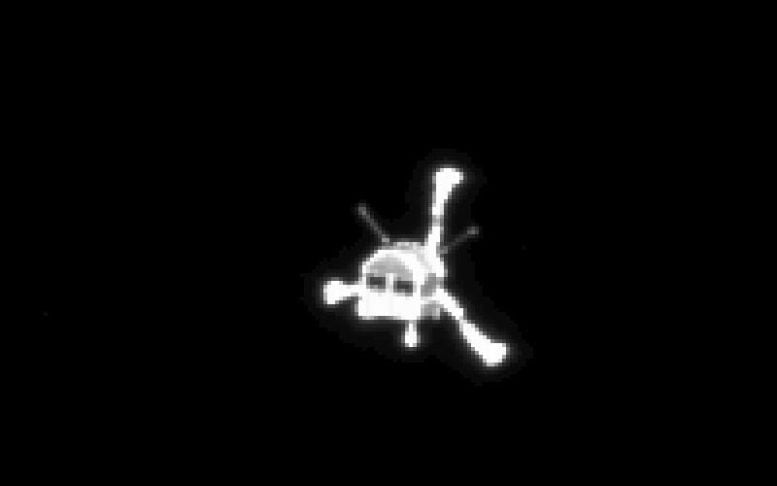
    Philae Lander After Separation
    The Onboard Scientific Imaging System (OSIRIS) on the European Space Agency’s Rosetta spacecraft captured this parting shot of the mission’s Philae lander after its separation from the mother ship on November 12, 2014. The image was taken with the OSIRIS narrow-angle camera. Credit: ESA/Rosetta/OSIRIS/MPS/UPD/LAM/IAA/SSO/INTA/UPM/DASP/IDA

    The European Space Agency has confirmed that the Philae lander has successfully reached the surface of comet 67P/Churyumov-Gerasimenko. This is the first time in history that a spacecraft has made a soft landing on a comet.

    The Onboard Scientific Imaging System (OSIRIS) on the European Space Agency’s Rosetta spacecraft captured this parting shot of the mission’s Philae lander after its separation from the mother ship on November 12, 2014. The image was taken with the OSIRIS narrow-angle camera.

    Rosetta and Philae had been riding through space together for more than 10 years. Philae is the first probe to achieve soft landing on a comet, and Rosetta is the first to rendezvous with a comet and follow it around the sun. The information collected by Philae at one location on the surface will complement that collected by the Rosetta orbiter for the entire comet.

    Rosetta is a European Space Agency (ESA) mission with contributions from its member states and NASA. Rosetta’s Philae lander is provided by a consortium led by the German Aerospace Center, Cologne; Max Planck Institute for Solar System Research, Gottingen; French National Space Agency, Paris; and the Italian Space Agency, Rome. NASA’s Jet Propulsion Laboratory (JPL), a division of the California Institute of Technology, Pasadena, manages the U.S. participation in the Rosetta mission for NASA’s Science Mission Directorate in Washington. Rosetta carries three NASA instruments in its 21-instrument payload.

    OSIRIS was built by a consortium led by the Max Planck Institute for Solar System Research, Gottigen, Germany, in collaboration with the Center for Studies and Activities in Space, University of Padua, Italy; the Astrophysics Laboratory, Marseille, France; the Institute of Astrophysics of Andalucia, Spain; the Scientific Support Office of the European Space Agency, The Netherlands; the National Institute for Aerospace Technology, Torrejon de Ardoz, Spain; the Technical University of Madrid, Spain; the Department of Physics and Astronomy of Uppsala University, Sweden; and the Institute of Computer and Network Engineering of the Technical University, Braunschweig, Germany. OSIRIS was financially supported by the national funding agencies of the German Space Agency, Cologne, Germany; National Center for Space Studies, Paris, France; Italian Space Agency, Rome; Ministry of Education and Science, Madrid, Spain; the Swedish National Space Board, Solna, Sweden; and the European Space Agency Technical Directorate, Paris, France.

    Never miss a breakthrough: Join the SciTechDaily newsletter.
    Follow us on Google and Google News.

    Astronomy Comet European Space Agency Rosetta Spacecraft
    Share. Facebook Twitter Pinterest LinkedIn Email Reddit

    Related Articles

    Rosetta Views Comet 67P Making Its Closest Approach to the Sun

    Rosetta Spacecraft Views an Outburst from Comet 67P

    Rosetta Monitors Active Pits on Comet 67P

    Rosetta and Philae Reveal That Comet 67P is Not Magnetized

    Philae Lander Makes Historic First Landing on Comet 67P

    Rosetta Spacecraft Picks Up a Mysterious “Song” From Comet 67P

    How to Land on a Comet Moving 40 Times Faster Than a Speeding Bullet

    Rosetta Orbiter Delivers First Batch of Science Data

    ESA Identifies Five Candidate Landing Sites on Comet 67P

    Leave A Reply Cancel Reply

    • Facebook
    • Twitter
    • Pinterest
    • YouTube

    Don't Miss a Discovery

    Subscribe for the Latest in Science & Tech!

    Trending News

    Why Popular Diabetes Drugs Like Ozempic Don’t Work for Everyone: The “Genetic Glitch”

    Scientists Stunned After Finding Plant Thought Extinct for 60 Years

    Scientists Discover Tiny New Spider That Hunts Prey 6x Its Size

    Natural Component From Licorice Shows Promise for Treating Inflammatory Bowel Disease

    Scientists Warn: Popular Sweetener Linked to Dangerous Metabolic Effects

    Monster Storms on Jupiter Unleash Lightning Beyond Anything on Earth

    Scientists Create “Liquid Gears” That Spin Without Touching

    The Simple Habit That Could Help Prevent Cancer

    Follow SciTechDaily
    • Facebook
    • Twitter
    • YouTube
    • Pinterest
    • Newsletter
    • RSS
    SciTech News
    • Biology News
    • Chemistry News
    • Earth News
    • Health News
    • Physics News
    • Science News
    • Space News
    • Technology News
    Recent Posts
    • Ancient Bacteria Turned a DNA System Into a Cell Skeleton
    • Researchers Finally Solve 50-Year-Old Blood Group Mystery
    • Scientists Discover “Molecular Switch” That Fuels Alzheimer’s Brain Inflammation
    • Hidden Ocean Currents Revealed in Stunning Detail by AI
    • Trees Emit Tiny Lightning Flashes During Storms and Scientists Finally Prove It
    Copyright © 1998 - 2026 SciTechDaily. All Rights Reserved.
    • Science News
    • About
    • Contact
    • Editorial Board
    • Privacy Policy
    • Terms of Use

    Type above and press Enter to search. Press Esc to cancel.