
Close Menu
    Facebook X (Twitter) Instagram
    SciTechDaily
    • Biology
    • Chemistry
    • Earth
    • Health
    • Physics
    • Science
    • Space
    • Technology
    Facebook X (Twitter) Pinterest YouTube RSS
    SciTechDaily
    Home»Biology»Stem Cells Regenerate Tissue in an Uninjured Mammal
    Biology

    Stem Cells Regenerate Tissue in an Uninjured Mammal

    By Bill Hathaway, Yale UniversityJuly 2, 2012No Comments3 Mins Read
    Facebook Twitter Pinterest Telegram LinkedIn WhatsApp Email Reddit
    Share
    Facebook Twitter LinkedIn Pinterest Telegram Email Reddit
    Mouse Cells Hair Follicles
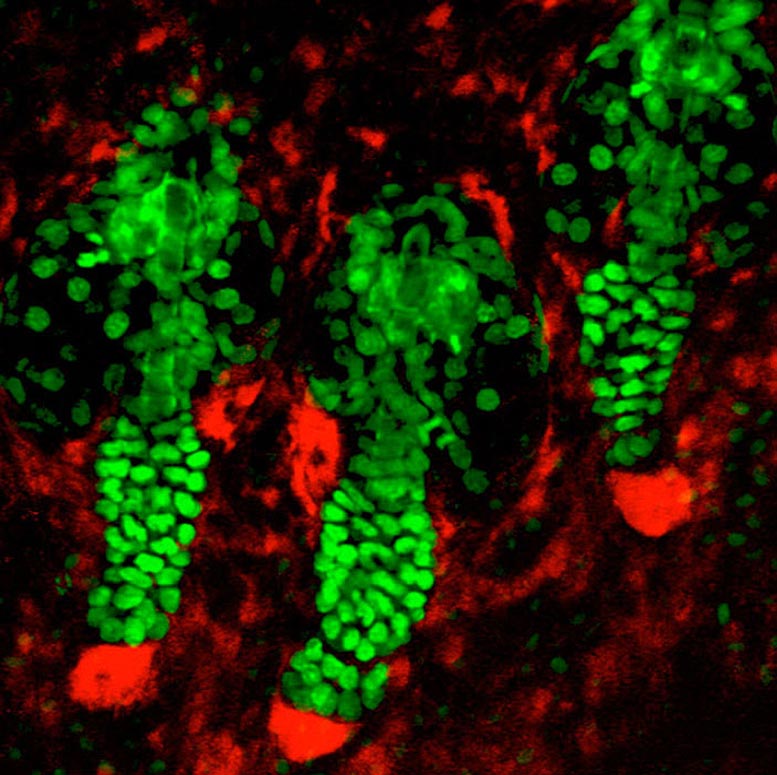
    Yale researchers captured these images of hair follicles of a mouse, with nuclei of epithelial cells stained in green and mesenchymal cells, which are active in early development, in red. Yale scientists found that mesenchymal cells were crucial to hair growth. Credit: Image courtesy of Dr. Pantelis Rompolas, Greco Lab, Yale School of Medicine

    Using 2-photon intravital microscopy and focusing on the stem cell behavior in the hair follicle of a mouse, researchers at Yale were able to study the interaction between stem cells and their progeny, watching as stem cells regenerate tissue in real-time.

    Scientists have for the first time watched and manipulated stem cells as they regenerate tissue in an uninjured mammal, Yale researchers report July 1 online in the journal Nature.

    Using a sophisticated imaging technique, the researchers also demonstrated that mice lacking a certain type of cell do not regrow hair. The same technique could shed light on how stem cells interact with other cells and trigger repairs in a variety of other organs, including lung and heart tissue.

    “This tells us a lot about how the tissue regeneration process works,” said Valentina Greco, assistant professor of genetics and of dermatology at the Yale Stem Cell Center, a researcher for the Yale Cancer Center and senior author of the study.

    Greco and her team focused on stem cell behavior in the hair follicle of the mouse. The accessibility of the hair follicle allowed real-time and non-invasive imaging through a technology called 2-photon intravital microscopy.

    Using this method, Panteleimon Rompolas, a post-doctoral fellow in Greco’s lab and lead author of this paper, was able to study the interaction between stem cells and their progeny, which produce all the different types of cells in the tissue. The interaction of these cells with the immediate environment determines how cells divide, where they migrate, and which specialized cells they become.

    The technology allowed the team to discover that hair growth in mice cannot take place in the absence of connective tissue called mesenchyme, which appears early in embryonic development.

    Stem cells not only spur the growth of hair in mammals including humans, but also can serve to regenerate many other types of tissues.

    “Understanding how stem cell behavior is regulated by the microenvironment can advance our use of stem cells for therapeutic purposes and uncover mechanisms that go wrong in cancer and other diseases,” Greco said.

    Reference: “Live imaging of stem cell and progeny behaviour in physiological hair-follicle regeneration” by Panteleimon Rompolas, Elizabeth R. Deschene, Giovanni Zito, David G. Gonzalez, Ichiko Saotome, Ann M. Haberman and Valentina Greco, 1 July 2012, Nature.
    DOI: 10.1038/nature11218

    The study was funded by an Alexander Brown Coxe postdoctoral fellowship. This work was supported in part by the American Skin Association and the American Cancer Society and the Yale Rheumatologic Disease Research Core Center and the National Institutes of Health.

    Other Yale authors include Elizabeth Deschene, Giovanni Zito, David G. Gonzalez, Ichiko Saotome, and Ann M. Haberman.

    Never miss a breakthrough: Join the SciTechDaily newsletter.
    Follow us on Google and Google News.

    Disease Genetics Stem Cells Tissue Yale University
    Share. Facebook Twitter Pinterest LinkedIn Email Reddit

    Related Articles

    DNA2 Molecule Helps Repair Chromosome Rearrangements Linked to Cancer

    New Yale Study Points to a Possible Treatment for a Rare Vascular Disease

    Yale Scientists Recode Organisms to Resist Viral Contamination

    CCNE1 Gene Turns Back Cellular Clock

    Study Reveals Non-Inherited Mutations Account for Many Heart Defects

    piRNAs Key Role in Coordinating Biological Activity

    Study Shows that Genetics Play an Important Role in Anti-Tobacco Policies

    Disabling MicroRNAs Allows Mice to Regenerate White Cells and Platelets Depleted by Chemotherapy

    Physical Properties of Stem Cells Predict What They Will Become

    Leave A Reply Cancel Reply

    • Facebook
    • Twitter
    • Pinterest
    • YouTube

    Don't Miss a Discovery

    Subscribe for the Latest in Science & Tech!

    Trending News

    Researchers Have Found a Dietary Compound That Increases Longevity

    Scientists Baffled by Bizarre “Living Fossil” From 275 Million Years Ago

    Your IQ at 23 Could Predict Your Wealth at 27, Study Finds

    320 Light-Years Away, a Planet Confirms a Fundamental Cosmic Assumption

    The Crown Jewel of Dentistry? Breakthrough Tech Could Transform Tooth Repair

    Python Blood Could Hold the Secret to Weight Loss Without Side Effects

    Naturally Occurring Bacteria Completely Eradicate Tumors in Mice With a Single Dose

    New “Nanozyme Hypothesis” Could Rewrite the Story of Life’s Origins

    Follow SciTechDaily
    • Facebook
    • Twitter
    • YouTube
    • Pinterest
    • Newsletter
    • RSS
    SciTech News
    • Biology News
    • Chemistry News
    • Earth News
    • Health News
    • Physics News
    • Science News
    • Space News
    • Technology News
    Recent Posts
    • Scientists Uncover Hidden Clues to the Origin of the Genetic Code
    • Scientists Discover Unexpected Role of Alzheimer’s Protein in Cell Division
    • Scientists Uncover Brain Changes That Link Pain to Depression
    • A New Chapter in Chemistry? Scientists Uncover New Way Metals Bind Oxygen
    • New Study Reveals Earth Is Getting Brighter at Night – About 2% Each Year
    Copyright © 1998 - 2026 SciTechDaily. All Rights Reserved.
    • Science News
    • About
    • Contact
    • Editorial Board
    • Privacy Policy
    • Terms of Use

    Type above and press Enter to search. Press Esc to cancel.