
Newly uncovered wooden tools from Pleistocene China reveal complex, plant-focused technology far earlier than expected in East Asia.
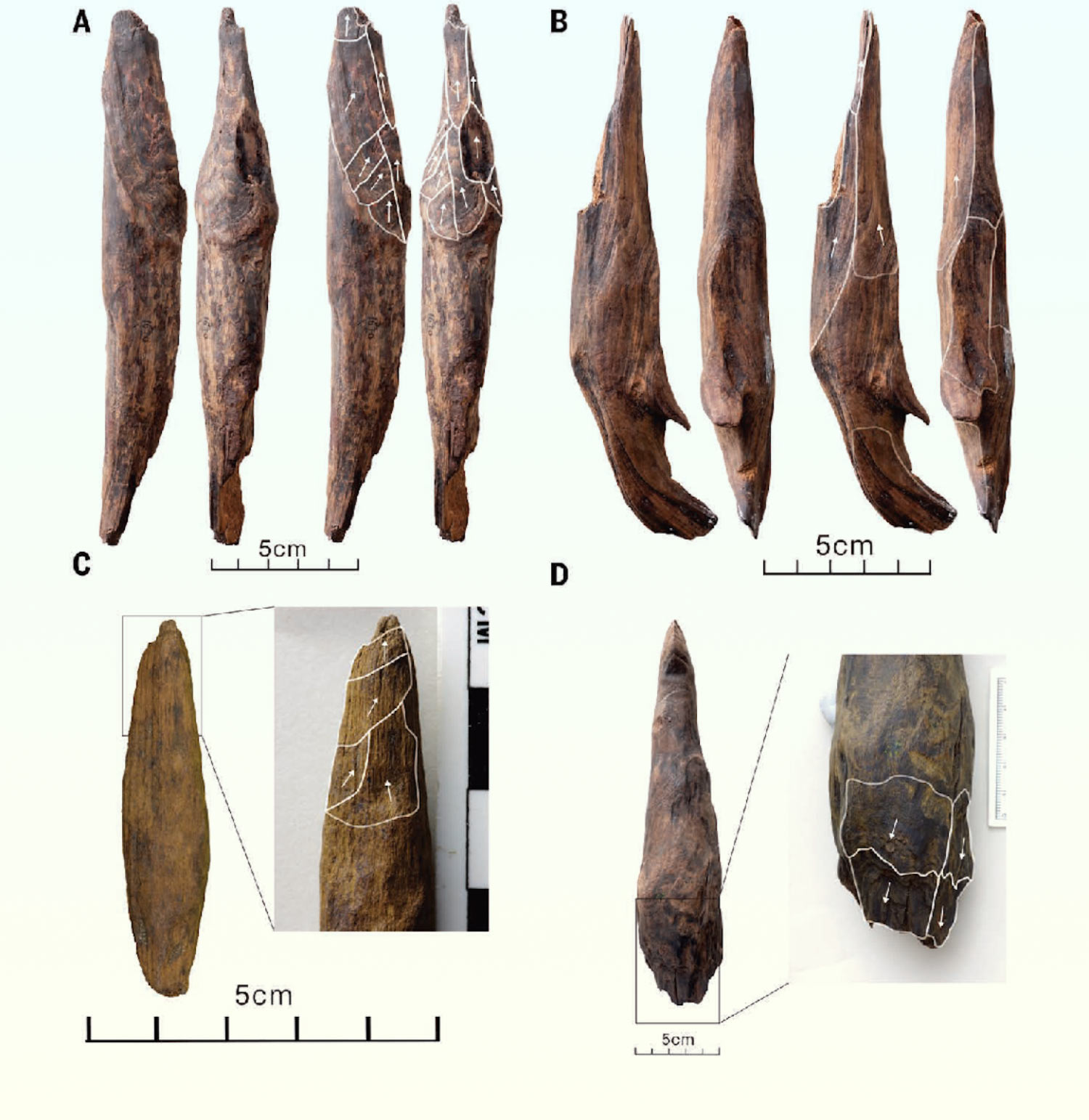
Researchers working at the Pleistocene-era Gantangqing site in southwestern China have uncovered a diverse set of wooden tools dating from approximately 361,000 to 250,000 years ago. This discovery represents the oldest known example of advanced wooden tool technology in East Asia. Analysis of the tools suggests they were not created for hunting but were instead designed for tasks like digging and processing plants, offering new insight into the daily lives of early humans in the region.
While it is well established that early humans have been crafting wooden tools for more than a million years, such artifacts are rarely preserved, especially from the Early and Middle Pleistocene. Most of the wooden tools previously recovered come from archaeological sites in Africa and western Eurasia. Some of the most significant finds include spears and throwing sticks unearthed in Germany and the United Kingdom, which date back between 300,000 and 400,000 years. Other important examples include wooden construction elements from Zambia and tools like digging sticks and planks found at sites in Israel and Italy.
While the long-standing Bamboo Hypothesis argues that early East Asian populations relied on bamboo for toolmaking, archaeological evidence for organic material-based tools from the region is scarce.
The Gantangqing Discovery: A Technological Milestone
Here, Jian-Hui Liu and colleagues present new findings from the Gantangqing site in southwestern China, which has yielded a wide range of artifacts. Among these are 35 wooden artifacts that exhibit clear evidence of intentional shaping and use, including signs of carving, smoothing, and wear, suggesting that they were purposefully crafted by hominins.
These tools, most of which were fashioned from pine, range from large two-handed digging sticks to smaller hand-held implements, and even include hook-like tools potentially used for cutting plant roots. According to Liu et al., compared to other well-known contemporaneous wooden tool sites in Europe, which are generally characterized by medium-sized hunting gear, Gantangqing stands out for its broader and more diverse array of small, hand-held tools designed primarily for digging up and processing plants.
The sophistication of these wooden tools underscores the importance of organic artifacts in interpreting early human behavior, particularly in regions where stone tools alone suggest a more “primitive” technological landscape, say the authors.
Reference: “300,000-year-old wooden tools from Gantangqing, southwest China” by Jian-Hui Liu, Qi-Jun Ruan, Jun-Yi Ge, Yong-Jiang Huang, Xiao-Ling Zhang, Jia Liu, Shu-Feng Li, Hui Shen, Yuan Wang, Thomas A. Stidham, Cheng-Long Deng, Sheng-Hua Li, Fei Han, Ying-Shuai Jin, Kieran O’Gorman, Bo Li, Robin Dennell and Xing Gao, 3 July 2025, Science.
DOI: 10.1126/science.adr8540
Never miss a breakthrough: Join the SciTechDaily newsletter.
Follow us on Google and Google News.
2 Comments
“include wooden construction elements”
I gather these were dated at 476 000years BP. And that is a sure indication that non- H saps had the wit to build things, which wit could no doubt build dug-out canoes to tour such places as Indonesia, PNG and Australia. And if one can build one dugout canoe, one could learn from rafting up such canoes during a communal fishing trip that catamaran-style dug-out canoes are more stable on the High Seas.
So H erectus, where are your bones in former balmy green Australia?
There has been some proof of your speculation already, but to my knowledge no bodies yet. If you think about it, unless traveling alone humans (proto or modern) are unlikely to leave their dead behind, or in obvious locations, making this far harder.