
Close Menu
    Facebook X (Twitter) Instagram
    SciTechDaily
    • Biology
    • Chemistry
    • Earth
    • Health
    • Physics
    • Science
    • Space
    • Technology
    Facebook X (Twitter) Pinterest YouTube RSS
    SciTechDaily
    Home»Earth»Scientists Discover Mysterious Leftovers of Earth’s Dramatic Formation
    Earth

    Scientists Discover Mysterious Leftovers of Earth’s Dramatic Formation

    By Australian National UniversityFebruary 18, 20222 Comments3 Mins Read
    Facebook Twitter Pinterest Telegram LinkedIn WhatsApp Email Reddit
    Share
    Facebook Twitter LinkedIn Pinterest Telegram Email Reddit
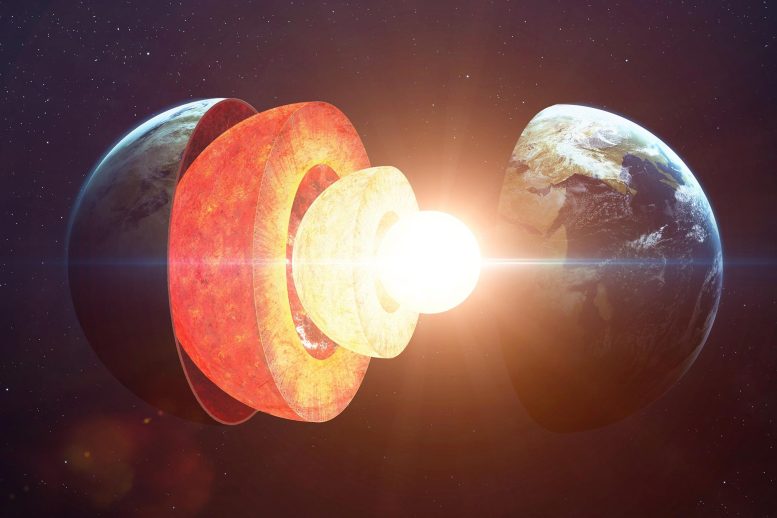
    Earth Core Structure
    Ultra-Low Velocity Zones sit between the Earth’s outer core and lower mantle.

    Ultra-Low Velocity Zones (ULVZs) beneath Earth’s mantle are remnants of ancient magma, composed of diverse materials that have remained unchanged for billions of years.

    Researchers have uncovered the most detailed view ever of the mysterious structures lying between the Earth’s mantle and core, providing the strongest evidence yet that they began as an ocean of molten magma that eventually sank.

    “For a long time no-one really knew for sure what these mysterious ULVZs were made up of.”

    The team of international researchers, including scientists from The Australian National University (ANU), used thousands of computer-modeled seismic waves to examine Ultra-Low Velocity Zones (ULVZs) beneath the Coral Sea between Australia and New Zealand. The area was selected because of the high frequency of earthquakes and the seismic waves these events unleash.

    Ancient Magma Remnants in ULVZs

    ULVZs sit at the bottom of the planet’s mantle and on top of its liquid metal outer core, and are so thin that they are normally invisible to tomographic imaging. For decades, scientists have speculated they are leftovers of the violent processes that shaped the early Earth.

    Study co-author, Professor Hrvoje Tkalčić from ANU, said the team’s findings confirm the chemicals, rocks, and layers that make up ULVZs have largely been sitting unchanged for billions of years and the early days of the planet’s formation.

    “For a long time no-one really knew for sure what these mysterious ULVZs were made up of. Now, we’ve developed the clearest picture yet. Using advances in seismology and mathematical geophysics made at ANU we’ve shown that ULVZs are made up of layers,” Professor Tkalčić said.

    “Over billions years of the Earth’s shaping and reshaping, these zones have churned close to the planet’s core but largely remained intact.

    “It’s like an egg in a cake that doesn’t get mixed in with the rest of the ingredients but stays as yoke and egg white, despite the constant mixing all around it.

    “This is a really significant breakthrough as we have unlocked not only a clue as to how the early Earth formed but confirmed ULVZs are clumps of leftovers from this process that are pretty much the same as they were billions of years ago.”

    The study, published in Nature Geoscience, was led by Dr. Surya Pachhai from the University of Utah, with much of the research completed as part of his PhD at ANU.

    Diverse Composition of ULVZs

    According to Dr. Pachhai the most surprising finding in the study is that ULVZs are made up of a lot more diverse materials than first thought.

    “ULVZs are not homogenous but contain strong structural and compositional variations within them,” he said.

    “We found that this type of ULVZs can be explained by chemical heterogeneities created at the very beginning of the Earth’s history and that they are still not well mixed after 4.5 billion years of mantle convection.”

    For more on this research, see Possible Chemical Leftovers From Early Earth Sit Near the Planet’s Core.

    Reference: “Internal structure of ultralow-velocity zones consistent with origin from a basal magma ocean” by Surya Pachhai, Mingming Li, Michael S. Thorne, Jan Dettmer and Hrvoje Tkalčić, 30 December 2021, Nature Geoscience.
    DOI: 10.1038/s41561-021-00871-5

    Never miss a breakthrough: Join the SciTechDaily newsletter.
    Follow us on Google and Google News.

    Australian National University Geophysics Geoscience Seismology
    Share. Facebook Twitter Pinterest LinkedIn Email Reddit

    Related Articles

    Scientists Say a Hidden Structure May Exist Inside Earth’s Core

    The Biggest Volcanic Event in Earth’s History Transformed an Entire Oceanic Plate

    Mysterious Structures Discovered Beneath Earth May Explain Why Our Planet Supports Life

    This Mineral Could Hold the Key to Earth’s Hidden Ocean

    Unusual Seismic Signals Are Rippling Through Earth’s Core, Revealing Planetary Secrets

    Researchers Uncover Mysterious Structural Changes in Earth’s Inner Core

    Scientists Uncover Mysterious Doughnut Structure in Earth’s Outer Core

    Quake-Ception – Groundbreaking Earthquake Discovery: Risk Models Overlook an Important Element

    Earthquake Doublets Reveal Changing Speed of the Earth’s Inner Core

    2 Comments

    1. The 10th Man on February 18, 2022 7:26 pm

      Go to a smelter sometime. Your looking at slag.

      Reply
    2. John Dang on February 20, 2022 8:44 am

      Slag? Yes, sounds about right. Slag: the non-biological equivalent of “scum” thus making this slag the original “scum of the earth”.

      Reply
    Leave A Reply Cancel Reply

    • Facebook
    • Twitter
    • Pinterest
    • YouTube

    Don't Miss a Discovery

    Subscribe for the Latest in Science & Tech!

    Trending News

    Mezcal “Worm” in a Bottle Mystery: DNA Testing Reveals a Surprise

    New Research Reveals That Your Morning Coffee Activates an Ancient Longevity Switch

    This Is What Makes You Irresistible to Mosquitoes

    Shockingly Powerful Giant Octopuses Ruled the Seas 100 Million Years Ago

    Scientists Stunned by New Organic Molecules Found on Mars

    Rewriting Dinosaur Evolution: Scientists Unearth Remarkable 150-Million-Year-Old Stegosaur Skull

    Omega-3 Supplements Linked to Cognitive Decline in Surprising New Study

    First-of-Its-Kind Discovery: Homer’s Iliad Found Embedded in a 1,600-Year-Old Egyptian Mummy

    Follow SciTechDaily
    • Facebook
    • Twitter
    • YouTube
    • Pinterest
    • Newsletter
    • RSS
    SciTech News
    • Biology News
    • Chemistry News
    • Earth News
    • Health News
    • Physics News
    • Science News
    • Space News
    • Technology News
    Recent Posts
    • New Research Challenges Long-Held Beliefs About How the Brain Makes Decisions
    • Breakthrough Technology Reveals New Treatment Targets for Cancer
    • Scientists Discover New Way To Make Drug-Resistant Cancer Treatable Again
    • This Simple Exercise Trick Builds Muscle With Less Effort, Study Finds
    • Middle Age Is Becoming a Breaking Point in America, Study Reveals
    Copyright © 1998 - 2026 SciTechDaily. All Rights Reserved.
    • Science News
    • About
    • Contact
    • Editorial Board
    • Privacy Policy
    • Terms of Use

    Type above and press Enter to search. Press Esc to cancel.