
Close Menu
    Facebook X (Twitter) Instagram
    SciTechDaily
    • Biology
    • Chemistry
    • Earth
    • Health
    • Physics
    • Science
    • Space
    • Technology
    Facebook X (Twitter) Pinterest YouTube RSS
    SciTechDaily
    Home»Health»Not Just One Type – Identifying Cancer Genes’ Multiple Personalities
    Health

    Not Just One Type – Identifying Cancer Genes’ Multiple Personalities

    By Cold Spring Harbor LaboratoryApril 22, 2023No Comments4 Mins Read
    Facebook Twitter Pinterest Telegram LinkedIn WhatsApp Email Reddit
    Share
    Facebook Twitter LinkedIn Pinterest Telegram Email Reddit
    Mouse Liver Cells
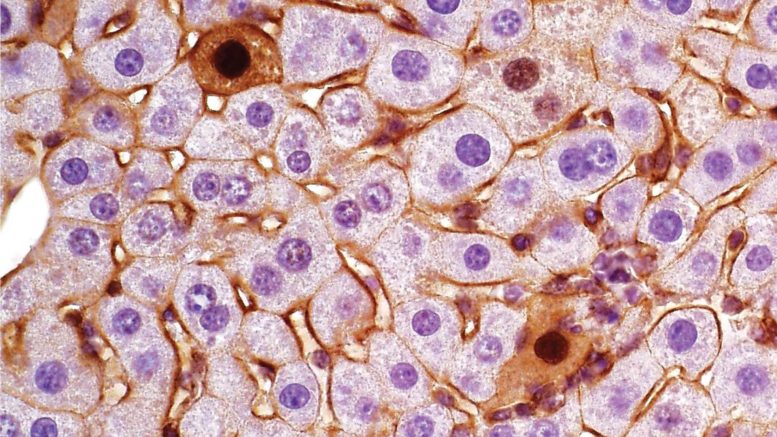
    An up-close look at a mouse’s liver; the cells with dark centers were turned cancerous using a new gene-editing strategy devised by Semir Beyaz’s lab. Credit: Beyaz lab/Cold Spring Harbor Laboratory

    A novel CRISPR-based method links protein isoforms from exon skipping to distinct liver cancer subtypes, offering a potential breakthrough in therapeutic research.

    Mutations in our genetic makeup can result in severe problems, such as colon or liver cancer. However, cancer is an intricate disease and the same genetic mutations can result in varying subtypes of tumors in different individuals. Currently, there is no effective method for creating these tumor subtypes in the lab.

    Now, Assistant Professor Semir Beyaz from Cold Spring Harbor Laboratory has developed a novel technique for modeling certain subtypes of liver cancer tumors using the CRISPR-Cas9 gene-editing tool.

    Genes contain the information our bodies need to create proteins. Highly similar proteins produced from the same gene are called isoforms. Different isoforms generate different tumors. This process is known as exon skipping, where multiple parts of a gene are stitched together to make a different version of a protein.
    Liver Tumor Subtypes
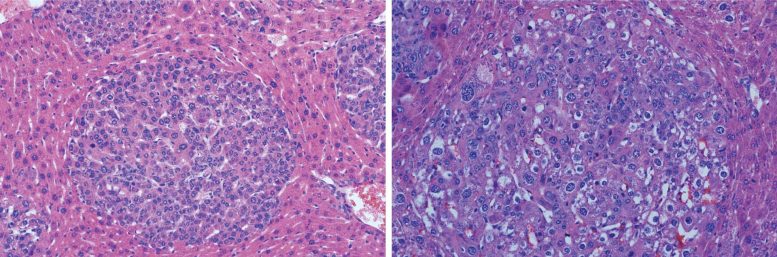
    CSHL scientists created two liver tumor subtypes, imaged above, in mice. The left image shows a liver tumor subtype that is associated with the most common form of human liver cancer, hepatocellular carcinoma. On the right is a tumor subtype associated with a rarer liver cancer, mostly found in children, named hepatoblastoma. Credit: Beyaz lab/Cold Spring Harbor Laboratory

    “Everyone thinks that cancer is just one type,” Beyaz explains. “But with different isoforms, you can end up with cancer subtypes that have different characteristics.”

    Beyaz and his colleagues produced two distinct tumor subtypes by targeting a single section of the mouse gene, Ctnnb1, with CRISPR. The tool is mostly used to inhibit gene function. This is the first time CRISPR has been used to generate different cancer-causing gain-of-function mutations in mice. These mutations enhance protein activity to promote tumor growth. The team sequenced each tumor subtype to figure out which isoform was associated with the differences they observed.

    “We were able to define those isoforms that associated with different cancer subtypes,” Beyaz says. “That was, for us, a surprising discovery.”

    Next, to confirm that these isoforms actually caused the variances, they produced them in the mouse without using CRISPR. They found that they were indeed able to generate the two different tumor subtypes with their respective characteristics. Both of these liver tumor subtypes are also found in humans.

    The mutations Beyaz targeted can lead to colon and liver cancers. Targeting exon skipping has emerged as a potential therapeutic approach for treating cancer and other diseases. Beyaz’s new study method allows researchers to investigate this phenomenon in living mice cells using CRISPR. The platform could someday help researchers develop new therapeutic interventions. “Ultimately,” Beyaz explains, “what we want to do is find the best models to study the biology of cancer so that we can find a cure.”

    Reference: “CRISPR-induced exon skipping of β-catenin reveals tumorigenic mutants driving distinct subtypes of liver cancer” by Haiwei Mou, Onur Eskiocak, Kadir A. Özler, Megan Gorman, Junjiayu Yue, Ying Jin, Zhikai Wang, Ya Gao, Tobias Janowitz, Hannah V. Meyer, Tianxiong Yu, John E Wilkinson, Alper Kucukural, Deniz M. Ozata and Semir Beyaz, 15 January 2023, The Journal of Pathology.
    DOI: 10.1002/path.6054

    Funding for the study was from the National Cancer Institute, the National Institutes of Health, the Mark Foundation For Cancer Research, the Oliver S. and Jennie R. Donaldson Charitable Trust, the STARR Cancer Consortium, the National Center for Advancing Translational Sciences (NCATS), and the Swedish Research Council.

    Never miss a breakthrough: Join the SciTechDaily newsletter.
    Follow us on Google and Google News.

    Cancer Cold Spring Harbor Laboratory CRISPR Genetics Liver Tumor
    Share. Facebook Twitter Pinterest LinkedIn Email Reddit

    Related Articles

    A New Treatment for a Rare and Complex Cancer

    Ancestry Unlocks Secrets to Personalized Cancer Treatments

    A Flip of a Genetic Switch: Stopping a Rare Childhood Cancer in Its Tracks

    A New Study Has Identified Genes Associated With the Most Aggressive Kidney Cancer

    Cervical Cancer Breakthrough: Major New Clue to Better Understanding the Disease

    Effectiveness of Ultrasound Cancer Therapy Boosted by CRISPR/Cas9 Gene Editing

    Using CRISPR Gene Editing Technology as a Research Tool to Develop Cancer Treatments

    When Mutant Cells Team Up, an Even Deadlier Blood Cancer Emerges [Video]

    MIT Develops New Model To Speed Up Colon Cancer Research

    Leave A Reply Cancel Reply

    • Facebook
    • Twitter
    • Pinterest
    • YouTube

    Don't Miss a Discovery

    Subscribe for the Latest in Science & Tech!

    Trending News

    289-Million-Year-Old Reptile Mummy Reveals Origin of Human Breathing System

    New Brain Discovery Challenges Long-Held Theory of Teenage Brain Development

    Scientists Discover Plants “Scream” – We Just Couldn’t Hear Them Until Now

    Scientists Discover a Surprising Reason Intermittent Fasting Extends Life

    This Simple Fruit Wash Could Make Produce Safer and Last Days Longer

    Scientists Say Adding This Unusual Seafood to Your Diet Could Reverse Signs of Aging

    Scientists Say a Hidden Structure May Exist Inside Earth’s Core

    Doctors Surprised by the Power of a Simple Drug Against Colon Cancer

    Follow SciTechDaily
    • Facebook
    • Twitter
    • YouTube
    • Pinterest
    • Newsletter
    • RSS
    SciTech News
    • Biology News
    • Chemistry News
    • Earth News
    • Health News
    • Physics News
    • Science News
    • Space News
    • Technology News
    Recent Posts
    • Scientists Just Discovered Light Can Actually Slow Plant Growth
    • Scientists Finally Solved One of Water’s Biggest Mysteries
    • 7,000-Year-Old DNA Rewrites the Story of the “Neolithic Revolution”
    • Missing Medieval Relic of Legendary English King Found After Being Missing for 40 Years
    • New Study Challenges Long-Held Assumptions About Cancer and Aging
    Copyright © 1998 - 2026 SciTechDaily. All Rights Reserved.
    • Science News
    • About
    • Contact
    • Editorial Board
    • Privacy Policy
    • Terms of Use

    Type above and press Enter to search. Press Esc to cancel.