

How Would the Earth Look Like to an Extraterrestrial Civilization Situated Light Years Away?
A collaborative study conducted by a group of scientists from the University of Mauritius and the University of Manchester has employed crowd-sourced data to model the radio signals emanating from cellular towers, with the aim of speculating what such a distant civilization could potentially perceive from a range of proximate stars. This includes Barnard’s Star, situated a mere six light years from our planet.
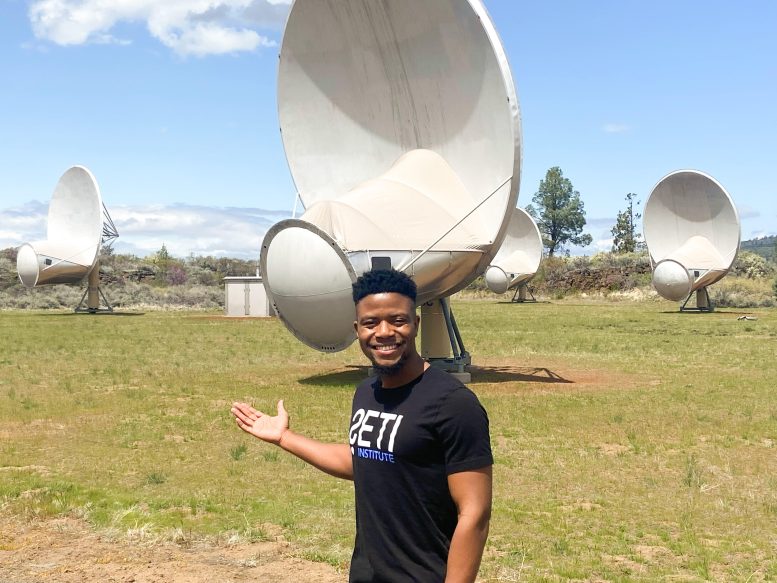
Ramiro Saide, an intern at the SETI Institute’s Hat Creek Radio Observatory and a postgraduate student at the University of Mauritius, has developed models that represent the radio frequency power these extraterrestrial societies would receive as the Earth rotates and the towers rise and set.
Saide believes that unless an alien civilization is much more advanced than ours, they would have difficulty detecting the current levels of mobile tower radio leakage from Earth. However, the team suggests that some technical civilizations are likely to have much more sensitive receiving systems than we do, and the detectability of our mobile systems will increase substantially as we move to much more powerful broadband systems.
The Global Footprint of Mobile Communications
Saide is also excited by the fact that his simulations show that the Earth’s mobile radio signature includes a substantial contribution from developing countries, including Africa. According to team leader Professor Mike Garrett (University of Manchester, Jodrell Bank Centre for Astrophysics), “the results highlight Africa’s success in bypassing the landline stage of development and moving directly into the digital age.”
Garrett is pleased with the results. “I’ve heard many colleagues suggest that the Earth has become increasingly radio-quiet in recent years – a claim that I always contested – although it’s true we have fewer powerful TV and radio transmitters today, the proliferation of mobile communication systems around the world is profound. While each system represents relatively low radio powers individually, the integrated spectrum of billions of these devices is substantial.”
Dr. Nalini Heeralall-Issur, Saide’s supervisor in Mauritius, thinks Saide might be right. “Every day we learn more about the characteristics of exoplanets via space missions like Kepler and TESS, with further insights from the JWST – I believe that there’s every chance advanced civilizations are out there, and some may be capable of observing the human-made radio leakage coming from planet Earth.”
The team is eager to extend their research to include other contributors to the Earth’s radio leakage signature. The next step is to include powerful civilian and military radars, new digital broadcast systems, Wi-Fi networks, individual mobile handsets, and the swarm of satellite constellations now being launched into low Earth orbit, such as Elon Musk’s Starlink system.
Earth’s Increasing Visibility in the Radio Spectrum
According to Garrett, “Current estimates suggest we will have more than one hundred thousand satellites in low Earth orbit and beyond before the end of the decade. The Earth is already anomalously bright in the radio part of the spectrum; if the trend continues, we could become readily detectable by any advanced civilization with the right technology.”
“This work is a superb example of how a detailed analysis of the properties of human technology (the “anthropogenic technosphere”) can be leveraged toward developing exciting, novel strategies for detecting extraterrestrial technologies,” said Allen Telescope Array Project Scientist Dr. Wael Farah. “We look forward to using the unique instrumentation capabilities and scheduling flexibility of the Allen Telescope Array, paired with our growing knowledge of nearby exoplanet systems, to undertake new searches based on these strategies.”
Reference: “Simulation of the Earth’s radio-leakage from mobile towers as seen from selected nearby stellar systems” by Ramiro C Saide, M A Garrett and N Heeralall-Issur, 6 February 2023, Monthly Notices of the Royal Astronomical Society.
DOI: 10.1093/mnras/stad378
Saide’s M.Phil research has been funded by the Development in Africa with Radio Astronomy (DARA) Project.
Never miss a breakthrough: Join the SciTechDaily newsletter.
Follow us on Google and Google News.
1 Comment
HAVE ALIENS ARRIVED IN THE WORLD