
Close Menu
    Facebook X (Twitter) Instagram
    SciTechDaily
    • Biology
    • Chemistry
    • Earth
    • Health
    • Physics
    • Science
    • Space
    • Technology
    Facebook X (Twitter) Pinterest YouTube RSS
    SciTechDaily
    Home»Space»This Week @NASA: Record-Breaking Heat, High-Flying Aircraft Study Lightning, Landing on Rooftop Hubs
    Space

    This Week @NASA: Record-Breaking Heat, High-Flying Aircraft Study Lightning, Landing on Rooftop Hubs

    By NASAAugust 20, 20232 Comments3 Mins Read
    Facebook Twitter Pinterest Telegram LinkedIn WhatsApp Email Reddit
    Share
    Facebook Twitter LinkedIn Pinterest Telegram Email Reddit
    Record Heat July 2023
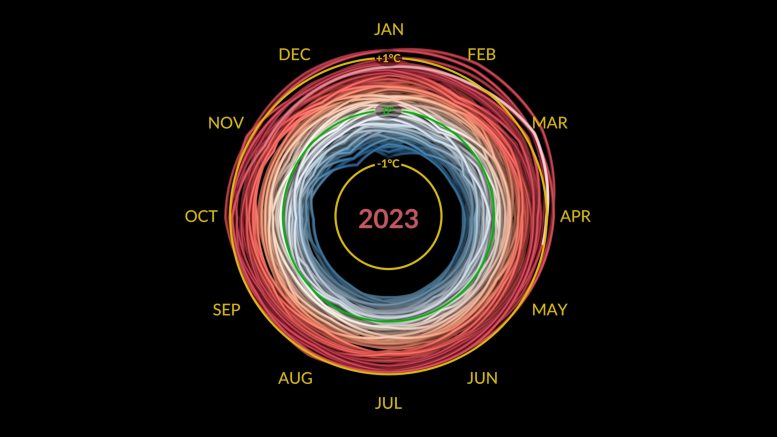
    According to NASA, Earth in July 2023 was 1.18°C (2.12°F) warmer than the average for the month, and warmer than any other month in the 143-year record. Credit: NASA

    Find out why July 2023 was a record-breaking month …

    A high-flying NASA aircraft is helping to study lighting …

    And making landings safe for flights of the future …

    A few of the stories to tell you about – This Week at NASA!

    Data Shows July 2023 as Hottest Month on Record

    According to research by NASA’s Goddard Institute for Space Studies, July 2023 was 0.43 degrees Fahrenheit warmer than any other July in NASA’s record, and hotter than any other month in the global temperature record. NASA and partner agency NOAA discussed this and our changing climate during a news conference. According to NASA data, the five hottest Julys since 1880 have all happened in the past five years.

    NASA ER-2 Aircraft
    In July 2023, NASA’s ER-2 aircraft flew near thunderclouds to study the relationship between lightning and atmospheric energy fields. The aircraft, part of the ALOFT project, operates at a unique altitude, allowing scientists to collect detailed data on high-energy radiation emissions from thunderstorms. Credit: NASA

    NASA Aircraft Flies High to Investigate Lightning

    Researchers with the ALOFT project have been using NASA’s high-flying ER-2 aircraft to help them study lightning and its connection to the vast energy fields in our atmosphere. The ER-2 can fly above and as close to thunderclouds as safely possible to observe gamma-ray activity within thunderclouds and collect detailed data that can advance the study of high-energy radiation emissions from thunderstorms.

    Drone Landing on Vertiport
    NASA’s AEROcAST flight campaign focuses on studying wind patterns to ensure the safe landing of drones on rooftop hubs, known as vertiports, intended for future transportation of people and goods. Credit: NASA

    Wind Study to Help Future Aircraft Land Safely

    NASA’s AEROcAST flight campaign is a wind study that aims to help drones land safely on rooftop hubs called vertiports for future delivery of people and goods. The campaign uses drones, sensors, weather balloons, and other technology to measure wind at altitudes below 2,000 feet and collect other data to resolve unknowns that could hinder these types of flights. The campaign, which continues through this month, may also improve weather prediction.


    NASA is calling on middle and high school students across the country to submit experiment ideas for a high-altitude balloon or rocket-powered lander test flight in the third TechRise Student Challenge. Credit: NASA

    NASA Seeks Experiment Ideas for TechRise Student Challenge

    NASA is looking for middle and high school students across the country to submit experiment ideas to send on a high-altitude balloon or a rocket-powered lander test flight as part of the third TechRise Student Challenge. Led by NASA’s Flight Opportunities program and administered by Future Engineers, the challenge allows student teams to participate directly in designing and building experiments for suborbital flight. For more details visit futureengineers.org/nasatechrise.

    That’s what’s up this week @NASA!

    Never miss a breakthrough: Join the SciTechDaily newsletter.
    Follow us on Google and Google News.

    NASA
    Share. Facebook Twitter Pinterest LinkedIn Email Reddit

    Related Articles

    Scientists Discover a New Meteor Shower From a Mysterious Crumbling Asteroid

    NASA Artemis II Splashdown and Astronaut Recovery Operation [Image Gallery]

    Splashdown! NASA Artemis II Returns From Record-Breaking Moon Mission

    NASA Artemis II Nears Dramatic Moon Flyby With Record-Breaking Moment Ahead

    A Fiery Finale: How NASA’s Artemis II Moon Mission Returns to Earth

    NASA Artemis II Skips Burn As Astronaut Captures Stunning View of Earth

    NASA’s Artemis II: Humans Just Left Earth Orbit for the First Time Since 1972

    NASA’s Artemis II Cleared for Moon Flight As Orion Prepares for Critical Engine Burn

    Scientists Propose a Radical New Method To Find Alien Life

    2 Comments

    1. Clyde Spencer on August 20, 2023 9:33 am

      The caption for the lede illustration says,”…, Earth in July 2023 was 1.18°C (2.12°F) warmer than the average for the month, …”; farther down the article says, “…, July 2023 was 0.43 degrees Fahrenheit warmer than any other July in NASA’s record, …” Do you think that they made it clear that July was warm?

      I don’t think that they are mathematically justified in claiming a precision to the one-hundredths digit. One is only justified in increasing the precision of measurements in proportion to the square-root of the number of measurements when the variations are random, which is achieved by making multiple measurements of the SAME air parcel with the SAME thermometer. As usual, there are no error bars provided. That is important because if there is significant overlap with the error envelope of July 2023 with the other July error envelopes, then the claimed 0.4 deg F difference is not statistically significant.

      The mentioned illustration is a poor choice because it distorts the relationships between the months, with the length of the warm traces being about 3X (actually, Pi) longer than the cool traces, giving subjective emphasis to the warm traces.

      Reply
    2. Clyde Spencer on August 20, 2023 9:41 am

      “the five hottest Julys since 1880 have all happened in the past five years.”

      If the global temperature were to miraculously hold steady for the next 50 years, one would be justified in similarly claiming that “the 50 hottest Julys since 1880 have all happened in the past 50 years.” Is that useful information, or a non sequitur?

      Reply
    Leave A Reply Cancel Reply

    • Facebook
    • Twitter
    • Pinterest
    • YouTube

    Don't Miss a Discovery

    Subscribe for the Latest in Science & Tech!

    Trending News

    This Copper Drug Clears Alzheimer’s Brain Toxins and Boosts Memory

    Adults Over 65 Lost Massive Amounts of Weight With Ozempic

    How Flocking Birds “Defy” One of Physics’ Most Fundamental Laws

    Physicists Create a New Kind of Schrödinger’s Cat State From Exotic Quantum Building Blocks

    Your Diet Could Be Missing the Key Ingredient for Heart Protection

    Researchers Warn Widely Prescribed Blood Pressure Drugs Could Be Harming Diabetic Kidneys

    James Webb Spots Something Strange Between Day and Night on an Alien Planet

    How Ancient People Moved a 6-Ton Stone 700 Kilometers to Stonehenge

    Follow SciTechDaily
    • Facebook
    • Twitter
    • YouTube
    • Pinterest
    • Newsletter
    • RSS
    SciTech News
    • Biology News
    • Chemistry News
    • Earth News
    • Health News
    • Physics News
    • Science News
    • Space News
    • Technology News
    Recent Posts
    • A Surprising Discovery Challenges What Scientists Thought DNA Methylation Was For
    • This New DNA Test Solves Rare Disease Mysteries That Standard Genetics Misses
    • Scientists Just Discovered the Eye Defies a Long-Held Rule of Vision
    • Ancient Black Holes May Have Survived a Cosmic Era Before the Big Bang
    • What if Time Isn’t Fundamental? Physicists Just Tested the Idea in the Lab
    Copyright © 1998 - 2026 SciTechDaily. All Rights Reserved.
    • Science News
    • About
    • Contact
    • Editorial Board
    • Privacy Policy
    • Terms of Use

    Type above and press Enter to search. Press Esc to cancel.