
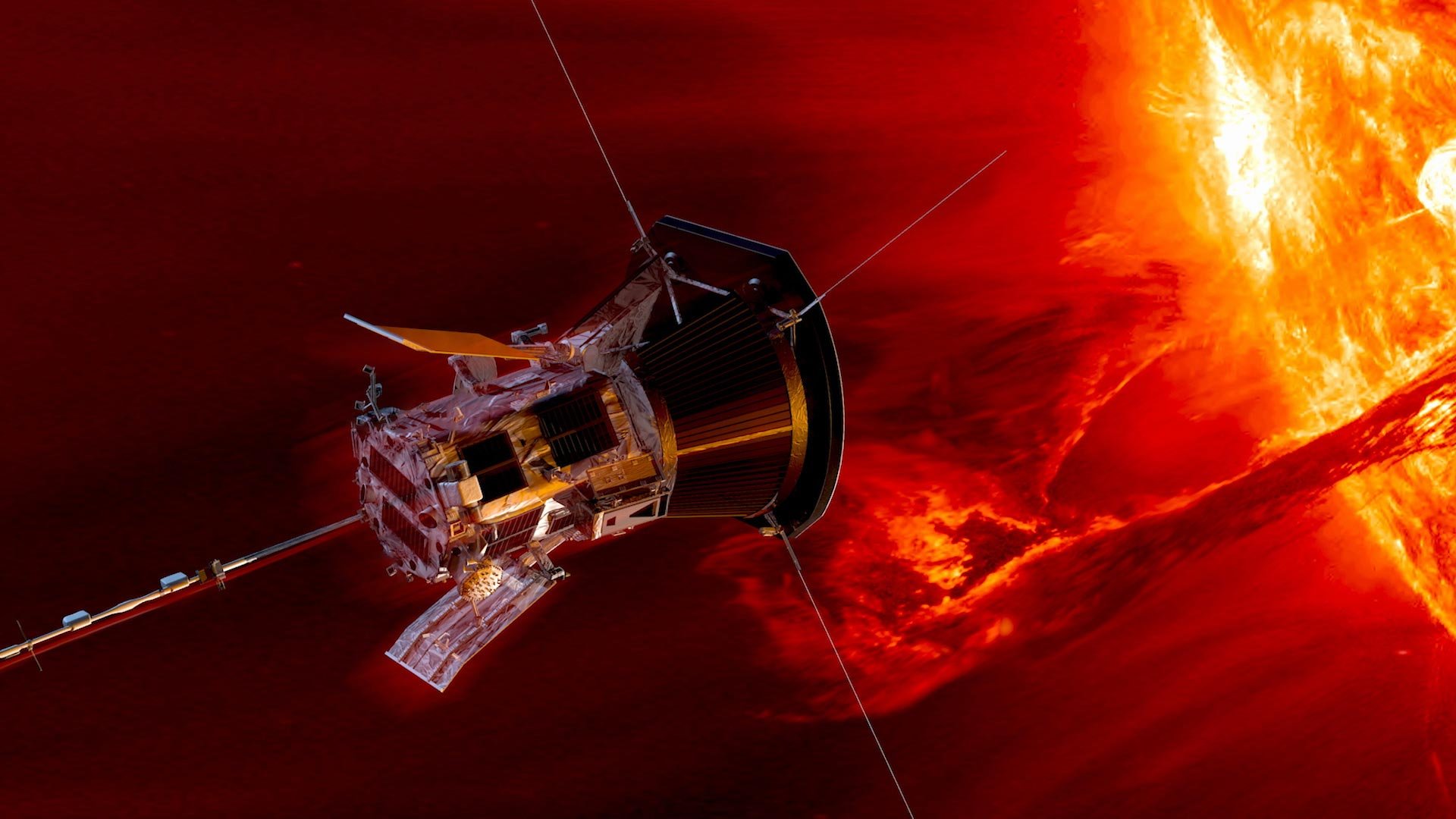
NASA’s Parker Solar Probe is poised for its closest approach to the Sun on December 24.
By December 27, following its perilous journey near the Sun, Parker is expected to transmit data, offering new insights into solar phenomena.
Heading into the Sun: Parker Solar Probe’s Historic Journey
NASA’s Parker Solar Probe is healthy and functioning as expected as it prepares for its closest-ever approach to the Sun, scheduled for Christmas Eve.
At 7:20 p.m. EST on December 20, mission operators at the Johns Hopkins Applied Physics Laboratory (APL) in Laurel, Maryland, confirmed the spacecraft’s status through a beacon transmission received via NASA’s Deep Space Network in Canberra, Australia. The transmission indicated that all systems were operating normally.
“This is one example of NASA’s bold missions, doing something that no one else has ever done before to answer longstanding questions about our universe,” said Arik Posner, Parker Solar Probe program scientist at NASA Headquarters in Washington. “We can’t wait to receive that first status update from the spacecraft and start receiving the science data in the coming weeks.”

Approaching the Perihelion: A Milestone for Space Exploration
Parker is now on course to fly just 3.8 million miles (around 6.1 million kilometers) from the surface of the Sun on Tuesday, December 24, at 6:53 a.m. EST. During closest approach, or perihelion, mission operations will be out of contact with the spacecraft, and Parker will transmit another beacon tone on Friday, December 27, to confirm its health following the close flyby.
“No human-made object has ever passed this close to a star, so Parker will truly be returning data from uncharted territory,” said Nick Pinkine, Parker Solar Probe mission operations manager at APL. “We’re excited to hear back from the spacecraft when it swings back around the Sun.”
The Parker Solar Probe, part of NASA’s Living With a Star program, is a groundbreaking mission designed to study the Sun and its impact on the Sun-Earth system. This mission aims to uncover critical information about solar activity and its direct effects on life and society. Managed by NASA’s Goddard Space Flight Center in Greenbelt, Maryland, for the Science Mission Directorate in Washington, the Parker Solar Probe is operated by the Johns Hopkins Applied Physics Laboratory (APL) in Laurel, Maryland. APL also designed and built the spacecraft, which is on a historic journey to explore the Sun up close, providing insights that will advance our understanding of solar phenomena.
Never miss a breakthrough: Join the SciTechDaily newsletter.
Follow us on Google and Google News.