
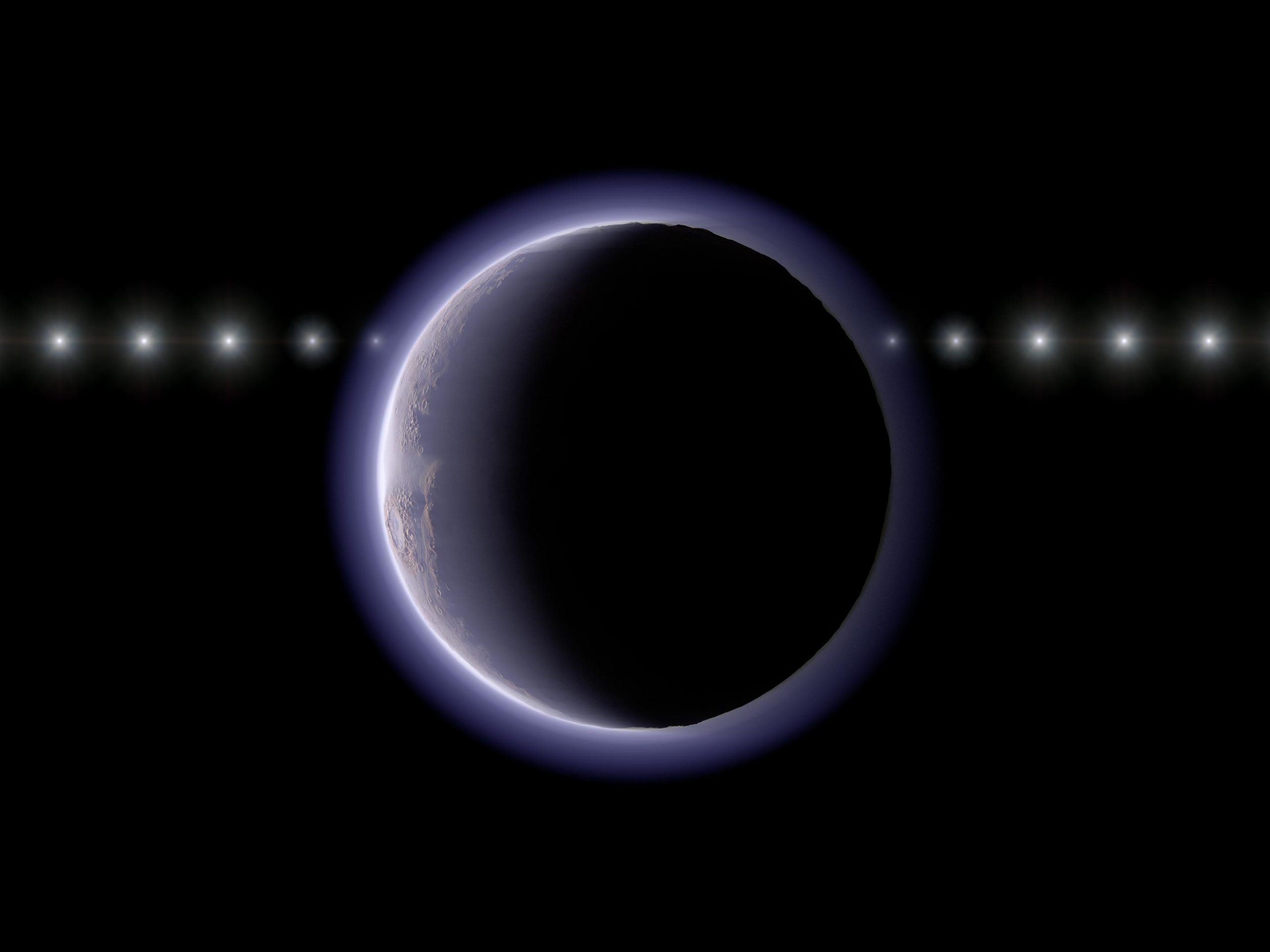
A tiny world in our Solar System has an atmosphere it shouldn’t—hinting something dramatic happened there recently.
A group of Japanese astronomers, including both professionals and amateur observers, has found signs of a thin atmosphere surrounding a small object far beyond Neptune. The discovery is surprising because the object is so small that it should not be able to hold onto gas for long. This raises new questions about when the atmosphere formed and what is keeping it there. Additional observations will be needed to better understand this unusual finding.
Why Most Trans-Neptunian Objects Are Airless
The outer Solar System is filled with icy bodies known as trans-Neptunian objects (TNOs), which orbit the Sun beyond Neptune. Pluto is the best-known example and is one of the few confirmed to have a thin atmosphere. For most TNOs, however, conditions make atmospheres unlikely. These objects are extremely cold, and their weak gravity allows gases to escape easily, leaving their surfaces exposed to space.
Conceptual video showing how the light from a star changes when it passes behind an object with an atmosphere. Credit: NAOJ
A Rare Stellar Alignment Provides a Clue
To investigate further, astronomers took advantage of a fortunate “natural experiment” involving a TNO called (612533) 2002 XV93. This object, often shortened to 2002 XV93, is about 500 km in diameter, much smaller than Pluto, which measures 2,377 km across.
On January 10, 2024, 2002 XV93 passed directly in front of a distant star as seen from Japan. Events like this allow scientists to study distant objects in detail. If the object has no atmosphere, the star’s light should vanish instantly. If gas surrounds it, the light dims gradually as it passes through the atmosphere before disappearing.
Observations Reveal Signs of a Thin Atmosphere
A team led by Ko Arimatsu at NAOJ Ishigakijima Astronomical Observatory monitored this event from several locations across Japan. Their measurements showed a pattern of fading starlight consistent with the presence of a thin atmosphere. This suggests that 2002 XV93 is not completely bare, as previously expected.
A Short-Lived Atmosphere With an Unknown Source
Further analysis indicates that this atmosphere cannot last long. Calculations suggest it would dissipate in less than 1000 years unless new material is continually added. This means the atmosphere must have formed or been refreshed in the recent past.
Observations from the James Webb Space Telescope add to the mystery. They show no clear evidence of surface ice that could slowly turn into gas and maintain the atmosphere. Scientists are now considering other explanations. One idea is that material from inside the object reached the surface and released gas. Another possibility is that a comet impact supplied or triggered the release of gas, creating a temporary atmosphere.
More data will be needed to determine which explanation is correct and to understand how such a small object can briefly support an atmosphere at all.
Reference: “Detection of an atmosphere on a trans-Neptunian object beyond Pluto” by Ko Arimatsu, Fumi Yoshida, Tsutomu Hayamizu, Satoshi Takita, Katsumasa Hosoi, Takafumi Ootsubo and Jun-ichi Watanabe, 4 May 2026, Nature Astronomy.
DOI: 10.1038/s41550-026-02846-1
Never miss a breakthrough: Join the SciTechDaily newsletter.
Follow us on Google and Google News.