
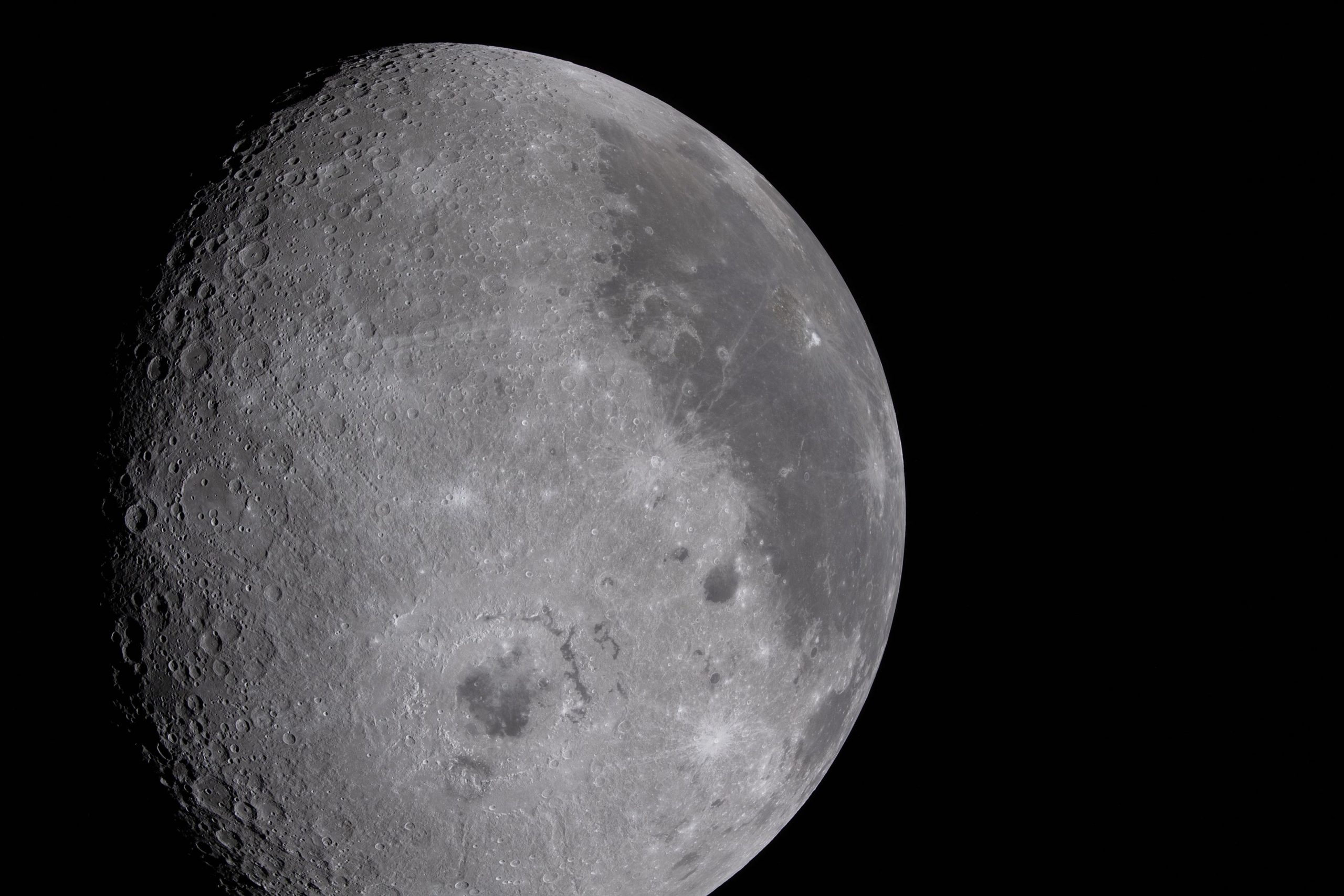
By studying how seismic waves move through frozen soil on Earth, a geophysicist helped develop a more effective method for detecting water ice on the Moon.
Beneath the Moon’s permanently shadowed polar craters, water ice may lie hidden beyond the reach of instruments in orbit. Researchers now think those buried deposits could be located by listening for changes in the vibrations traveling through lunar soil.
Geologists from the University of Maryland, Lawrence Berkeley National Laboratory and the University of Hawaii found that seismic waves, the same vibrations recorded during earthquakes, could reveal and map ice beneath the lunar surface.
Published in Science Advances, the findings arrive as NASA prepares to send astronauts toward the Moon’s south polar region through its Artemis program, with crewed landings targeted for 2028. Ice preserved inside the deep shadows of polar craters could become one of the most useful local resources available to future explorers.
Once melted and purified, lunar ice could provide drinking water. Electricity could also separate it into oxygen for breathing and hydrogen for rocket fuel, reducing the amount of material that long missions and permanent outposts would need to carry from Earth.
“It’s crucial to identify any materials on the moon that an astronaut can make use of while they’re up there,” said Nicholas Schmerr, an associate professor in UMD’s Department of Geological, Environmental, and Planetary Sciences and a co-author of the study. “Since they will be limited by the few resources they brought from Earth, anything they find on the moon will help them basically live off the land, especially for longer-term missions or outposts.”
Seismic waves can probe deeper
The amount and distribution of lunar ice remain uncertain. Satellites can examine the Moon from orbit, but their observations are largely limited to the shallowest layer of soil. Some deposits may be buried much farther below the surface, where seismic measurements could provide a clearer view.
The principle rests on a measurable difference between dry and frozen soil. Ice makes the material around it stiffer, allowing seismic vibrations to travel two to three times faster than they move through dry soil. Ice-rich regions may also reflect seismic energy instead of allowing it to continue through the ground, producing an effect similar to sound echoing from a wall.
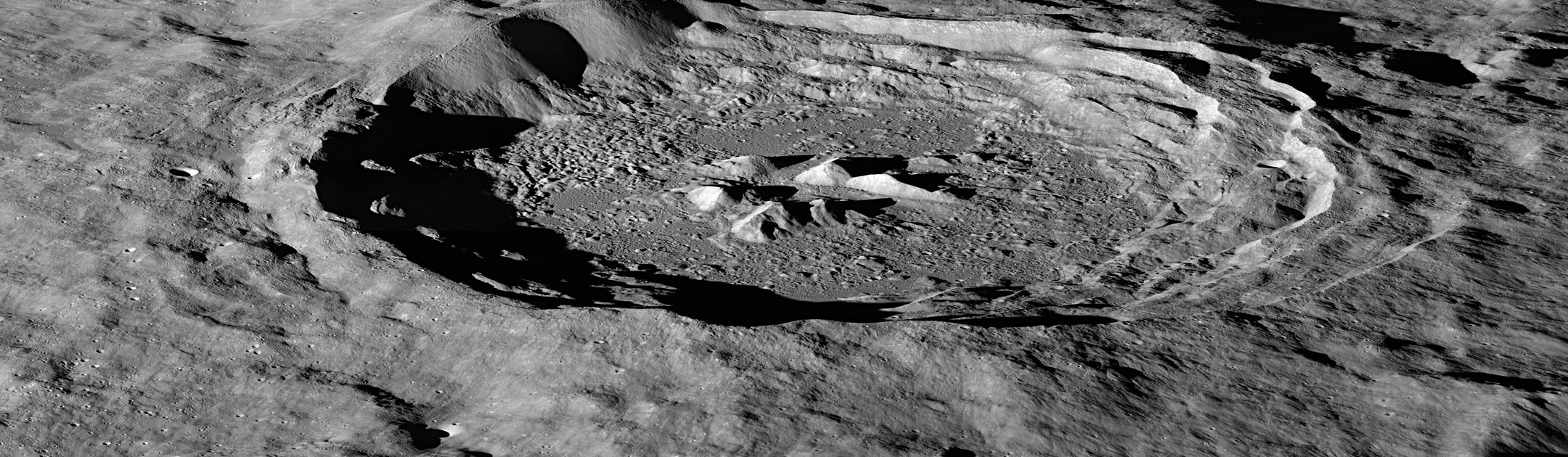
According to Schmerr, a properly positioned lunar seismometer could record both signatures.
“We can use seismic waves to not just see whether ice is present but also roughly how much of it there is,” he explained.
Three tests produced the same signal
The researchers tested the idea through three complementary approaches. Lead author Harrison Lisabeth (Ph.D. ’16, geology), a UMD graduate and rock physicist at Lawrence Berkeley National Laboratory, began with volcanic rock from Arizona that closely resembles Moon dust when crushed.
Lisabeth froze the material, then used X-rays to observe how ice collected within the microscopic openings between its grains. This experiment helped establish how frozen lunar soil might be structured below the surface.
Co-author Matthew Siegler of the University of Hawaii created detailed temperature models of the Moon’s south polar region. The maps identified craters that have remained cold enough to preserve ice for billions of years.
At UMD, Schmerr simulated small moonquakes traveling through deposits of buried lunar ice. Across the laboratory work, temperature modeling, and computer simulations, the presence of ice produced clear, measurable changes in the seismic signals.
Lunar ice preserves an ancient record
Ice on the Moon could provide more than supplies for astronauts. Permanently shadowed craters can capture and freeze volatile substances such as water, preserving them with little disturbance over immense spans of time.
Because some lunar rocks are roughly four billion years old, ice trapped among them may retain evidence from the early history of the solar system. Examining those deposits could help scientists investigate how water reached the inner planets.
“The moon witnessed some of the most critical parts of the early solar system, including how water was delivered,” Schmerr said. “Studying the ice deposited there could reveal how water spread and ultimately how Earth’s oceans formed.”
Upcoming missions can test the prediction
Future lunar missions may soon provide the first opportunity to search for the predicted seismic patterns. China’s Chang’e-7 mission is expected to land near Shackleton Crater in late 2026 with a seismometer aboard. Several suspected ice deposits are located nearby.
NASA’s Artemis astronauts may follow in 2028 by deploying the Lunar Environmental Monitoring Station, an instrument Schmerr helped develop for seismic exploration. Data from these instruments could show whether natural lunar vibrations reveal buried ice in the way the researchers anticipate.
“Our findings are laying the groundwork for an observation we’ll get in the next couple of years,” Schmerr said. “No one has physically measured the ice on the moon yet, but we now have a prediction for what to look out for. That’s an important first step.”
Reference: “The seismic signature of lunar ice” by Harrison P. Lisabeth, Nicholas Schmerr and Matthew Siegler, 31 July 2026, Science Advances.
DOI: 10.1126/sciadv.adz7220
This research was funded by the U.S. Department of Energy Office of Science, Office of Basic Energy Sciences, Chemical Sciences, Geosciences, and Biosciences Division (Contract No. DEAC02-05CH11231), and the NASA Solar System Exploration Research Virtual Institute CLEVER project (Grant No. GR00024738) and GEODES project (Grant No. 80NSSC19M0216). This article does not necessarily reflect the views of these organizations.
Never miss a breakthrough: Join the SciTechDaily newsletter.
Follow us on Google and Google News.