
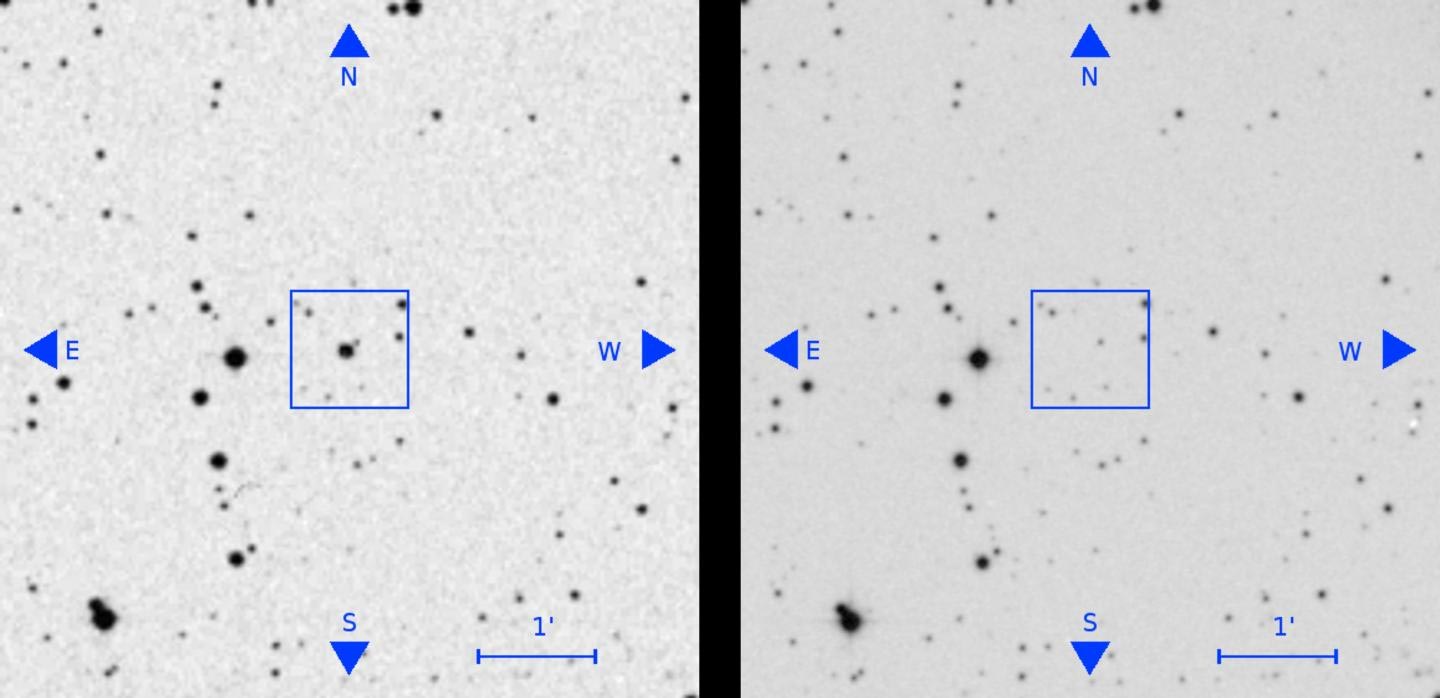
A project led by an international team of researchers uses publicly available data with images of the sky dating as far back as to the 1950s to try to detect and analyze objects that have disappeared over time. In the project “Vanishing & Appearing Sources during a Century of Observations” (VASCO), they have particularly looked for objects that may have existed in old military sky catalogs from the 1950s, not to be found again in modern sky surveys. Among the physical indicators that they are looking for are stars that have vanished in the Milky Way.
“Finding an actually vanishing star — or a star that appears out of nowhere! — would be a precious discovery and certainly would include new astrophysics beyond the one we know of today,” says project leader Beatriz Villarroel, Stockholm University and Instituto de Astrofísica de Canarias, Spain.
When a star dies it either undergoes very slow changes and becomes a white dwarf or it dies with a sudden bright explosion i.e. supernova. A vanishing star can be an example of an “impossible phenomenon” that could be attributed either to new astrophysical phenomena or to extra-terrestrial activity. Indeed, the only non-ETI (extra-terrestrial intelligence) explanation for a vanishing star would be exceedingly rare events called “failed supernova.” A failed supernova is theoretically predicted to occur when a very massive star collapses into a black hole without any visible explosion. Other physical indicators of ETI activity that the authors are looking for are signs of red interstellar communication lasers and Dyson spheres. A Dyson sphere is a hypothetical giant structure surrounding a star to harness its energy.
“As a by-product, VASCO has the potential to discover rare extremely-variable objects. These can shed light on fast hard-to-observe phases of stellar evolution and active galactic nuclei,” says co-author Sébastien Comerón, Oulu University, Finland.
The researchers have carefully examined about 15% of the 150,000 candidate objects in the available data and found approximately a hundred red transients — very variable objects or events in the sky. Some of these objects appear to have flared up at least ~ 8-9 magnitudes, or several thousand times brighter, in a very short time.
“We are very excited about following up on the 100 red transients we have found,” says Beatriz Villarroel.
“But we are clear that none of these events have shown any direct signs of being ETI. We believe that they are natural, if somewhat extreme, astrophysical sources”, says Martin López Corredoira, co-author of the paper, Instituto de Astrofísica de Canarias, Spain.
The researchers are now looking for the possibility to arrange a citizen science project, one that is aided by artificial intelligence. In order to be able to examine all the 150,000 candidates that have been identified from the material, they must speed up the process of identifying anomalies in the images.
“We hope to get help from the community to look through the images as a part of a citizen science project. We are looking at ways to do that right now and that will be something we will be able to talk more about at a later date”, says Lars Mattsson, Stockholm University.
The paper was published in the Astronomical Journal today, December 12th, 2019.
Reference: “The Vanishing and Appearing Sources during a Century of Observations Project. I. USNO Objects Missing in Modern Sky Surveys and Follow-up Observations of a ‘Missing Star'” by Beatriz Villarroel, Johan Soodla, Sébastien Comerón, Lars Mattsson, Kristiaan Pelckmans, Martín López-Corredoira, Kevin Krisciunas, Eduardo Guerras, Oleg Kochukhov, Josefine Bergstedt, Bart Buelens, Rudolf E. Bär, Rubén Cubo, J. Emilio Enriquez, Alok C. Gupta, Iñigo Imaz, Torgny Karlsson, M. Almudena Prieto, Aleksey A. Shlyapnikov, Rafael S. de Souza, Irina B. Vavilova and Martin J. Ward, 12 December 2019, The Astronomical Journal.
DOI: 10.3847/1538-3881/ab570f
Never miss a breakthrough: Join the SciTechDaily newsletter.
Follow us on Google and Google News.