

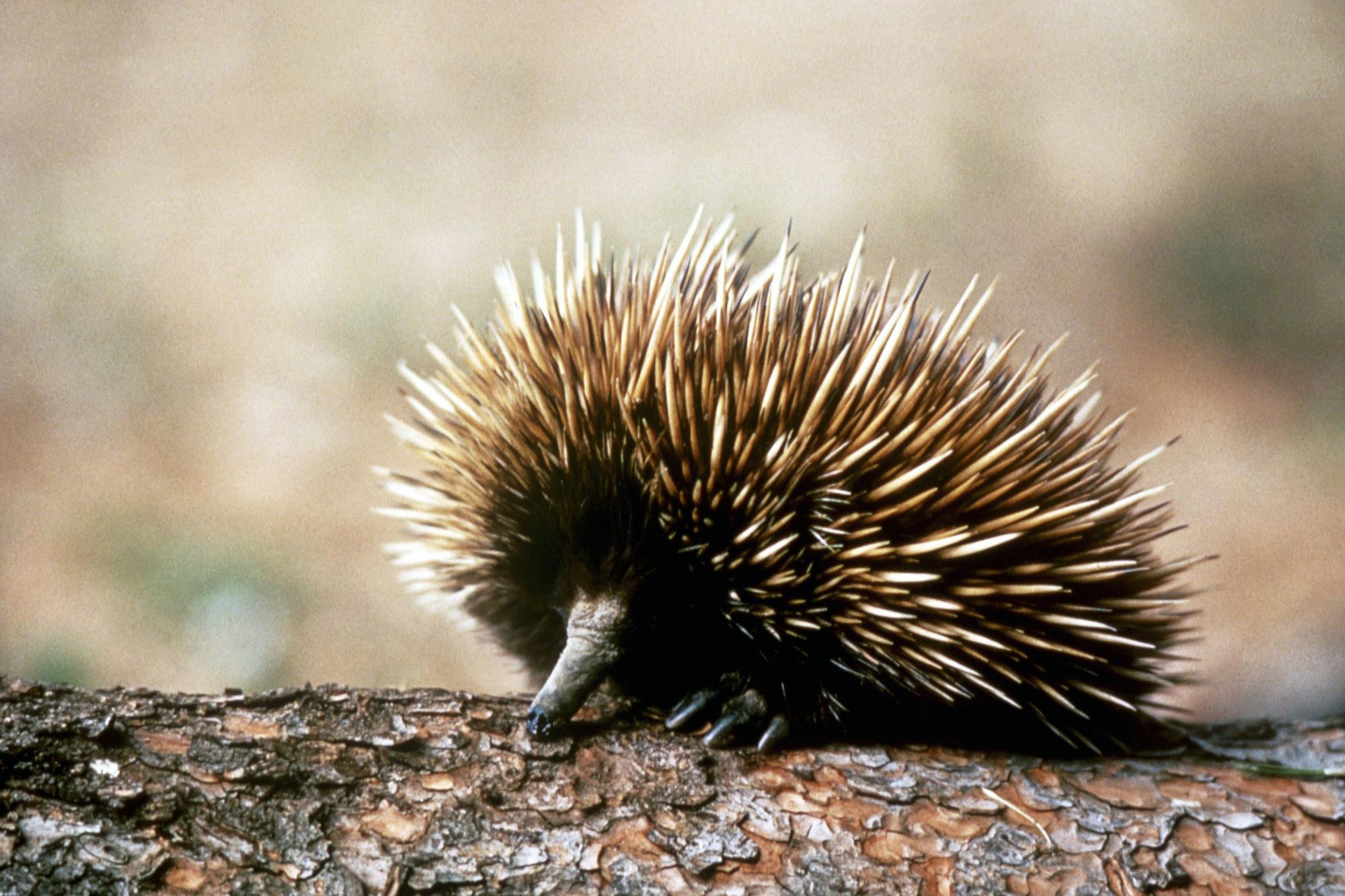
New fossil evidence suggests echidnas evolved from a water-dwelling ancestor, not a land-based one. The bone structure closely resembles that of semi-aquatic animals like the platypus.
A tiny fossilized bone unearthed three decades ago at Dinosaur Cove in southeastern Australia may dramatically alter our understanding of how echidnas and platypuses evolved.
Until now, scientists believed that these distinctive egg-laying mammals, collectively known as monotremes, descended from a common ancestor that lived on land. According to this widely accepted view, platypus ancestors later adapted to an aquatic lifestyle, while echidnas remained terrestrial.
However, new research led by the University of New South Wales (UNSW) challenges this narrative. The analysis, based on the long-overlooked fossil originally found by a team from Museums Victoria, suggests that both echidnas and platypuses may have descended from a semi-aquatic or fully aquatic ancestor.
Emeritus Professor Suzanne Hand, the study’s lead author and a palaeontologist at UNSW’s School of Biological, Earth and Environmental Sciences (BEES), points out that there are about 30 instances where mammals evolved from land-dwelling to live wholly or partly in water, for example, whales, dolphins, dugongs, seals, walruses, otters and beavers. But it’s virtually unheard of to see mammals evolve in the opposite direction.
“We’re talking about a semiaquatic mammal that gave up the water for a terrestrial existence, and while that would be an extremely rare event, we think that’s what happened with echidnas,” she says.
Something funny about this humerus
In a study published in the science journal PNAS, the researchers describe how a single humerus bone discovered in Victoria in the early 1990s challenges the terrestrial ancestor theory. The humerus bone – which is the upper arm bone between the shoulder and elbow – is the only bone known that belongs to the extinct species, Kryoryctes cadburyi, named in 2005.
Outwardly, the single humerus looked more similar to those found in echidnas than in platypuses, and led some scientists to conclude it may have been an ancestor of modern echidnas. But other scientists have suggested it was an early common ancestor to the platypus and echidna, known as a stem-monotreme. Whether Kryoryctes lived life solely on land like modern echidnas, or were amphibious like the living platypus, has been debated.
To answer these questions, Prof. Hand and colleagues decided to have a closer look at the fossil, including the internal microstructure of the bone using CT and other scanning techniques.
“While the external structure of a bone allows you to directly compare it with similar animals to help work out the animal’s relationships, the internal structure tends to reveal clues about its lifestyle and ecology,” she says.
“So the internal structure doesn’t necessarily give you information about what that animal actually is, but it can tell you about its environment and how it lived.”
When Kryoryctes cadburyi lived in southern Victoria around 108 million years ago, during the Age of Dinosaurs (or Mesozoic), monotremes and monotreme-relatives dominated Australia’s mammal faunas.
“Australian Mesozoic mammals are rare and are known mostly only from their teeth and jaws. Kryoryctes cadburyi is so far the only one known from a limb bone,” says co-author Professor Michael Archer, also from UNSW School of BEES.
“This humerus has provided an exceptional opportunity to gain insights into how early Australian mammals lived, and it tells quite a story–perhaps not one we expected to discover.”
When the researchers looked at the internal structure of the ancient humerus bone, they were surprised to discover it didn’t match the light bones of echidnas.
“The internal structure revealed platypuses have very thick bone walls and a very reduced cavity within the bone for the bone marrow, while echidnas have very thin bone walls,” says Prof. Hand.
“The microstructure of the fossil Kryoryctes humerus is more like the internal bone structure seen in platypuses, in which their heavy bones act like ballast allowing them to easily dive to forage for food. You see this in other semiaquatic mammals.”
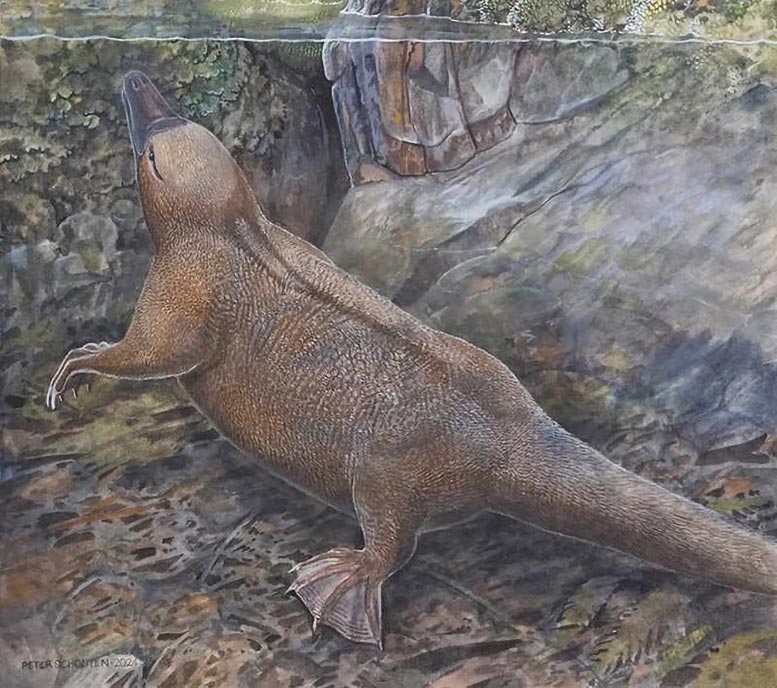
The researchers have concluded that this analysis adds far more weight to the idea that stem-monotremes started off as semi-aquatic animals. Somewhere along the line, they argue, ancestors of echidnas moved onto the land where their bones became lighter as they adapted to a new way of life. But unfortunately, the fossil record of platypus and echidna ancestors is sparse, and it’s not possible yet to say exactly when this happened.
“This is one of the reasons why we’re increasing our efforts to help investigate the Mesozoic opalized fossils of Lightning Ridge, NSW, which are about the same age as the Victorian fossil deposits,” Prof. Archer says.
“We’re hoping we’ll discover other ancestral monotremes that will help unravel the early history of this most fascinating group of mammals.”
Come to think of it…
There are other oddities about modern echidnas that could be further clues that speak to their semi-aquatic, ancient past.
“The bill of the platypus is well known to have lots of highly sensitive receptors that detect tiny electrical currents generated by prey,” Prof. Hand says.
“And while the beak of the echidnas has fewer receptors, people have suggested that these receptors are a leftover of their platypus-heritage, as are remnants of the platypus bill that can be found in the beak of echidna embryos.”
Another feature that could’ve been inherited from an aquatic ancestor, says Prof. Hand, is that the echidnas’ hind feet are turned backwards, much like a platypus’s hind feet which it uses as rudders when swimming.
“But in echidnas, this feature is used when burrowing, something not seen in other mammals except platypuses.”
Echidnas have also been found to have a diving reflex triggered when immersed in water that helps conserve oxygen and prolong breath-holding, and a study of a respiratory protein called myoglobin in mammals also suggests a semi-aquatic ancestry for echidnas.
“A positive charge on the surface of myoglobin is associated with increased capacity of the muscles in the body to store oxygen and increase the length of time a mammal can spend diving. This is high in the platypus, but is also higher than expected in echidnas, even as burrowers.”
Case closed?
Next up for the researchers is to further examine the microscopic anatomy – known as histology – of the Kryoryctes humerus using other methods.
“We know that bone histology can say a lot about how an animal lives. This kind of investigation typically requires destructive sectioning of a bone, which is not possible to do with a unique fossil like Kryoryctes. Instead, we are applying powerful scanning techniques, including non-destructive synchrotron imaging of the fossil, in order to gather even more information to help unravel this ancient mystery,” says Prof. Hand.
Reference: “Bone microstructure supports a Mesozoic origin for a semiaquatic burrowing lifestyle in monotremes (Mammalia)” by Suzanne J. Hand, Laura A. B. Wilson, Camilo López-Aguirre, Alexandra Houssaye, Michael Archer, Joseph J. Bevitt, Alistair R. Evans, Amalia Y. Halim, Tzong Hung, Thomas H. Rich, Patricia Vickers-Rich and Robin M. D. Beck, 28 April 2024, Proceedings of the National Academy of Sciences.
DOI: 10.1073/pnas.2413569122
Funding: Australian Research Council, Australian Nuclear Science and Technology Organisation
Never miss a breakthrough: Join the SciTechDaily newsletter.
Follow us on Google and Google News.