
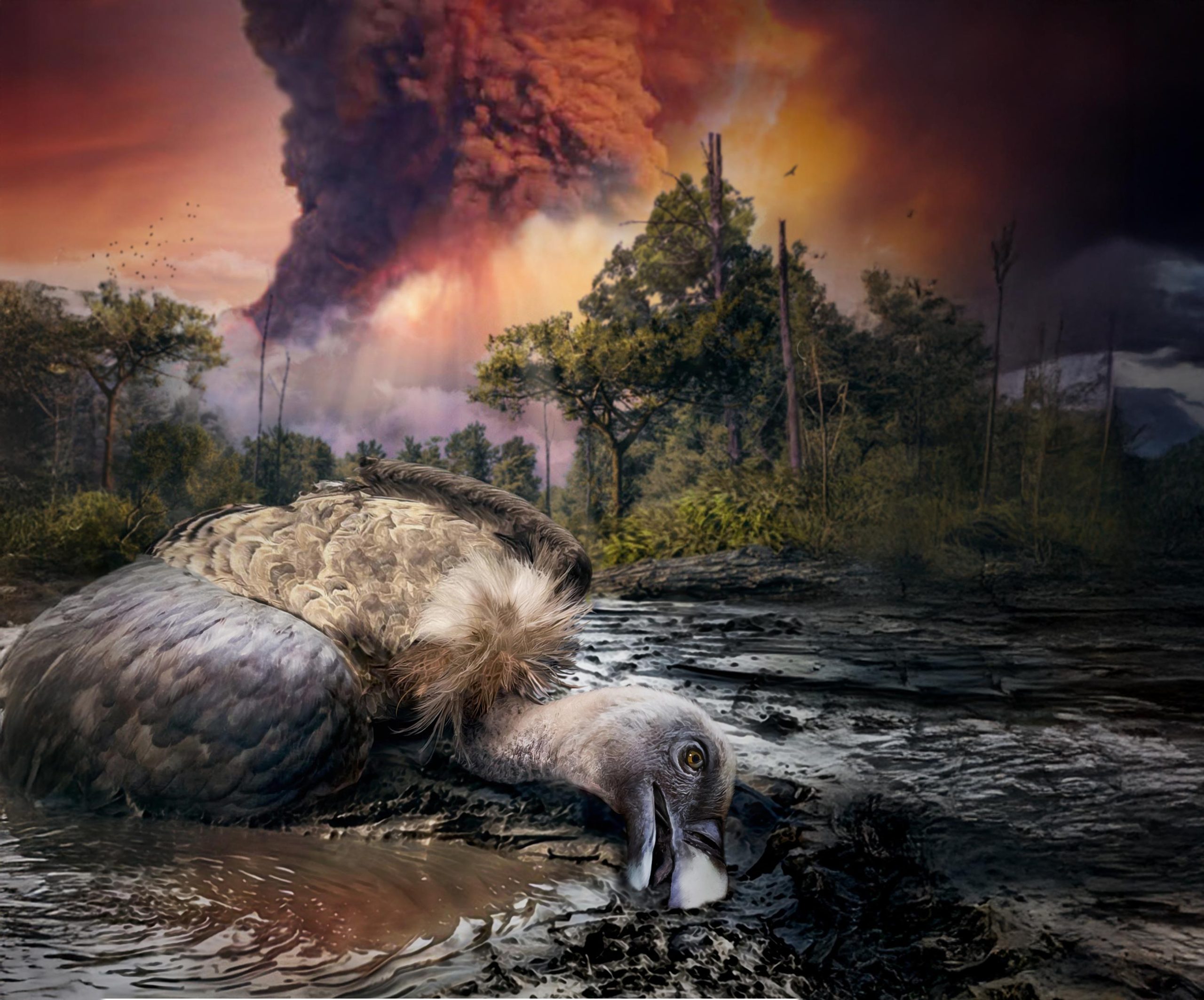
Paleontologists have unveiled a 30,000-year-old vulture fossil in Italy, preserved in volcanic ash, showcasing microscopic feather details through the formation of zeolite minerals.
This remarkable discovery challenges our understanding of fossil preservation, suggesting that even delicate soft tissues can survive in harsh volcanic environments.
Unique Fossil Discovery
A recent study of a 30,000-year-old fossilized vulture from Central Italy has revealed, for the first time, that volcanic rock can preserve microscopic details of feathers. This groundbreaking discovery marks the first recorded instance of such preservation.
Led by Dr. Valentina Rossi of University College Cork, Ireland, an international research team identified a previously unknown way that soft tissues can be preserved when animals are buried in ash-rich volcanic sediments.
Published today (March 18) in the journal Geology, the study found that the fossil’s feathers are preserved in a mineral called zeolite, an entirely new form of soft tissue preservation.

Unprecedented Preservation in Volcanic Ash
The vulture fossil was originally discovered in 1889 near Rome by a local landowner, who recognized its exceptional state of preservation. The entire body was fossilized as a three-dimensional impression, retaining remarkable details such as eyelids and wing feathers. The new research confirms that this preservation extends to microscopic feather pigment structures, offering unprecedented insight into ancient plumage.
Dr. Rossi said: “Fossil feathers are usually preserved in ancient mudrocks laid down in lakes or lagoons. The fossil vulture is preserved in ash deposits, which is extremely unusual. When analyzing the fossil vulture plumage, we found ourselves in uncharted territory. These feathers are nothing like what we usually see in other fossils”.
By analyzing tiny samples of the fossil feathers using electron microscopes and chemical tests, the team revealed that the feathers are preserved in the mineral zeolite, a mode of fossil preservation never reported before.
The Role of Zeolite in Preserving Fossils
“Zeolites are minerals rich in silicon and aluminum and are common in volcanic and hydrothermal geological settings” Rossi explains “zeolites can form as primary minerals (with pretty crystals) or can form secondarily, during the natural alteration of volcanic glass and ash, giving the rock a “mudrock-like” aspect”. The alteration of the ash due to passage of water induced the precipitation of zeolites nanocrystals that, in turn, replicated the feathers to the tiniest cellular detail.
“The fine preservation of the feather structures indicates that the vulture carcass was entombed in a low-temperature pyroclastic deposit.”

Implications for Paleontology
Prof. Dawid A. Iurino (University of Milan), coordinator of the study said: “We are used to think that volcanic deposits are associated with hot, fast-moving pyroclastic currents that will destroy soft tissues. However, these geological settings are complex and can include low-temperature deposits that can preserve soft tissues at the cellular level.”
Prof. Maria McNamara (UCC) said “The fossil record is continually surprising us, be it new fossil species, strange new body shapes, or in this case, new styles of fossil preservation. We never expected to find delicate tissues such as feathers preserved in a volcanic rock. Discoveries such as these broaden the range of potential rock types where we can find fossils, even those preserving fragile soft tissues.”
The discovery of a new mode of preservation of soft tissues potentially specific of volcanic rocks indicates that these deposits can contain remarkable fossils and should be the focus of new research.
Reference: “Fossil feathers from the Colli Albani volcanic complex (Late Pleistocene, Central Italy) preserved in zeolites” by Valentina Rossi, Tiffany Slater, Richard Unitt, Beatriz Carazo del Hoyo, Edoardo Terranova, Mario Gaeta, Maria E. McNamara, Raffaele Sardella and Dawid A. Iurino, 18 March 2025, Geology.
DOI: 10.1130/G52971.1
Never miss a breakthrough: Join the SciTechDaily newsletter.
Follow us on Google and Google News.
4 Comments
Very exciting bird find
What bird? I only saw a feather. They may as well claimed to find Santa Claus and show a small piece of red cloth.
So you didn’t read the entire piece. The vulture fossil was discovered nearly 150ya. Only a feather is shown here because that is where the new discovery lies.
I could believe it. So it’s false advertising.