
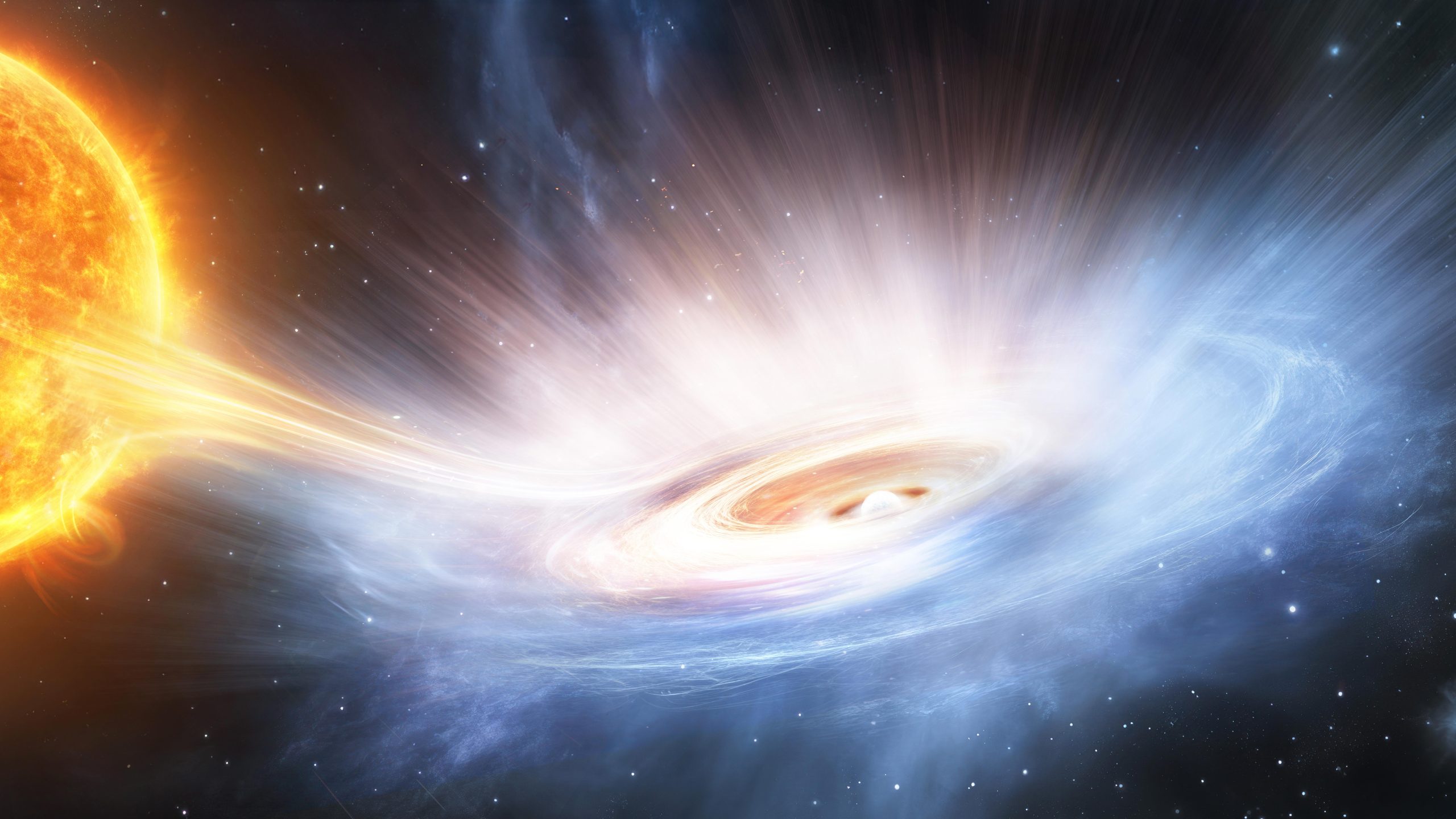
XRISM found a slow, thick wind from a neutron star, pointing to temperature as the key driver of cosmic wind behavior.
The X-Ray Imaging and Spectroscopy Mission (XRISM) has uncovered an unexpected contrast between the winds launched from matter spiraling around a neutron star and those produced near supermassive black holes. The unusually dense outflow detected from the neutron star system raises new questions about how such winds are generated and how they influence their surroundings.
On 25 February 2024, XRISM’s Resolve instrument observed the neutron star GX13+1, the collapsed core of a once massive star. GX13+1 is a strong X-ray source, produced by a disc of superheated gas, known as an accretion disc, that gradually funnels material onto the neutron star’s surface.
These inward flows of matter not only feed the neutron star but also create outflows that shape their cosmic environment. However, the exact processes driving these outflows remain unclear, which is why GX13+1 was chosen as a target for XRISM.

Winds as drivers of cosmic change
Thanks to Resolve’s unprecedented ability to analyze the energy of incoming X-ray photons, the XRISM team expected to gain new insights into these processes.
“When we first saw the wealth of details in the data, we felt we were witnessing a game-changing result,” says Matteo Guainazzi, ESA XRISM project scientist. “For many of us, it was the realization of a dream that we had chased for decades.”
Cosmic winds are far more than a scientific curiosity. They are key forces that drive change across the universe.
Such winds are also found around supermassive black holes at the centers of galaxies. They can compress giant molecular clouds to spark the birth of stars, or they can heat and scatter those clouds, halting star formation. Astronomers refer to this process as “feedback,” and in extreme cases, the winds from a supermassive black hole can determine the growth and evolution of its host galaxy.
A rare opportunity at the Eddington limit
Since the mechanisms generating the winds from supermassive black holes may be fundamentally the same as those at work around GX13+1, the team chose to look at GX13+1 because it is closer and therefore appears brighter than the supermassive black hole varieties, meaning that it can be studied in more detail.
There was a surprise. A few days before their observations were due to take place, GX13+1 unexpectedly got brighter – reaching or even exceeding a theoretical ceiling known as the Eddington limit.
The principle behind this limit is that as more matter falls onto a compact object such as a black hole or a neutron star, more energy is released. The faster energy is released, the greater the pressure it exerts on other infalling material, pushing more of it back into space. At the Eddington limit, the amount of high-energy light being produced is essentially enough to transform almost all of the infalling matter into a cosmic wind.
And Resolve happened to be watching GX13+1 as this staggering event took place.
Slow winds and puzzling differences
“We could not have scheduled this if we had tried,” said Chris Done, Durham University, UK, the lead researcher on the study. “The system went from about half its maximum radiation output to something much more intense, creating a wind that was thicker than we’d ever seen before.”
But mysteriously, the wind was not traveling at the speed that the XRISM scientists were expecting. It remained around 1 million km/h. While fast by any terrestrial standard, this is decidedly sluggish when compared to the cosmic winds produced near the Eddington limit around a supermassive black hole. In that situation, the winds can reach 20 to 30 percent the speed of light, more than 200 million km/h.
“It is still a surprise to me how ‘slow’ this wind is,” says Chris, “as well as how thick it is. It’s like looking at the Sun through a bank of fog rolling towards us. Everything goes dimmer when the fog is thick.”
It was not the only difference the team observed. XRISM had earlier revealed a wind from a supermassive black hole at the Eddington limit. There, the wind was ultrafast and clumpy, whereas the wind in GX13+1 is slow and smooth-flowing.
Temperature of accretion discs as a key factor
“The winds were utterly different, but they’re from systems which are about the same in terms of the Eddington limit. So if these winds really are just powered by radiation pressure, why are they different?” asks Chris.
The team has proposed that it comes down to the temperature of the accretion disc that forms around the central object. Counterintuitively, supermassive black holes tend to have accretion discs that are lower in temperature than those around stellar mass binary systems with black holes or neutron stars.
This is because the accretion discs around supermassive black holes are larger. They are also more luminous, but their power is spread across a larger area – everything is bigger around a big black hole. So, the typical kind of radiation released by a supermassive black hole accretion disc is ultraviolet, which carries less energy than the X-rays released by the stellar binary accretion discs.
Rethinking winds and cosmic evolution
Since ultraviolet light interacts with matter much more readily than X-rays do, Chris and her colleagues speculate that this may push the matter more efficiently, creating the faster winds observed in black hole systems.
If so, the discovery promises to reshape our understanding of how energy and matter interact in some of the most extreme environments in the Universe, providing a more complete window into the complex mechanisms that shape galaxies and drive cosmic evolution.
“The unprecedented resolution of XRISM allows us to investigate these objects – and many more –in far greater detail, paving the way for the next-generation, high-resolution X-ray telescope such as NewAthena,” says Camille Diez, ESA Research fellow.
Reference: “Stratified wind from a super-Eddington X-ray binary is slower than expected” by XRISM collaboration, XRISM collaboration, 17 September 2025, Nature.
DOI: 10.1038/s41586-025-09495-w
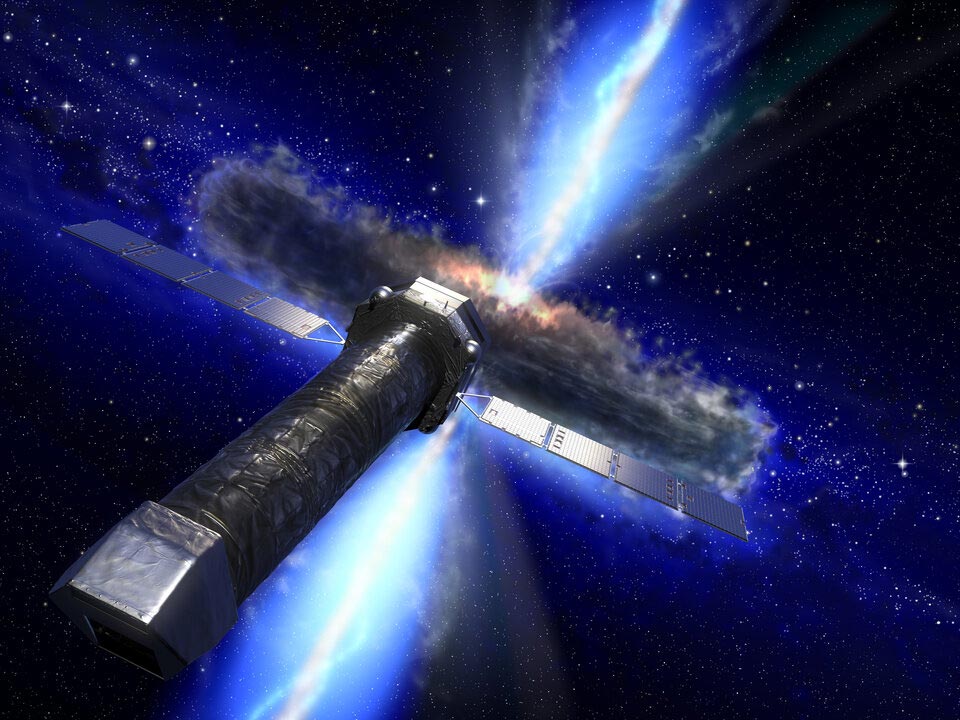
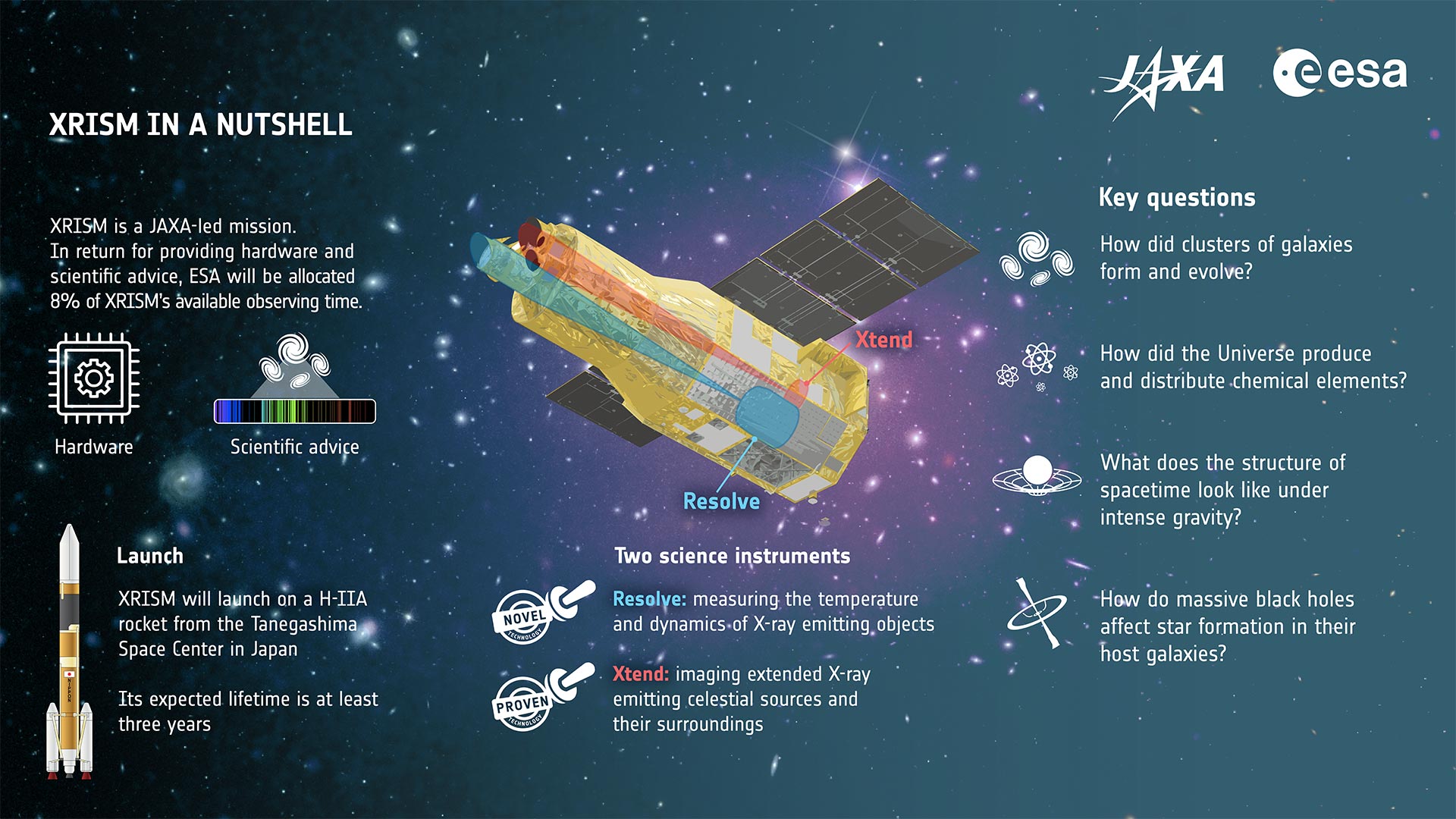
XRISM (pronounced krizz-em) was launched on September 7, 2023. It is a mission led by the Japan Aerospace Exploration Agency (JAXA) in partnership with NASA and ESA. It carries two instruments: an X-ray calorimeter called Resolve capable of measuring the energy of individual X-ray photons to produce a spectrum at unprecedented level of ‘energy resolution’ (the capability of an instrument to distinguish the X-ray ‘colours’), and a large field-of-view X-ray CCD camera to image the surrounding field called Xtend.
Never miss a breakthrough: Join the SciTechDaily newsletter.
Follow us on Google and Google News.