
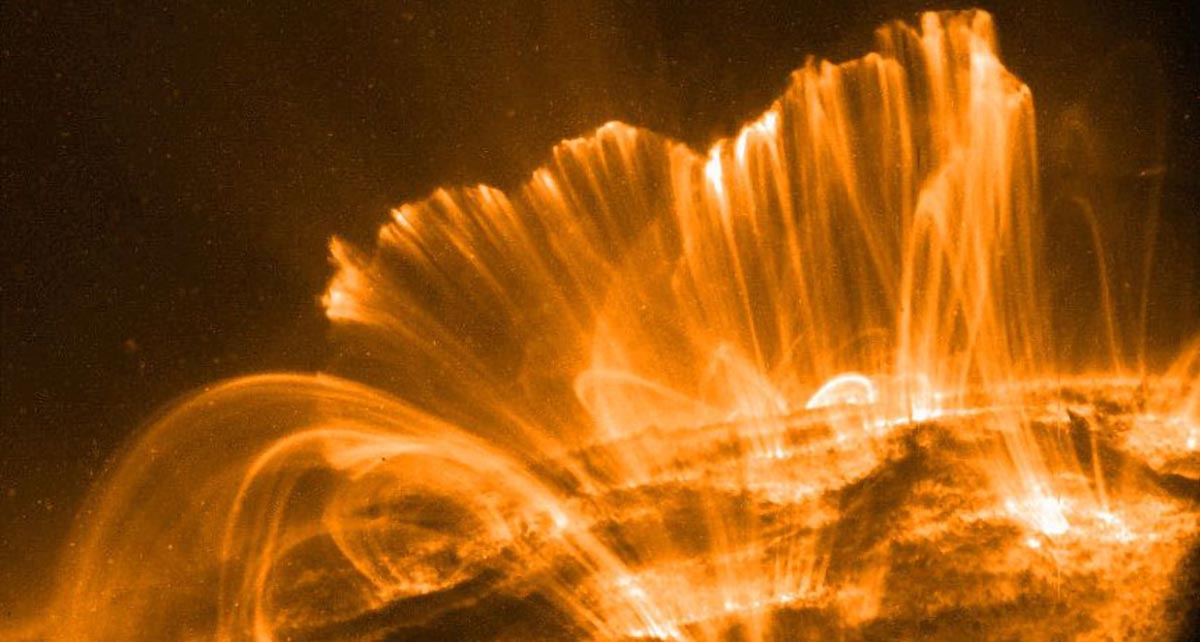
Researchers at the University of Hawaiʻi are harnessing the power of the world’s largest solar telescope and advanced AI to transform our understanding of the Sun.
Their project aims to rapidly analyze immense datasets to better predict solar phenomena like solar storms, which could lead to advancements in the accuracy and speed of solar research.
Revolutionary Solar Research
Astronomers and computer scientists at the University of Hawaiʻi Institute for Astronomy (IfA) are conducting groundbreaking research that could revolutionize our understanding of the Sun.
As part of the “SPIn4D” project, the team is merging advanced solar astronomy with cutting-edge computer science to process data collected by the world’s largest ground-based solar telescope, located atop Haleakalā in Maui.
Their work, recently published in the Astrophysical Journal, centers on developing deep learning models capable of rapidly analyzing the massive datasets generated by the NSF’s Daniel K. Inouye Solar Telescope. These efforts aim to maximize the telescope’s capabilities, paving the way for significant advances in the speed, accuracy, and depth of solar data analysis.

The Importance of Understanding Solar Storms
“Large solar storms are responsible for stunning auroras, but can also pose risks to satellites, radio communications, and power grids. A better understanding of their birthplace, the solar atmosphere, is extremely important,” said Kai Yang, an IfA postdoctoral researcher who led the work. “We used state-of-the-art simulations to mimic what the Inouye will see. Combining these data with machine learning offers an invaluable opportunity to explore the three-dimensional solar atmosphere in near real-time.”
The Inouye Solar Telescope, operated by the NSF National Solar Observatory (NSO), is by far the world’s most powerful solar telescope, and stands on the 10,000-foot summit of Maui’s Haleakalā, which translates to “the house of the Sun.” The telescope’s instruments are designed to measure the Sun’s magnetic field using polarized light, and the SPIn4D project was designed specifically to use this data, which is only available from the solar telescope’s instrumentation suite.

AI-Driven Analysis of the Solar Atmosphere
The team of scientists from NSO and High Altitude Observatory (HAO) utilizes deep neural networks to estimate the physical properties of the solar photosphere from the Inouye Solar Telescope’s high-resolution observations. This method promises to significantly speed up the analysis of the massive data volumes produced by the solar telescope, which can reach tens of terabytes per day.
“Machine learning is very good at providing fast approximations to expensive computations. In this case, the model will enable astronomers to visualize the Sun’s atmosphere in real-time, rather than waiting hours to achieve the same accuracy,” said co-author Peter Sadowski, an associate professor at the UH Mānoa information and computer sciences department.
Developing AI Tools for Solar Data
To train their AI models, the team has produced an extensive dataset of simulated solar observations. Using more than 10 million CPU hours on the NSF’s Cheyenne supercomputer, they’ve created 120 terabytes of data mimicking Inouye Solar Telescope observations at extremely high resolution.
The team has already made a 13-terabyte subset of their data publicly available, along with a detailed tutorial. They plan to release their fully trained deep learning models as a community tool for analyzing Inouye Solar Telescope observations.
Reference: “Spectropolarimetric Inversion in Four Dimensions with Deep Learning (SPIn4D). I. Overview, Magnetohydrodynamic Modeling, and Stokes Profile Synthesis” by Kai E. Yang, Lucas A. Tarr, Matthias Rempel, S. Curt Dodds, Sarah A. Jaeggli, Peter Sadowski, Thomas A. Schad, Ian Cunnyngham, Jiayi Liu, Yannik Glaser and Xudong Sun, 25 November 2024, The Astrophysical Journal.
DOI: 10.3847/1538-4357/ad865b
This research is supported by a $669,000 grant from NSF’s Astronomy and Astrophysics Grants program. The team of scientists is composed of Yang, Xudong Sun, Ian Cunningham, Jiayi Liu, Curt Dodds (UH IfA), Sadowski, Yannik Glaser (UH Mānoa ICS), and Sarah Jaeggli, Tom Schad, Lucas Tarr (NSO) and Matthias Rempel (HAO).
Never miss a breakthrough: Join the SciTechDaily newsletter.
Follow us on Google and Google News.