
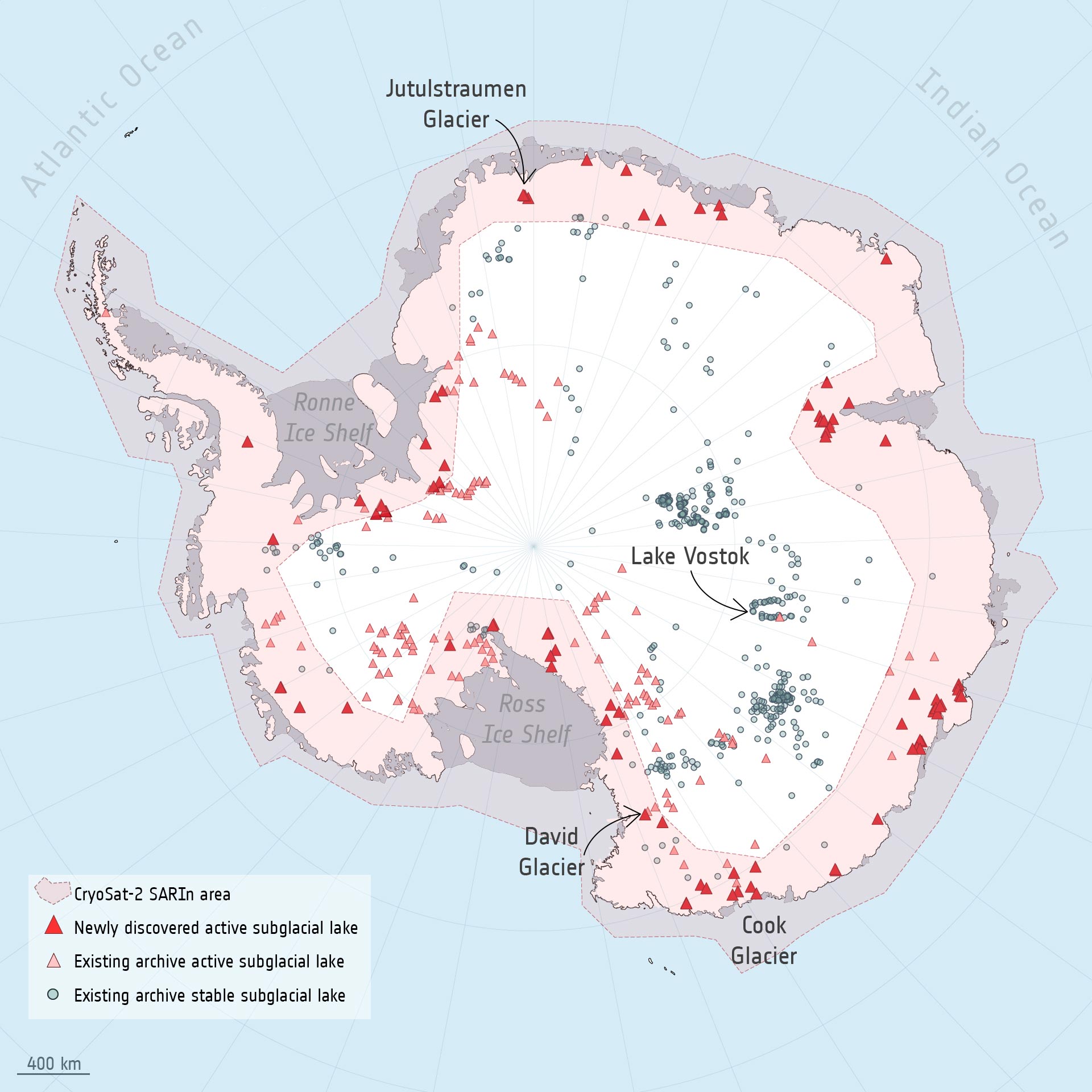
Scientists using ESA’s CryoSat satellite uncovered 85 new subglacial lakes in Antarctica, showing how hidden water networks beneath the ice drive glacier movement and affect sea level rise.
Hidden deep beneath Antarctica’s massive ice sheet are hundreds of subglacial lakes that play a vital role in shaping the continent’s frozen landscape. These underground reservoirs influence how glaciers shift and flow, which in turn affects global sea levels.
Drawing on ten years of observations from the European Space Agency’s CryoSat satellite, scientists have uncovered 85 previously unknown lakes located several kilometers beneath the ice near the South Pole. With this discovery, the number of documented active subglacial lakes in Antarctica has risen by more than half, reaching 231 in total.
Rare Insights Into Antarctic Ice Dynamics
The study, released on September 19 in Nature Communications, is especially important because these active lakes periodically drain and refill, offering a rare window into processes occurring far below the surface at the base of the ice sheet. The researchers also identified new underground drainage routes, including five systems of interconnected lakes.
Lead author Sally Wilson, a doctoral researcher at the University of Leeds, emphasized how little is currently understood about these hidden waters. The challenge, she explained, is that they are buried beneath hundreds of meters of ice.
“It is incredibly difficult to observe subglacial lake filling and draining events in these conditions, especially since they take several months or years to fill and drain. Only 36 complete cycles, from the start of subglacial filling through to the end of draining, had been observed worldwide before our study. We observed 12 more complete fill-drain events, bringing the total to 48.”
Why Satellites Matter
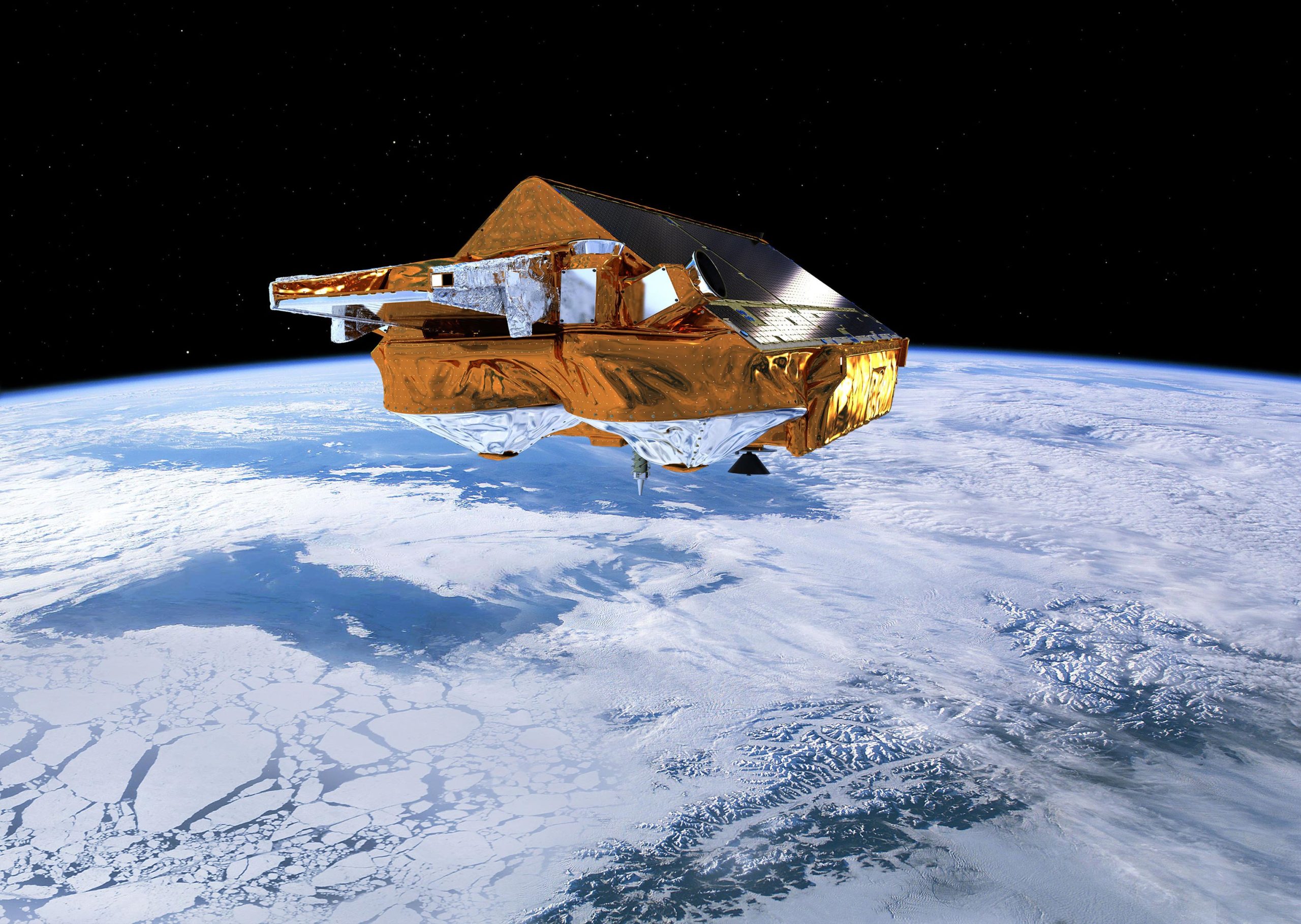
This is where satellites were able to contribute valuable data to the research. Observations from the CryoSat mission, which was launched in 2010, were able to produce a dataset spanning from 2010 to 2020.
ESA’s CryoSat satellite, part of ESA’s FutureEO program, measures the thickness of polar sea ice and monitors changes in the height of ice sheets over Greenland and Antarctica and glaciers worldwide. Its main instrument is a radar altimeter, which can detect tiny variations in the height of the ice surface as well as measure sea surface height.
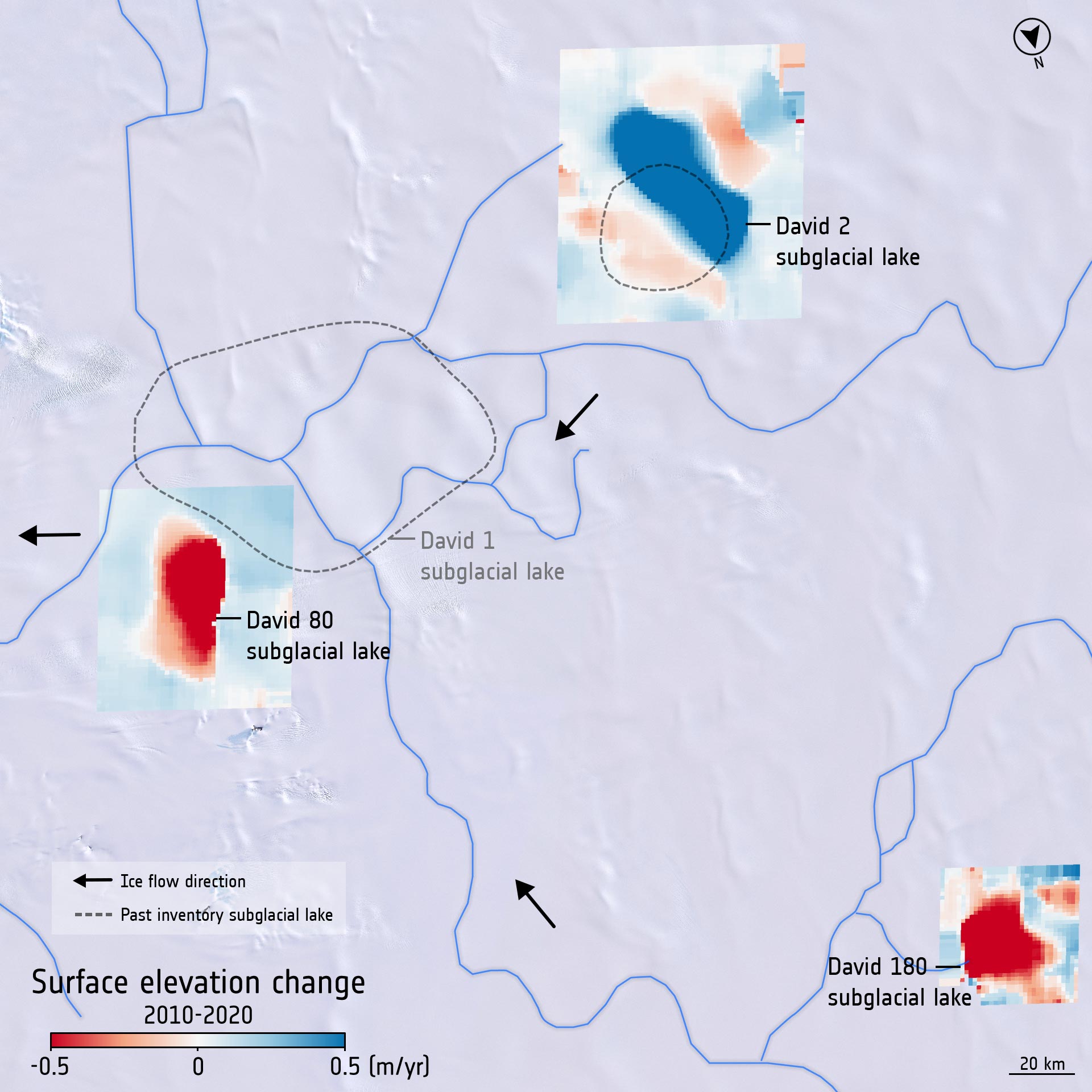
Using a decade of observations from CryoSat, researchers detected localized changes in the height of Antarctica’s icy surface, which rises and falls as the lakes fill and drain at the base of the ice sheet. They could then detect and map subglacial lakes and monitor their filling and draining cycles over time.
Anna Hogg, a co-author on the study and Professor at the University of Leeds, said, “It was fascinating to discover that the subglacial lake areas can change during different filling or draining cycles. This shows that Antarctic subglacial hydrology is much more dynamic than previously thought, so we must continue to monitor these lakes as they evolve in the future.”
A Vital Piece for Sea Level Predictions
Sally explained that observations like these are vital to understanding the structural dynamics of ice sheets and how they affect the ocean around them. “The numerical models we currently use to project the contribution of entire ice sheets to sea level rise do not include subglacial hydrology. These new datasets of subglacial lake locations, extents, and timeseries of change, will be used to develop our understanding of the processes driving water flow beneath Antarctica.”
Martin Wearing, ESA Polar Science Cluster Coordinator, noted, “This research again demonstrates the importance of data from the CryoSat mission to improve our understanding of polar regions and particularly the dynamics of ice sheets. The more we understand about the complex processes affecting the Antarctic Ice Sheet, including the flow of meltwater at the base of the ice sheet, the more accurately we will be able to project the extent of future sea level rise.”
How Does a Subglacial Lake Form?
Subglacial meltwater forms due to geothermal heat from Earth’s bedrock surface and frictional heat as ice slides over bedrock. This meltwater can pool on the bedrock surface, and periodically drains. This flow of water has the potential to reduce the friction between the ice and the bedrock it sits on, allowing ice to slide more quickly into the ocean.
Not all subglacial lakes are considered active – many are thought to be stable because they are not known to fill or drain. The biggest known subglacial lake is Lake Vostok underneath the East Antarctic Ice Sheet, holding an estimated 5,000-65,000 cubic km of water beneath 4 km of ice (the water contained in Lake Vostok is enough to fill the Grand Canyon and overflow by at least 25 %). Although Lake Vostok is thought to be stable, if it did drain, it would impact the stability of the Antarctic Ice Sheet, surrounding ocean circulation, marine habitats, and global sea level.
Implications for Climate Modelling
The filling-and-draining cycles of subglacial lakes are an important dataset for icesheet and climate models. By monitoring such phenomena, scientists can improve their understanding of interactions between the ice sheet, bedrock, ocean and atmosphere, which is key to understanding the future stability of ice sheets.
“Subglacial hydrology is a missing piece in many ice sheet models,” said Sally. “By mapping where and when these lakes are active, we can start to quantify their impact on ice dynamics and improve projections of future sea level rise.”
Reference: “Detection of 85 new active subglacial lakes in Antarctica from a decade of CryoSat-2 data” by Sally F. Wilson, Anna E. Hogg, Richard Rigby, Noel Gourmelen, Isabel Nias and Thomas Slater, 19 September 2025, Nature Communications.
DOI: 10.1038/s41467-025-63773-9
Never miss a breakthrough: Join the SciTechDaily newsletter.
Follow us on Google and Google News.