

A decade-long radio mystery has finally been solved: astronomers have linked repeating pulses to a white dwarf and red dwarf in a tight orbit.
Every two hours, their magnetic interactions generate radio bursts, a phenomenon previously only tied to neutron stars. This discovery reshapes our understanding of long-period radio transients and their origins.
Mysterious Radio Pulses Traced to an Unprecedented Home
An international team of astronomers, including a Northwestern University astrophysicist, has identified the source of mysterious radio pulses first detected a decade ago.
These pulses, occurring every two hours, were traced to a region near the Big Dipper. By analyzing data from multiple telescopes, researchers determined that the signals come from an unexpected source – a binary star system containing a dead star.
The system consists of a red dwarf and a white dwarf orbiting each other so closely that their magnetic fields interact. Every two hours, as their magnetic fields clash, they produce a powerful radio burst.
Breaking Assumptions About Radio Bursts
Until now, long-period radio pulses had only been linked to neutron stars. This discovery reveals that binary star systems can also generate these signals, expanding our understanding of how such bursts occur.
The findings were published on March 12 in the journal Nature Astronomy.
“There are several highly magnetized neutron stars, or magnetars, that are known to exhibit radio pulses with a period of a few seconds,” said Northwestern astrophysicist and study coauthor Charles Kilpatrick. “Some astrophysicists also have argued that sources might emit pulses at regular time intervals because they are spinning, so we only see the radio emission when source is rotated toward us. Now, we know at least some long-period radio transients come from binaries. We hope this motivates radio astronomers to localize new classes of sources that might arise from neutron star or magnetar binaries.”
Kilpatrick is a research assistant professor at Northwestern’s Center for Interdisciplinary Exploration and Research in Astrophysics. Iris de Ruiter, a postdoctoral scholar at the University of Sydney in Australia, led the study. At the time of the research, she was a Ph.D. student at the University of Amsterdam in the Netherlands.

Uncovering the Source of the Pulses
De Ruiter first discovered the pulses last year as she combed through archives from the Low Frequency Array (LOFAR), the largest radio telescope operating at the lowest frequencies that can be observed from Earth. Looking through the data, she found the first pulse appeared in 2015. When she subsequently sifted through more archival data from the same area of sky, de Ruiter discovered six more pulses.
Like a short flash of light — but in radio form — each pulse lasts anywhere from seconds to minutes in length. And, strangely, the pulses repeat at regular intervals, like a cosmic clock that ticks once every two hours. In recent years, astronomers have discovered more and more fast radio burst (FRBs). The radio pulses in question, however, are a much rarer event.
“The radio pulses are very similar to FRBs, but they each have different lengths,” Kilpatrick said. “The pulses have much lower energies than FRBs and usually last for several seconds, as opposed to FRBs which last milliseconds. There’s still a major question of whether there’s a continuum of objects between long-period radio transients and FRBs, or if they are distinct populations.”
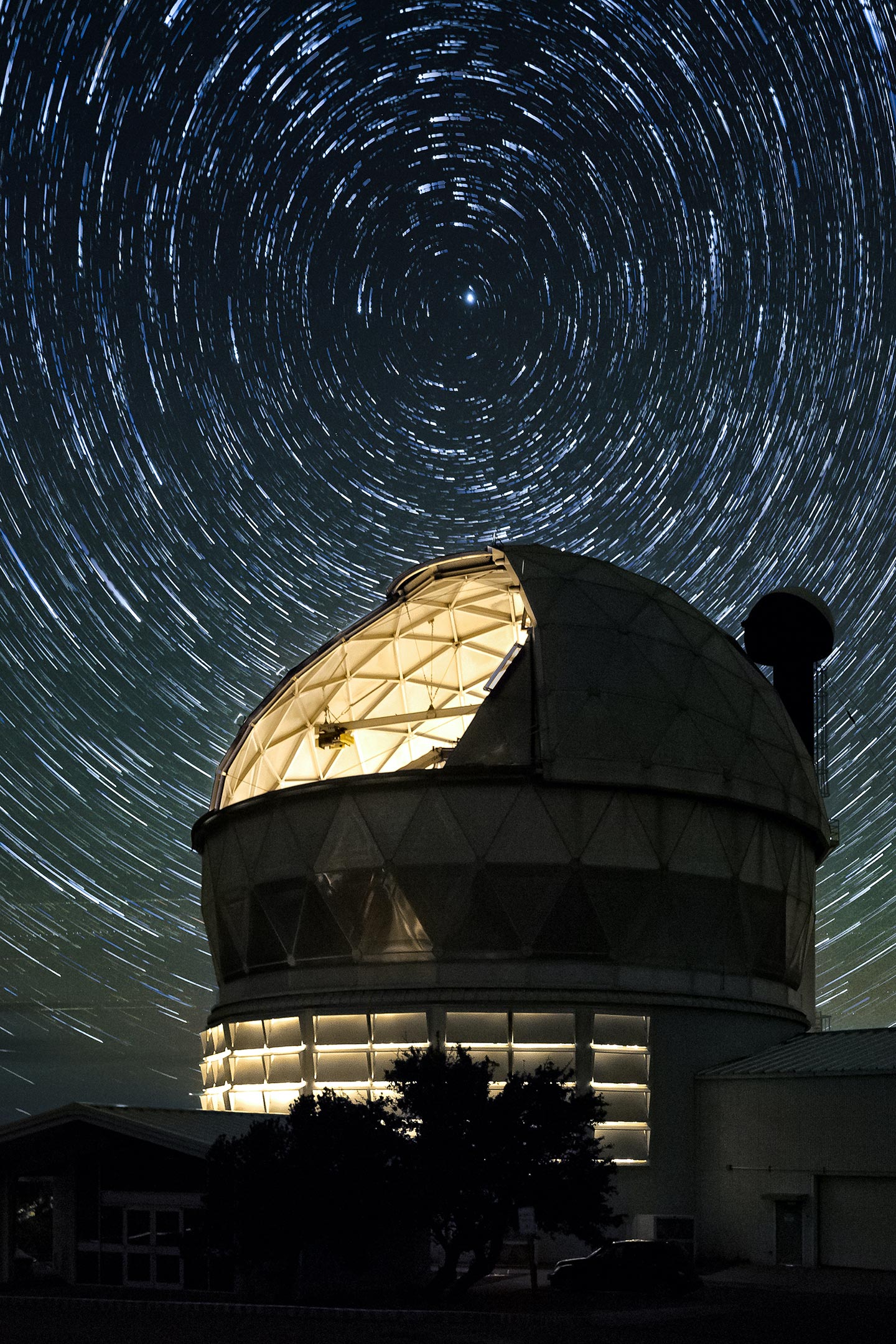
Curious about the pulses’ sources, de Ruiter and her team obtained follow-up observations from the MMT Observatory in Arizona and the McDonald Observatory in Texas. Those observations revealed the source was not one flashing star — but two stars pulsing together. Located just 1,600 lightyears from Earth, the two stars orbit a common center of gravity, making a full revolution every 125.5 minutes.
The Dead Star Dance
To confirm these findings, Kilpatrick used Northwestern’s remote access to the Multiple Mirror Telescope (MMT) in Arizona to observe the system during its full two-hour-long cycle. “Northwestern’s private access to the MMT enabled this science, which would not have been possible otherwise,” he said.
These observations allowed Kilpatrick to track variations in the system’s movement and gain optical spectra from the red dwarf. By taking light emitted from a star and splitting it into its component colors (or spectra), Kilpatrick was able to gain information about the star itself.
“The spectroscopic lines in these data allowed us to determine that the red dwarf is moving back and forth very rapidly with exactly the same two-hour period as the radio pulses,” Kilpatrick said. “That is convincing evidence that the red dwarf is in a binary system.”
A White Dwarf’s Hidden Role
The “back-and-forth” motion appeared to be from a companion star’s gravity pulling the red dwarf around. By precisely calculating the variation in these motions, Kilpatrick measured the mass of the much fainter companion. The calculated mass aligned with the typical mass of a white dwarf. While white dwarfs can range from low- to medium-mass, like our sun, red dwarfs are always much smaller and cooler.
“In almost every scenario, its mass and the fact that it is too faint to see means it must be a white dwarf,” Kilpatrick said. “This confirms the leading hypothesis for the white dwarf binary origin and is the first direct evidence we have for the progenitor systems of long-period radio transients.”
Looking to the Future
In the future, astronomers plan to study the ultraviolet emission of the binary source, dubbed ILTJ1101, in more detail. The findings could help determine the temperature of the white dwarf and reveal more about the history of white and red dwarfs.
“It was especially cool to add new pieces to the puzzle,” de Ruiter said. “We worked with experts from all kinds of astronomical disciplines. With different techniques and observations, we got a little closer to the solution step by step.”
Explore Further:
Reference: “Sporadic radio pulses from a white dwarf binary at the orbital period” by I. de Ruiter, K. M. Rajwade, C. G. Bassa, A. Rowlinson, R. A. M. J. Wijers, C. D. Kilpatrick, G. Stefansson, J. R. Callingham, J. W. T. Hessels, T. E. Clarke, W. Peters, R. A. D. Wijnands, T. W. Shimwell, S. ter Veen, V. Morello, G. R. Zeimann and S. Mahadevan, 12 March 2025, Nature Astronomy.
DOI: 10.1038/s41550-025-02491-0
The study is based in part on data obtained with the International LOFAR Telescope (ILT), designed and constructed by ASTRON.
Never miss a breakthrough: Join the SciTechDaily newsletter.
Follow us on Google and Google News.