
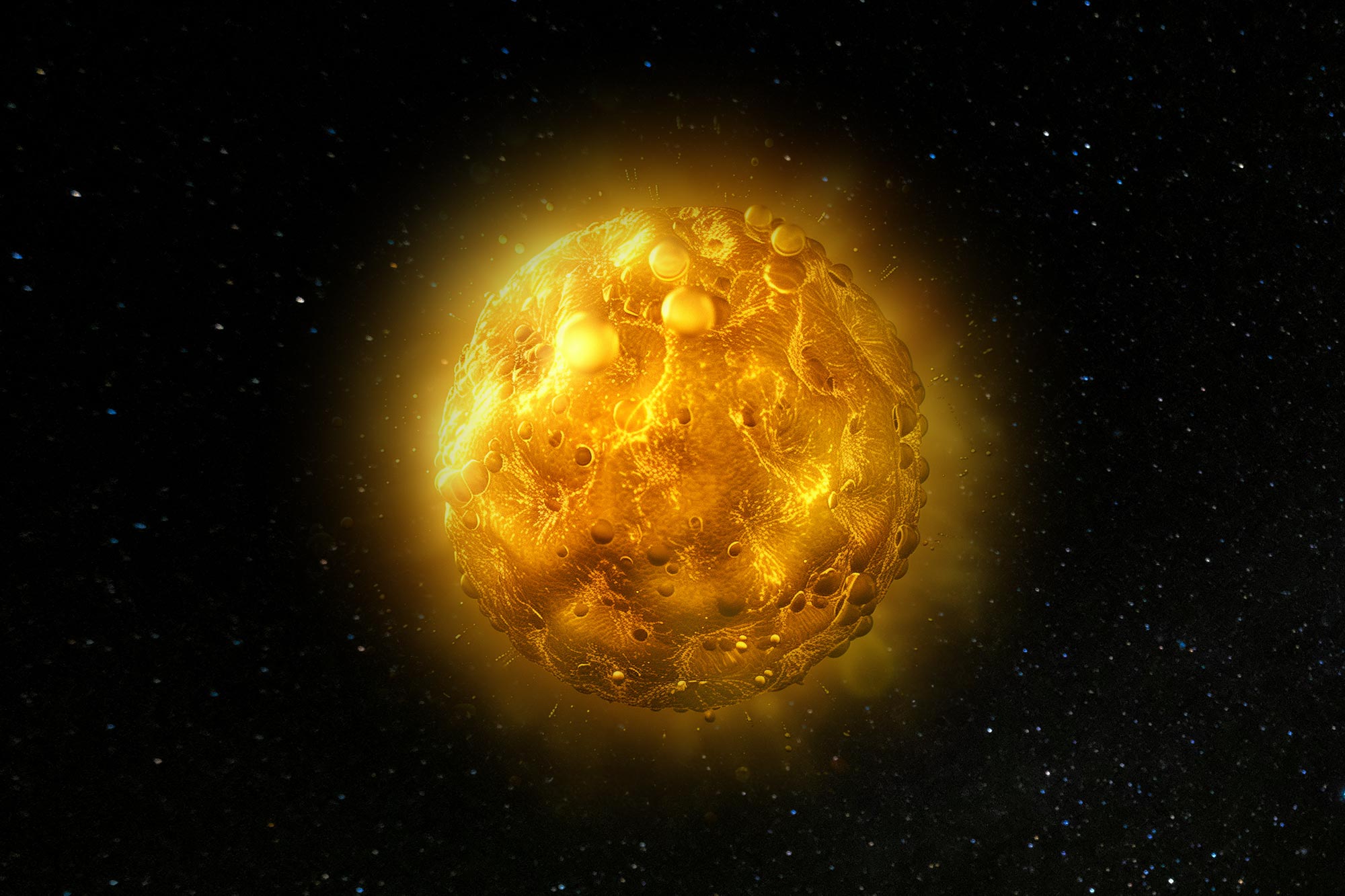
Astronomers used ALMA to capture detailed images of R Doradus, showing gas bubbles 75 times the size of the Sun, providing new insights into stellar convection processes that are critical to understanding star aging and the redistribution of elements essential for new star and planet formation.
For the first time, astronomers have captured images of a star other than the Sun in enough detail to track the motion of bubbling gas on its surface. The images of the star, R Doradus, were obtained with the Atacama Large Millimeter/submillimeter Array (ALMA), a telescope co-owned by the European Southern Observatory (ESO), in July and August 2023. They show giant, hot bubbles of gas, 75 times the size of the Sun, appearing on the surface and sinking back into the star’s interior faster than expected.
Unveiling Stellar Convection Dynamics
“This is the first time the bubbling surface of a real star can be shown in such a way,”[1] says Wouter Vlemmings, a professor at Chalmers University of Technology, Sweden, and lead author of the study published today in Nature. “We had never expected the data to be of such high quality that we could see so many details of the convection on the stellar surface.”
Stars produce energy in their cores through nuclear fusion. This energy can be carried out towards the star’s surface in huge, hot bubbles of gas, which then cool down and sink — like a lava lamp. This mixing motion, known as convection, distributes the heavy elements formed in the core, such as carbon and nitrogen, throughout the star. It is also thought to be responsible for the stellar winds that carry these elements out into the cosmos to build new stars and planets.
This video shows a timelapse of the star’s surface, where giant, hot bubbles of gas — 75 times the size of the Sun — are seen appearing on the surface and sinking back into the star’s interior. All images featured in this video are real images taken with ALMA. Credit: ALMA (ESO/NAOJ/NRAO)/W. Vlemmings et al.
Insights From a Nearby Red Giant
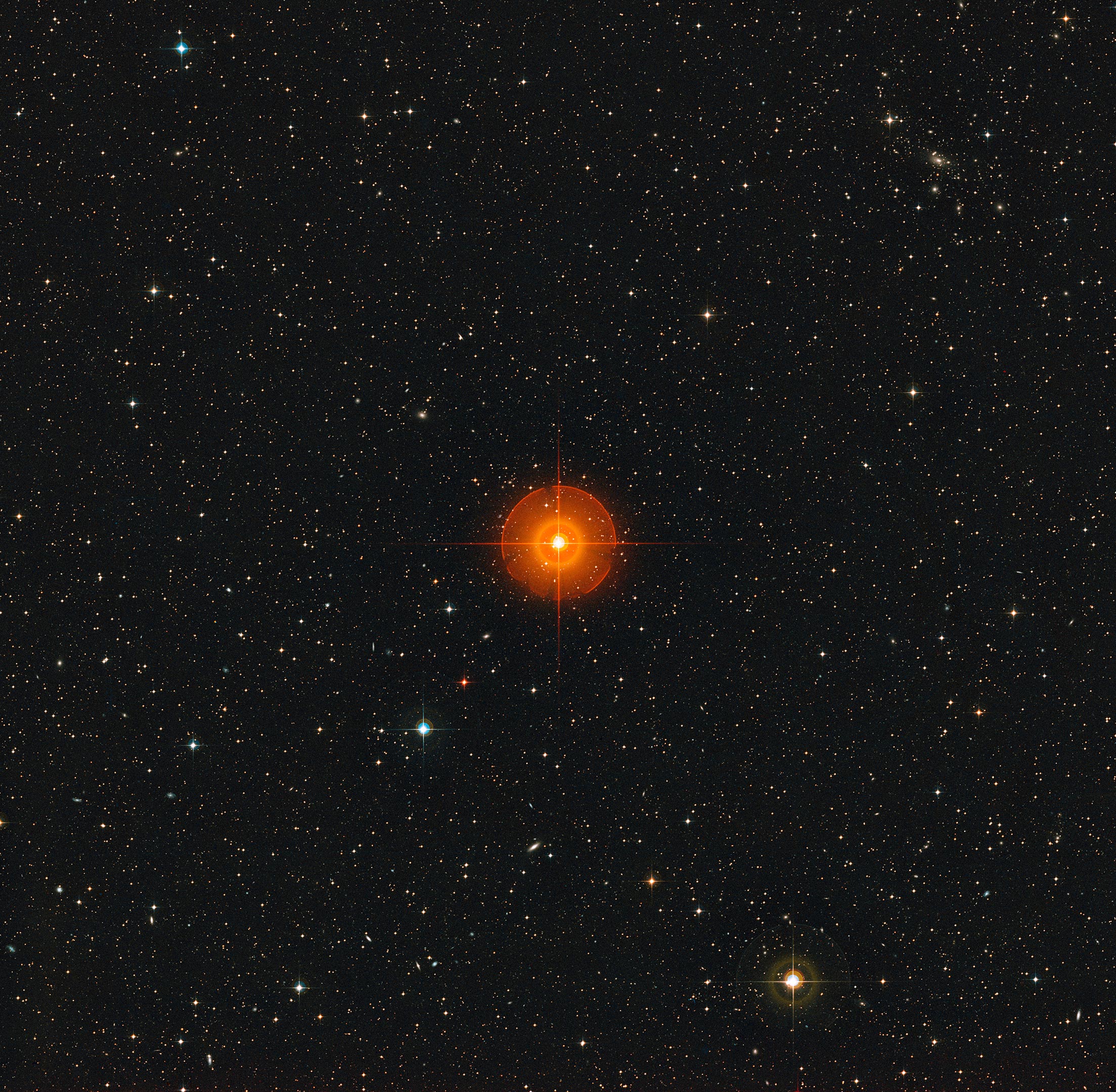
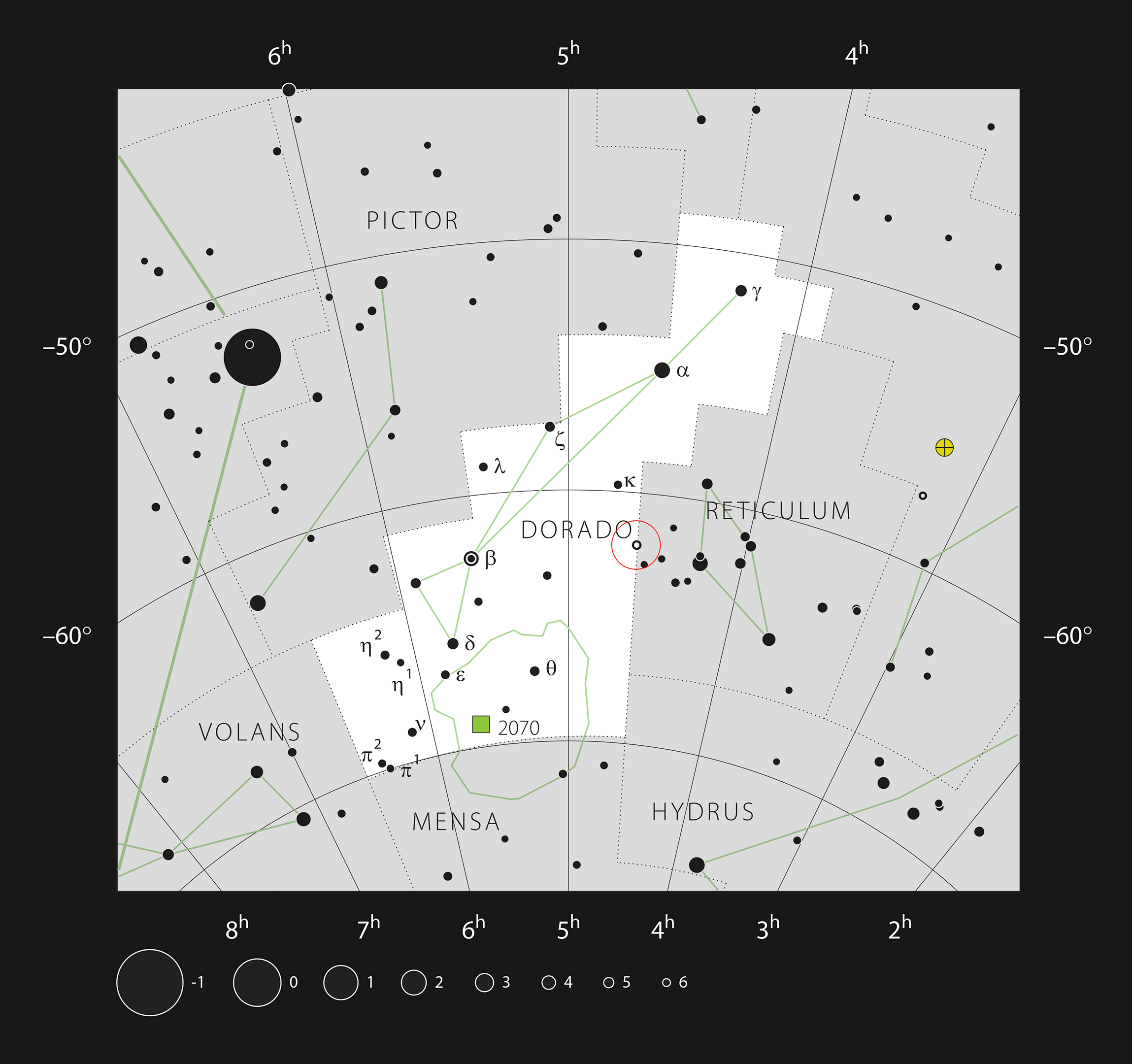
Convection motions had never been tracked in detail in stars other than the Sun, until now. By using ALMA, the team were able to obtain high-resolution images of the surface of R Doradus over the course of a month. R Doradus is a red giant star, with a diameter roughly 350 times that of the Sun, located about 180 light-years away from Earth in the constellation Dorado. Its large size and proximity to Earth make it an ideal target for detailed observations. Furthermore, its mass is similar to that of the Sun, meaning R Doradus is likely fairly similar to how our Sun will look like in five billion years, once it becomes a red giant.
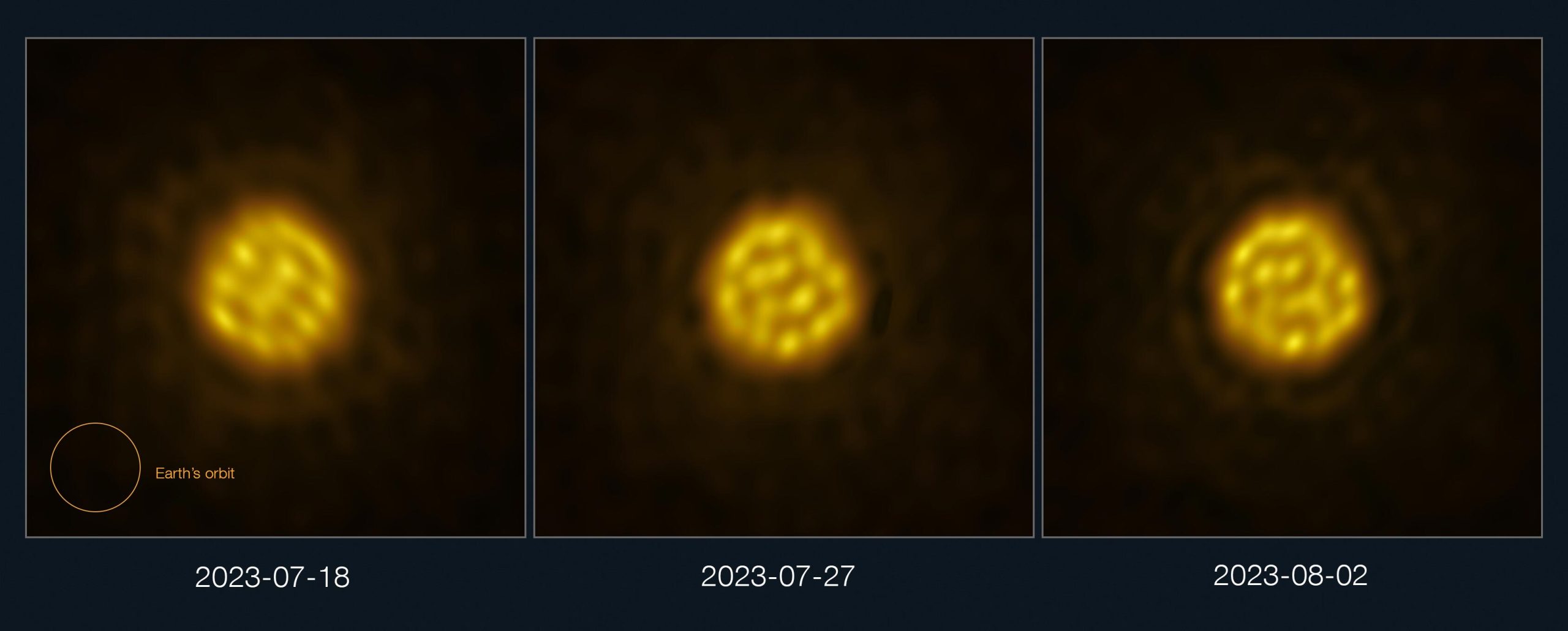
“Convection creates the beautiful granular structure seen on the surface of our Sun, but it is hard to see on other stars,” adds Theo Khouri, a researcher at Chalmers who is a co-author of the study. “With ALMA, we have now been able to not only directly see convective granules — with a size 75 times the size of our Sun! — but also measure how fast they move for the first time.”
Convection Patterns and Future Research
The granules of R Doradus appear to move on a one-month cycle, which is faster than scientists expected based on how convection works in the Sun. “We don’t yet know what is the reason for the difference. It seems that convection changes as a star gets older in ways that we don’t yet understand,” says Vlemmings. Observations like those now made of R Doradus are helping us to understand how stars like the Sun behave, even when they grow as cool, big, and bubbly as R Doradus is.
“It is spectacular that we can now directly image the details on the surface of stars so far away, and observe physics that until now was mostly only observable in our Sun,” concludes Behzad Bojnodi Arbab, a PhD student at Chalmers who was also involved in the study.
This video zooms into R Doradus. This red giant star has a diameter roughly 350 times that of the Sun and is located about 180 light-years away from Earth in the constellation Dorado. The Atacama Large Millimeter/submillimeter Array (ALMA), has recently captured images of the bubbling surface of the star R Doradus — the first time this motion is imaged in detail in a star other than the Sun.
The various images shown here, all of which are real images rather than artist’s impressions, were taken with different telescopes at different times, and have been blended together to create this zoom. The inset at the end shows a timelapse of images of the stellar surface taken with ALMA.
Credit: ESO/L. Calçada, N. Risinger (skysurvey.org), DSS, ALMA (ESO/NAOJ/NRAO)/W. Vlemmings et al. Music: Astral Electronic
Notes
- Convection bubbles have been previously observed in detail on the surface of stars, including with the PIONIER instrument on ESO’s Very Large Telescope Interferometer. However, the new ALMA observations track the motion of the bubbles in a way that was not possible before.
Reference: “One month convection timescale on the surface of a giant evolved star” by Wouter Vlemmings, Theo Khouri, Behzad Bojnordi Arbab, Elvire De Beck and Matthias Maercker, 11 September 2024, Nature.
DOI: 10.1038/s41586-024-07836-9
The team is composed of W. Vlemmings (Chalmers University of Technology, Sweden [Chalmers]), T. Khouri (Chalmers), B. Bojnordi (Chalmers), E. De Beck (Chalmers), and M. Maercker (Chalmers).
Never miss a breakthrough: Join the SciTechDaily newsletter.
Follow us on Google and Google News.
2 Comments
Vanity. Many people in the past and up till today believe that live is Vanity. I can tell you that that assumption / Idea was wrong and not thrue. People sing that Vanity upon vanity all is Vanity. I can assure you that is dangerous and not true. If You believe that in live is Vanity see you in Hell. That idea has mislead people to misbehave. When one human kil
ls another human that will leads you to Hell. No exception. Either you kills by yourself or ask other to kill, you are all in the same problems. People are very very bad. Bad bad individuals. Bad humans. Bad Servants. Bad bad news. Bad bad Products. Human and God PRODUCTS and they are all bad news. The injustices in the world is nothing to write home about. After second world war I thought things we changed but is now clear to me that that my assumption was wrong. I was wrong. I am sorry once again to all people that have passes through this Planet from beginning till today. Am sorry for every things they must have gone through. I am sorry I can not protect them. From bad people / bad Products. I will surely make it up to you. If You are unjustly killed or unjustly mistreated while you are on Earth I will make it up to you. Thanks. M. Luke. To be continued.
They are going to have to point JWST at this. Remember when Mars was though to have canals, partly because resolution was so low? Does this star really blow bubbles of star matter?