
Close Menu
    Facebook X (Twitter) Instagram
    SciTechDaily
    • Biology
    • Chemistry
    • Earth
    • Health
    • Physics
    • Science
    • Space
    • Technology
    Facebook X (Twitter) Pinterest YouTube RSS
    SciTechDaily
    Home»Space»Breaking Free in Space: ESA’s Proba-3 Satellites Separate for Historic Mission
    Space

    Breaking Free in Space: ESA’s Proba-3 Satellites Separate for Historic Mission

    By European Space Agency (ESA)January 24, 2025No Comments4 Mins Read
    Facebook Twitter Pinterest Telegram LinkedIn WhatsApp Email Reddit
    Share
    Facebook Twitter LinkedIn Pinterest Telegram Email Reddit
    Proba-3 Satellites
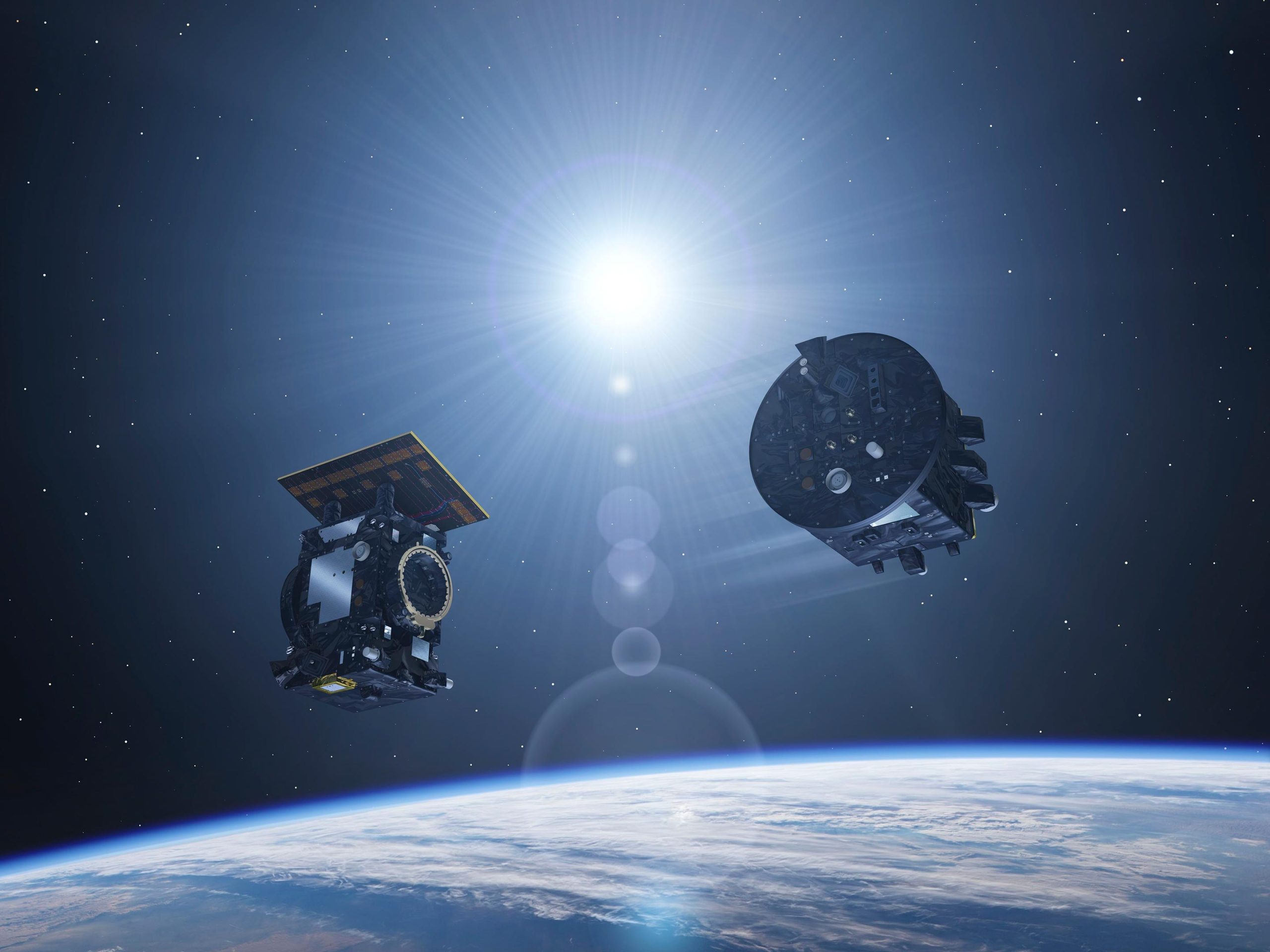
    ESA’s groundbreaking Proba-3 mission has successfully initiated its formation-flying phase, with two spacecraft now set to maintain a precise distance of 150 meters in orbit. This precision will facilitate the creation of artificial solar eclipses, providing unprecedented views of the solar corona. Credit: ESA-P. Carril

    ESA’s groundbreaking Proba-3 mission has successfully initiated its formation-flying phase, with two spacecraft now set to maintain a precise distance of 150 meters in orbit. This precision will facilitate the creation of artificial solar eclipses, providing unprecedented views of the solar corona.

    On January 14, the European Space Agency (ESA) achieved a major milestone in its Proba-3 mission, designed to create artificial solar eclipses. After flying together since their launch, the mission’s two spacecraft successfully separated, marking the beginning of the world’s first precision formation-flying mission.

    The two Proba-3 spacecraft were launched on December 5, 2024, aboard a four-stage PSLV-XL rocket from the Satish Dhawan Space Centre in Sriharikota, India. They remained connected for six weeks following launch as part of their initial mission phase.

    ESEC Operations Team Proba 3 Separation
    Operations team at ESEC in, Redu, Belgium, preparing for Proba-3 separation. Credit: ESA

    Achieving Separation

    During this period, the mission control team at ESA’s European Space Security and Education Centre in Redu, Belgium, oversaw initial system checks and calibrations. To communicate with the spacecraft, the team relied on four ground stations located in Australia, Chile, and Spain.

    The separation took place on January 14 at 23:00 GMT (January 15 at 00:00 CET) while the spacecraft were orbiting 60,000 kilometers above Earth, traveling at a speed of 1 kilometer per second.

    Proba-3 Team Inspecting Separation System Before Launch
    Proba-3 team inspecting the separation system before launch. Credit: ESA

    The Next Steps in Space

    Proba-3 mission manager Damien Galano describes the critical milestone: “The separation relied on a well-known technology, routinely used when a spacecraft separates from its launcher. The two Proba-3 spacecraft were held together by a clamp-band, which is essentially a belt tightened around two metal rings, each attached to one spacecraft. Once the clamp was released, the two satellites started slowly drifting away from each other.”

    Proba-3 Spacecraft Infographic
    Lined up with the Sun, Proba-3’s Occulter spacecraft uses its occulting disc to cast a precisely controlled shadow onto the Coronagraph spacecraft. The pair host multiple positioning technologies to achieve millimeter-level precision: GNSS receivers, radio links, optical cameras tracking flashing LEDs, a reflected laser, and shadow-detecting sensors. Credit: ESA-F. Zonno

    Although the clamp-band technology is not new, performing this kind of separation at spacecraft level – as opposed to the spacecraft/launcher separation – is uncommon, as not many satellites are launched while attached together in this way.

    “Now, the two platforms will drift up to 50 km away from each other. Over the coming week, we will determine their relative positions, then use their propulsion systems to stop this drift and bring them back into a stable, safe configuration,” Damien adds.

    Precision Formation Flying

    In their most precise formation, scheduled to be achieved initially in about two months’ time, the two Proba-3 spacecraft will be flying 150 m apart, the equivalent of one and a half football pitches, and will need to maintain their relative position down to a single millimeter, for up to six hours at a time. The distance will be maintained by a sophisticated set of propulsion and navigation systems working together using onboard autonomy.

    Proba-3 Occulter Eclipsing Sun for Coronagraph Spacecraft
     Proba-3 Occulter eclipsing Sun for Coronagraph spacecraft. Credit: ESA-P. Carril

    The mission will demonstrate this level of precision by creating artificial solar eclipses in orbit. The Occulter satellite will cast a shadow onto the main optical instrument of the Coronagraph satellite, allowing it to study the elusive solar corona.

    Multiple sensors, including a laser-based system, will ensure that the shadow of just 8 cm across created by the occulting disc will remain on the sensitive coronagraph instrument positioned 150 meters away. In this precise configuration, the two satellites will be mimicking a single, giant spacecraft.

    Proba-3 Firing Laser
    ESA’s Proba-3 spacecraft pair employs a set of positioning technologies to keep formation in space and this image shows the most precise: a laser shone from one platform to a retroreflector on the other. The reflected laser beam provides positioning precision down to a single millimeter. Credit: ESA – M. Pédoussaut / J. Versluys

    As the next step following separation, the flight control team will now make sure all systems on both spacecraft are running smoothly in preparation for the operational phase of the mission, due to begin in March.

    Never miss a breakthrough: Join the SciTechDaily newsletter.
    Follow us on Google and Google News.

    Astronomy European Space Agency Proba-3
    Share. Facebook Twitter Pinterest LinkedIn Email Reddit

    Related Articles

    Rare Solar Eruptions Explode From the Sun in New Space Time Lapse

    ESA Just Faked a Solar Eclipse – And Caught the Sun’s Hidden Halo

    Solar Eclipses on Demand: Proba-3’s Precision Satellites Enter Orbit

    Behind the Cosmic Veil: Proba-3’s Pioneering Solar Eclipse Technology

    Dancing With the Stars: Corridor Test of Proba-3’s Formation Flying Sensors

    Feared Apophis Impact Ruled Out – Asteroid Will Pass Close Enough to Earth to See With Naked Eye

    Spectacular Return to the Veil Nebula

    Tantalizing Evidence: Is the Nearest Star Cluster to the Sun Being Destroyed?

    Hubble Spots a Peculiar Sight: Unusual Spiral Galaxy With a Heavy Arm

    Leave A Reply Cancel Reply

    • Facebook
    • Twitter
    • Pinterest
    • YouTube

    Don't Miss a Discovery

    Subscribe for the Latest in Science & Tech!

    Trending News

    Scientists Discover Game-Changing New Way To Treat High Cholesterol

    This Small Change to Your Exercise Routine Could Be the Secret to Living Longer

    Scientists Discover 430,000-Year-Old Wooden Tools, Rewriting Human History

    AI Could Detect Early Signs of Alzheimer’s in Under a Minute – Far Before Traditional Tests

    What if Dark Matter Has Two Forms? Bold New Hypothesis Could Explain a Cosmic Mystery

    This Metal Melts in Your Hand – and Scientists Just Discovered Something Strange

    Beef vs. Chicken: Surprising Results From New Prediabetes Study

    Alzheimer’s Breakthrough: Scientists Discover Key Protein May Prevent Toxic Protein Clumps in the Brain

    Follow SciTechDaily
    • Facebook
    • Twitter
    • YouTube
    • Pinterest
    • Newsletter
    • RSS
    SciTech News
    • Biology News
    • Chemistry News
    • Earth News
    • Health News
    • Physics News
    • Science News
    • Space News
    • Technology News
    Recent Posts
    • Revolutionary Imaging Technique Unlocks Secrets of Matter at Extreme Speeds
    • Where Does Mass Come From? Scientists Find Evidence of a New Exotic Nuclear State
    • Quantum Breakthrough: Unhackable Keys Sent Over 120 km Using Quantum Dots
    • Researchers Discover Unknown Beetle Species Just Steps From Their Lab
    • Jellyfish Caught Feasting on Exploding Sea Worms for the First Time
    Copyright © 1998 - 2026 SciTechDaily. All Rights Reserved.
    • Science News
    • About
    • Contact
    • Editorial Board
    • Privacy Policy
    • Terms of Use

    Type above and press Enter to search. Press Esc to cancel.