
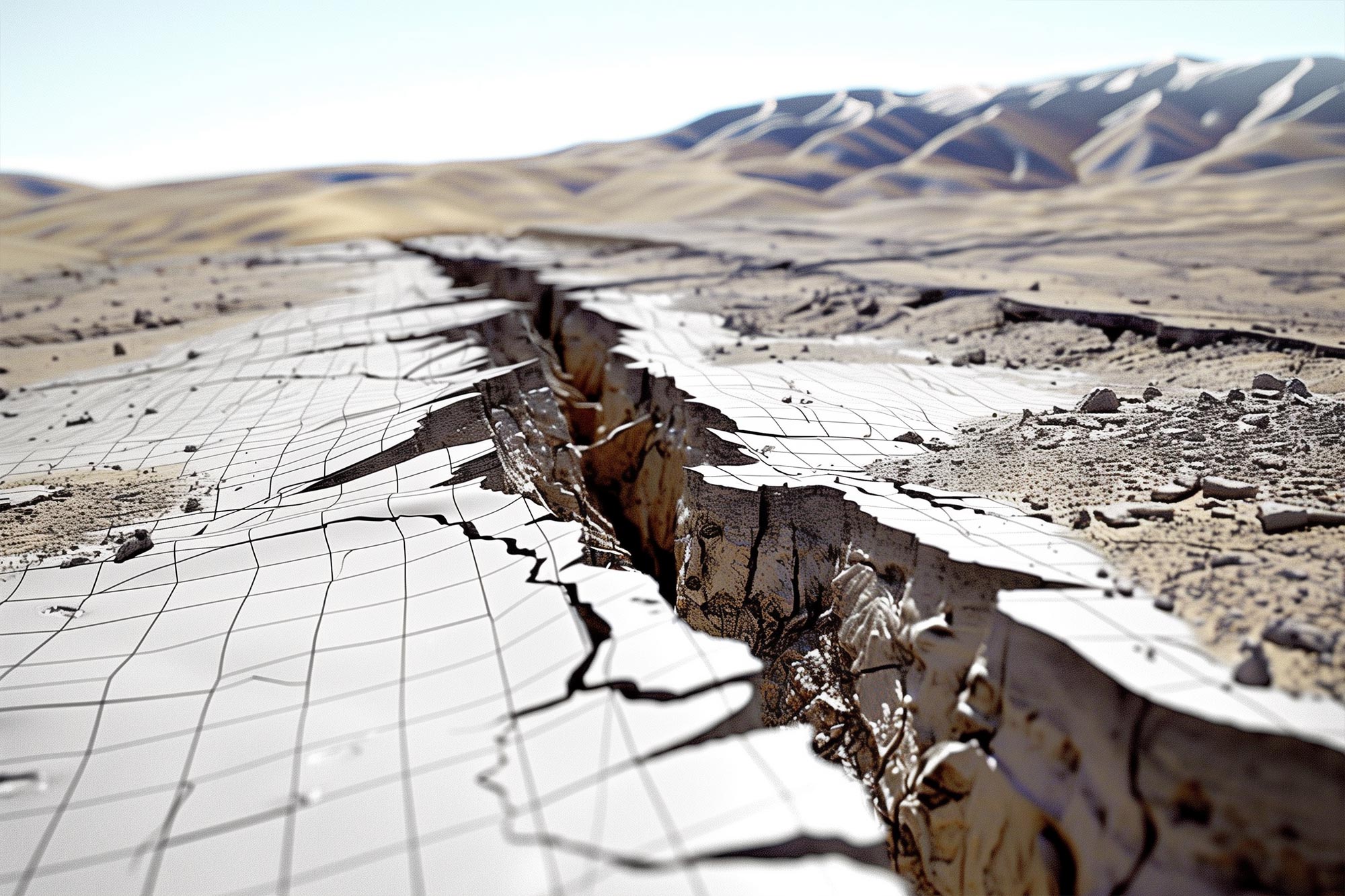
Seismic data from more than 1000 sites have shown a connection between the strength of faults and the size of earthquakes, suggesting a way to determine how close an area is to facing a major seismic event.
Situated on the Pacific Ring of Fire, Japan is among the most earthquake-prone nations globally, experiencing over 100,000 minor tremors annually, alongside the ongoing risk of a major quake. Although predicting when significant earthquakes will strike remains beyond current capabilities, Japanese seismologists aim to gain insights into the processes within the Earth’s crust that trigger major earthquakes by closely studying the frequent smaller tremors.
Now, researchers from Kyushu University and the University of Tokyo, Japan, have studied seismic activity at an unprecedented level of detail, identifying a link between fault strength and earthquake magnitude. Published in Nature Communications, the study proposes that the strength of the fault affects the b-value — and therefore the likelihood of a major earthquake.

Variability of the b-value and Fault Strength
“The b-value is a very important constant in seismology that characterizes the relationship between earthquake frequency and size,” explains Professor Satoshi Matsumoto, first author of the study and the Director of Kyushu University’s Institute of Seismology and Volcanology. “If there is a low b-value, this means there is a higher proportion of large earthquakes, while a high b-value means there is a higher proportion of smaller earthquakes.”
The b-value can vary between different locations and also over time, and is often reported to decrease just before a major earthquake. A previous study suggested that the decrease in b-value was caused by the increasing stress forces exerted on the fault. Now, this study suggests that fault strength is also a contributing factor.
In the study, the research teams analyzed the seismic action happening in the area around the epicenter of the Western Tottori Earthquake, which occurred in 2000 with a magnitude of 7.3. By installing more than 1000 seismic stations in the area, the researchers could conduct seismic observations with an unprecedented level of accuracy.

“Even two decades on, hundreds of tiny aftershocks still occur, most too small for us to feel,” says Matsumoto.
With so many sensors, the researchers could detect tiny movements of the faults, and also the orientation of each fault within the Earth’s crust.
Using this multitude of data, the team was able to estimate the stress field (the different directions of stress forces exerted on each fault at the time of failure) and allowed them to characterize the faults as strong or weak.
“Under certain stress conditions on each tectonic regime, there is a favorable direction of the fault plane to slip. When faults are in unfavorable directions, this suggests that these are weak faults that can slip more easily. On the other hand, strong faults require more stress to slip, and have a much more characteristic direction,” explains Matsumoto.
Strong Faults and Larger Earthquakes
From the stress field calculations, the researchers were also able to estimate the b-value of event group categorized by fault strength. They found that stronger faults have smaller b-values, suggesting that large earthquakes are more likely to occur, while weaker faults had larger b-values, suggesting that major earthquakes are less likely.
“Simply put, these weak faults will likely slip before a large amount of stress builds up, which means that they aren’t able to release a large amount of force,” says Matsumoto.
Through deeper understanding of the factors that impact b-values, the researchers hope that they will be able to inch closer to the “holy grail” of predicting earthquakes.
“I don’t think we will ever know exactly when an earthquake will strike, but looking at data such as fault direction and fault strength, and calculating b-values, could help us estimate when a fault has reached a critical point— where just a tiny extra nudge of force is needed for the fault to slip,” concludes Matsumoto. “This information is vital to know in order to be prepared for major earthquakes.”
Reference: “Strength dependency of frequency–magnitude distribution in earthquakes and implications for stress state criticality” by Satoshi Matsumoto, Yoshihisa Iio, Shinichi Sakai and Aitaro Kato, 11 June 2024, Nature Communications.
DOI: 10.1038/s41467-024-49422-7
Never miss a breakthrough: Join the SciTechDaily newsletter.
Follow us on Google and Google News.