
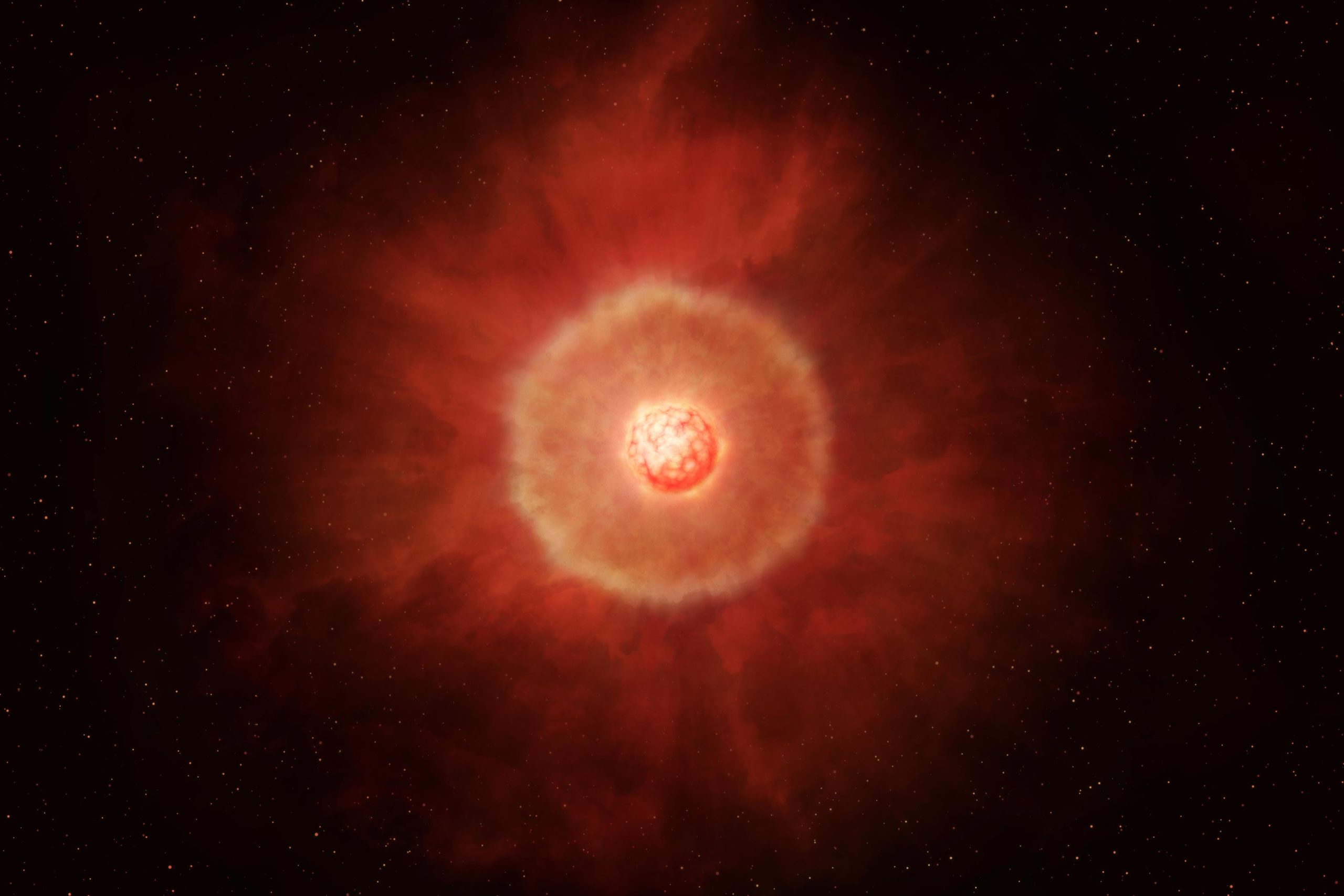
Stars with variable luminosity found to influence supply of dust that made life.
A long-period survey using AKARI and WISE infrared space telescopes found that the variable intensity of asymptotic giant branch (AGB) stars coincides with variations in the amount of interstellar dust they produce. This discovery by a University of Tokyo team could have implications for the study of the origins of life
Of the many different kinds of stars, asymptotic giant branch (AGB) stars, usually slightly larger and older than our own sun, are known producers of interstellar dust. Dusty AGBs are particularly prominent producers of dust, and the light they shine happens to vary widely. For the first time, a long-period survey has found the variable intensity of dusty AGBs coincides with variations in the amount of dust these stars produce. As this dust can lead to the creation of planets, its study can shed light on our own origins.
You’ve probably heard of the James Webb Space Telescope (JWST) which has been in the news lately. It’s famous for being the largest and most sensitive space telescope designed to observe infrared (IR) light. But long before the JWST took to the skies, two other IR space telescopes, AKARI and WISE, have been surveying the cosmos, both of which have ended their initial missions, but produced so much valuable data that astronomers are still finding new discoveries with it. The latest finding from that data by doctoral student Kengo Tachibana from the University of Tokyo’s Institute of Astronomy and his team, could have implications for the study of the origins of life itself.
Unlocking Star Secrets Through Long-Period IR Observations
“We study stars, and IR light from them is a key source of information that helps us unlock their secrets,” said Tachibana. “Until recently, most IR data was from very short-period surveys due to the lack of advanced dedicated platforms. But missions like AKARI and WISE have allowed us to take longer-period surveys of things. This means we can see how things might change over greater time periods, and what these changes might imply. Lately, we turned our attention to a certain class of star known as asymptotic giant branch stars, which are interesting because they are the main producers of interstellar dust.”
This interstellar dust is not the same stuff that accumulates on your floor when you forget to vacuum for a few days; it’s a name given to heavy elements that disperse from stars and lead to the formation of solid objects including planets. Although it’s long been known that AGBs, and especially so-called dusty AGBs, are the main producers of dust, it’s not known what the main drivers of dust production are and where we should be looking to find this out.
“Our latest study has pointed us in the right direction,” said Tachibana. “Thanks to long-period IR observations, we have found that the light from dusty AGBs varies with periods longer than several hundred days. We also found that the spherical shells of dust produced by and then ejected by these stars have concentrations of dust that vary in step with the stars’ changes in luminosity. Of the 169 dusty AGBs surveyed, no matter their variability period, the concentrations of dust around them would coincide. So, we’re certain these are connected.”
Finding a connection between the concentration of dust and the variability of stars’ brightness is just the first step in this investigation, however. Now the team wishes to explore the possible physical mechanisms behind the production of dust. For this, they intend to monitor various AGB stars for many years continuously. The University of Tokyo is nearing completion of a large ground-based telescope project, the University of Tokyo Atacama Observatory, in Chile, which will be dedicated to making infrared observations.
Reference: “Investigation of mid-infrared long-term variability of dusty AGB stars using multi-epoch scan data of AKARI and WISE” by Kengo Tachibana, Takashi Miyata, Takafumi Kamizuka, Ryou Ohsawa, Satoshi Takita, Akiharu Nakagawa, Yoshifusa Ita and Mizuho Uchiyama, 6 April 2023, Publications of the Astronomical Society of Japan.
DOI: 10.1093/pasj/psac088
Never miss a breakthrough: Join the SciTechDaily newsletter.
Follow us on Google and Google News.