
Scientists are hunting for axions, tiny particles that could solve major physics mysteries, including why neutrons don’t have an electric dipole moment and what dark matter is made of.
Using the powerful European XFEL in Hamburg, researchers fired X-rays through special crystals, hoping to witness axions converting into light—a sign of their existence. This pioneering experiment, already competitive with major particle accelerator studies, demonstrates that XFEL technology could be a game-changer in particle physics.
Searching for the Universe’s Missing Matter
Scientists from the University of Oxford, in collaboration with the UK Science and Technology Facilities Council (STFC) and other research institutions, have released new findings from their search for a hypothetical particle that could help explain dark matter. Their experiment, conducted at the European X-ray Free Electron Laser (European XFEL) in Hamburg, is detailed in a recent study published in Physical Review Letters.
The researchers are searching for axions, a theoretical particle proposed to resolve a major puzzle in physics: why neutrons, despite being made of charged quarks, do not have an electric dipole moment. Scientists believe that axions, which are extremely small and nearly massless, could “cancel out” this imbalance. If detected, axions would provide evidence of physics beyond the Standard Model.
Beyond this, axions are also considered a strong candidate for dark matter — the invisible substance that makes up most of the Universe’s mass and structure.
Harnessing the World’s Most Powerful X-Ray Laser
To conduct their search, the team used the world’s most powerful X-ray laser, the European XFEL, located in Schenefeld near Hamburg, Germany. This cutting-edge facility features a 3.4-kilometer-long tunnel with a superconducting linear accelerator and photon beamlines, capable of producing ultrashort X-ray flashes at an astonishing rate of 27,000 per second.
These are directed through thin slabs of precisely oriented germanium crystals, which have an intense internal electric field. To moving particles, the electric field appears as a strong magnetic field (~103 Tesla), enabling photons to convert into axions, and back again.
A ‘Light-Shining-Through-Walls’ Breakthrough
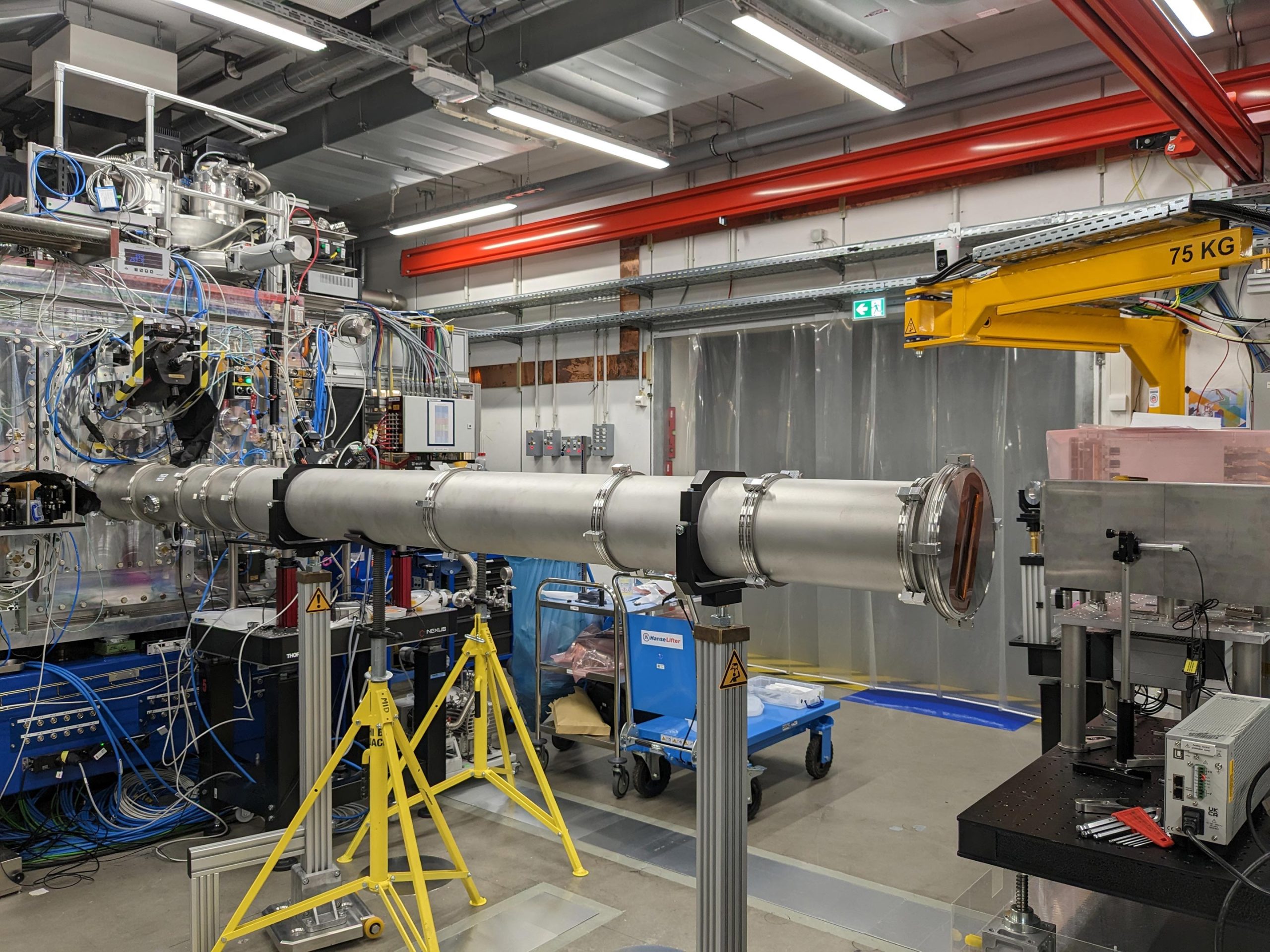
An opaque titanium sheet inserted between the crystals acts as a barrier to photons, allowing only the axions being searched for to pass through. These are then detected when they convert back into photons in the crystal on the other side – known as the ‘light-shining-through-walls’ technique.
In this proof-of-principle study, the researchers demonstrated that their setup has sensitivity to axions that is already competitive with other experiments using particle accelerators. It paves the way for future experiments in which researchers will focus on axions in the milli- to kilo-electron volt mass range. They aim to improve the sensitivity by a factor of several hundred so as to be able to detect axions with properties predicted by the theory of Quantum Chromodynamics.
A Collaborative Effort in Cutting-Edge Physics
Lead author Dr. Jack Halliday, an experimental plasma physicist at STFC, says, “This experiment underscores the versatility of XFEL technology in addressing some of the most challenging questions in fundamental physics and pushing the boundaries of our understanding of the universe.”
Principal Investigator Professor Gianluca Gregori says, “This study is the culmination of a long-standing collaboration in the Department of Physics at Oxford between myself (Atomic and Laser Physics), Professor Subir Sarkar (Theoretical Physics), and the late Professor Ian Shipsey (Particle Physics). This experiment required a difficult interpretation of a non-standard measurement, and it was thanks to the wide expertise brought together by such a team that we were able to address it successfully.”
Reference: “Bounds on Heavy Axions with an X-Ray Free Electron Laser” by Jack W. D. Halliday, Giacomo Marocco, Konstantin A. Beyer, Charles Heaton, Motoaki Nakatsutsumi, Thomas R. Preston, Charles D. Arrowsmith, Carsten Baehtz, Sebastian Goede, Oliver Humphries, Alejandro Laso Garcia, Richard Plackett, Pontus Svensson, Georgios Vacalis, Justin Wark, Daniel Wood, Ulf Zastrau, Robert Bingham, Ian Shipsey, Subir Sarkar and Gianluca Gregori, 6 February 2025, Physical Review Letters.
DOI: 10.1103/PhysRevLett.134.055001
Never miss a breakthrough: Join the SciTechDaily newsletter.
Follow us on Google and Google News.
10 Comments
Scientists are hunting for axions, tiny particles that could solve major physics mysteries, including why neutrons don’t have an electric dipole moment and what dark matter is made of.
Ask the scientists:
1. Is what you are observing necessarily an axion?
2. Are you sure that the basis for the axion is scientific?
3. How do you distinguish between science and pseudoscience?
4. Are the public all fools?
5. What do you think is shame?
6. Is the ’ The Blind and the Elephant ‘just a fable?
Scientific research guided by correct theories can enable researchers to think more. Can you get an Interpretation of Quantum Theory within the Framework of Topological Vortex Theory (TVT)? (https://scitechdaily.com/microscope-spacecrafts-most-precise-test-of-key-component-of-the-theory-of-general-relativity/#comment-875168). Can you get an Interpretation of Einstein’s Relativity within the Framework of Topological Vortex Theory (TVT)? (https://scitechdaily.com/microscope-spacecrafts-most-precise-test-of-key-component-of-the-theory-of-general-relativity/#comment-875170).
A topological vortex is a concept in physics that describes the natural gravitational field or the fluid-body coupled system. A topological vortex is formed by the interaction and balance of vortex and anti-vortex field pairs, which can be set into resonance by the body motion and interaction.
Topological Vortex Theory (TVT) treats space as an ideal fluid, posits that the topological vortex gravitational field is fundamental to the structure of the universe, and emphasizes the importance of topological phase transitions in understanding mass, inertia, and energy.
According to the Topological Vortex Theory (TVT), spins create everything, spins shape the world. There are substantial distinctions between Topological Vortex Theory (TVT) and traditional physical theories. Grounded in the inviscid, incompressible, and isotropic spaces, TVT introduces the concept of topological phase transitions and employs topological principles to elucidate the formation and evolution of matter in the universe, as well as the impact of interactions between topological vortices and anti-vortices on spacetime dynamics and thermodynamics.
Within TVT, low-dimensional spacetime matter serves as the foundation for high-dimensional spacetime matter, and the hierarchical structure of matter and its interaction mechanisms challenge conventional macroscopic and microscopic interpretations. The conflict between Quantum Physics and Classical Physics can be attributed to their differing focuses: Quantum Physics emphasizes low-dimensional spacetime matter, whereas Classical Physics centers on high-dimensional spacetime matter.
Subatomic particles in the quantum world often defy the familiar rules of the physical world. The fact repeatedly suggests that the familiar rules of the physical world are pseudoscience. In the familiar rules of the physical world, two sets of cobalt-60 can form the mirror image of each other by rotating in opposite directions, and should receive the Nobel Prize for physics.
Please witness the grand performance of some so-called peer review publications (including PRL, PNAS, Nature, Science, etc.). https://scitechdaily.com/microscope-spacecrafts-most-precise-test-of-key-component-of-the-theory-of-general-relativity/#comment-854286. Some so-called academic publications (including PRL, PNAS, Nature, Science, etc.) are addicted to their own small circles and have deviated from science for a long time.
As the background of various material interactions and movements, space exhibits inviscid, absolutely incompressible and isotropic physical characteristics. It may form various forms of spacetime vortices through topological phase transitions. Hence, vortex phenomena are ubiquitous in cosmic space, from vortices of quantum particles and living cells to tornados and black holes. Stars and radioactive elements are one of the most active topological nodes in spacetime. Utilizing them is more valuable and meaningful than simulating them. Small or micro power topology intelligent batteries may be the direction of future energy research and development for human society.
Under the topological vortex architecture, science and pseudoscience are clear at a glance. Topological Vortex Theory (TVT) can play a crucial role in elucidating the foundations of physics, establishing its principles, and combating pseudoscience. Therefore, TVT has been strongly opposed and boycotted by traditional so-called peer review publications (such as PRL, PNAS, Nature, Science, etc.).
These so-called peer review publications (including PRL, PNAS, Nature, Science, etc.) mislead the direction of science and are known for their various absurdities and wonders. They collude together, reference each other, and use so-called Impact Factor (IF) or the Nobel Prize to deceive people around.
Ask the so-called peer review publications (including PRL, PNAS, Nature, Science, etc.):
1. What are your criteria for distinguishing science from pseudoscience?
2. Is your Impact Factor (IF) the standard for distinguishing science from pseudoscience?
3. Is the Nobel Prize the standard for distinguishing science from pseudoscience?
4. What is the most important aspect of academic publications?
5. Is the most important aspect of academic publications being flashy and impractical articles?
Pseudo academic publications (including PRL, PNAS, Nature, Science, etc.) are neither inclusivity nor openness, nor transparency and fairness, and have already had a serious negative impact on the progress of science and technology. Some so-called peer review publications (including PRL, PNAS, Nature, Science, etc.) are addicted to their own small circle and no longer know what science is. They hardly know what is dirty and ugly.
Publications that mislead the public under the guise of scholarship are more reprehensible than ordinary publications. The field of physics faces an ongoing challenge in maintaining scientific rigor and integrity in the face of pervasive pseudoscientific claims. Fighting against rampant pseudoscience, physics still has a long way to go.
While my comments may be lengthy, they are necessary to combat the proliferation of rampant pseudoscience and to promote the advancement of science and technology, and also is all I can do.
Appreciate the SciTechDaily for its inclusivity, openness, transparency, and fairness. If the researchers are truly interested in cosmic matter, please read: A Brief History of the Evolution of Cosmic Matter (https://scitechdaily.com/microscope-spacecrafts-most-precise-test-of-key-component-of-the-theory-of-general-relativity/#comment-873523).
Topological Vortex Theory (TVT) is based on topology and fluid dynamics, which have solid mathematical and physical foundations. Under the topological vortex architecture, science and pseudoscience are clear at a glance. Topological Vortex Theory (TVT) can play a crucial role in elucidating the foundations of physics, establishing its principles, and combating pseudoscience.
However, some individuals, some AI (https://zhuanlan.zhihu.com/p/23079945169), and some so-called peer review publications (including PRL, PNAS, Nature, Science, etc.) stubbornly believe that two sets of cobalt-60 can form the mirror image of each other by rotating in opposite directions (https://scitechdaily.com/microscope-spacecrafts-most-precise-test-of-key-component-of-the-theory-of-general-relativity/#comment-854286), and stubbornly believe that the Topological Vortex Theory (TVT) currently lacks validation. This is because they have been misled by pseudoscientific information.
Vortex phenomena are ubiquitous in cosmic space, from vortices of quantum particles and living cells to tornados and black holes. The inviscid and incompressible spaces have been widely used in engineering simulation (https://scitechdaily.com/microscope-spacecrafts-most-precise-test-of-key-component-of-the-theory-of-general-relativity/#comment-870077). These all are the most powerful verification and validation.
Ask some so-called peer review publications (including PRL, PNAS, Nature, Science, etc.) again:
1. Does space not exist?
2. Does time not exist?
3. Does the ideal fluid not exist?
4. Do scientific experiments require time and space?
5. Do certain engineering simulations require ideal fluids?
6. If non-existent things are applied to scientific experiments and engineering simulations, and good results can be achieved. So, what is the difference between the non-existent thing and God?
Some individuals and some so-called peer review publications (including PRL, PNAS, Nature, Science, etc.) have been misleading the public with confusing concepts (https://pic2.zhimg.com/v2-4127b0b58fe8b88feb27c189fb705029_1440w.jpg?source=172ae18b), unscientific logic and reasoning, and self righteous Impact Factor (IF), hindering the progress of science and technology.
Fighting against rampant pseudoscience, physics still has a long way to go.
“The researchers are searching for axions, a theoretical particle proposed to resolve a major puzzle in physics: why neutrons, despite being made of charged quarks, do not have an electric dipole moment. Scientists believe that axions, which are extremely small and nearly massless, could “cancel out” this imbalance.”
It seems the quarks would only have to line up on a common spin axis, maybe more likely is a fundamental phase-change where quarks overlap/nest. “Lining up” could be vertical to spin or it can concentrically divide a common spin plane using ring structures. I look for triaxial retroreflection geometries in quark triplets, such a geometry could reduce to overlap in a single spinning flat disk that tends, on cooling, to face the strongest gravity source influencing it, which would also be a sort of Hebbian learning/annealing response.
“do not have an electric dipole moment”
A story today shows through probing small regions of the proton that the quark density resembles a standard random distribution. Neutron should be similar.
My way of looking at quark triplets at low temperatures, as in my previous post here, is more like a field-retro-reflective condensed state, at more energetic (strongly perturbed) temperatures it’s a field-reflective bound gas-like state that could re-create a standard mass distribution and avoid a systematic charge dipole, due in .part to the tightness of self-cancelling dipole effects in the unperturbed triplet and in part due to the triplet being perturbed.
Not sure how far to take it, but there is a notion I’ve seen, somewhere obscure, of force fields, wherein whenever particle magnetic binding effects come into play, electrostatic charge effects will be entirely supplanted by spinning effects, or by orbit effects, of the responsible charge. I could draw a few conclusions from that, suggesting division of binding energies between (strong/gravity) and (weak/ electromagnetic) binding energies, where new particles aren’t needed, but this one comment is already lengthy.
“electrostatic charge effects will be entirely supplanted by spinning effects, or by orbit effects, of the responsible charge”
It’s not a common idea, maybe more context would help but I haven’t been able to recall the source for it. On more thought it’s not looking visualizable to me as is. Maybe a hybrid of charge and magnetism works better, where only the magnetic poles are dominated by magnet flux while the equator is dominated by charge flux. I think I can visualize it without too much effort. Saw something that seemed very similar to that with a multi-nucleon system recently.
It’s maybe the best of both worlds.
Electrons with opposing spins don’t need a lot of provoking to pair together around a nucleus, loosely bound in a single orbital.
Opposing spin dipoles couple as opposing magnets while radiating charge away from the spin plane and confine magnetism like opposing magnet “keepers.” The coupling would be loose at shared orbital energy levels but could be more compact for coupled fractional charges.
Magnetic aspects and charge aspects would work as a team and avoid interfering with each other by localizing orthogonally while sharing a surface.
“The researchers are searching for axions, a theoretical particle proposed to resolve a major puzzle in physics: why neutrons, despite being made of charged quarks, do not have an electric dipole moment. Scientists believe that axions, which are extremely small and nearly massless, could “cancel out” this imbalance.”
The energy attributed to axions is part of the binding energy within the neutron, if you ask me. That being the case it can’t run away like a neutrino or hypothetical dark matter.
Maybe I missed something, the whole dark matter idea seems particle-happy. Every phase-change needs a new field particle now? Maybe it’s a Noether approach? I’m reminded of how it took so long to find the levitating trick with the spinning magnets.
The neutron should be tending to a unified dipole where component charges work together, in combination.
simple reason is a single unitary large dipole, compared to three small loosely linked dipoles bouncing around against themselves, is going to behave self-coherently, not disjointedly so to be radiating energy away on a continuing basis. Again, I’m remind everyone else seemed to be slow on the uptake about levitation in spin-locked magnets, and it’s only two spinning dipoles, not three, and they’re both visible, even.
Headless sentence and a typo “reminded” there. Sorry.
Oh well, not trying to impress everyone right now.
Anyway, the neutron is like quark-based magnets, each carrying one or two spinning fractional charges, It’s a 3-quark magnetic binding, not simply a charge binding.
Why limit it to three quarks, with one having twice the charge of the others, is a separate issue. That issue involves the three magnetic parts, not their shared bindings. I suppose three independent dimensions of spin and of gravity squeeze into the picture somewhere. Haven’t thought much about fitting an extra dimension in there, particularly one with a wormhole or a true shortcut in it. Four quarks combined is apparently less stable than three combined bound to a pair.
I mean it seems to me it’s most likely magnetic inter-quark binding energy, not simply a strong/gravity force binding energy, dominating neutrons. It shouldn’t require an axion to make/break quark magnets (or any other types of magnets) stick/stuck together in alignment as a single larger magnet.
Could be the magnetic binding ends up being quantized by electro-weak bosons, just guessing. These are just impressions I’ve gathered over a long time with only one lightweight course in freshman atomic physics around taken ~1980.