
An international team of astronomers has debunked the theory that stars and dark matter inexplicably compensate for each other in galaxies, revealing this perceived uniformity is due to oversimplified astronomical models.
By employing more detailed models and extensive data from the Very Large Telescope, the team demonstrated the true complexity of galactic structures, challenging the established understanding of galaxy formation and evolution.
A longstanding ‘conspiracy’ in astronomy – that stars and dark matter are interacting in inexplicable ways – has been overturned by an international team of astronomers, in a paper published on August 10 in Monthly Notices of the Royal Astronomical Society (MNRAS).
The authors are based in Australia, the UK, Austria, and Germany, and used the Very Large Telescope in Chile.
The conspiracy emerged to explain a phenomenon that had puzzled astronomers for a quarter of a century. The density of matter in different galaxies appeared to be decreasing at the same rate from their center to outer edges. This was perplexing because galaxies are diverse, with many different ages, shapes, sizes, and numbers of stars. So why would they have the same density structure?
Rethinking Galactic Structures
“This homogeneity suggested that dark matter and stars must somehow compensate for each other in order to produce such regular mass structures,” says Dr. Caro Derkenne, the first author of the paper and an ASTRO 3D researcher from Macquarie University.
Like many conspiracies, no researcher could come up with a mechanism. If dark matter and stars could interact in this way, then we would need to change our understanding of how galaxies form and evolve. But they also couldn’t find an alternate reason to explain what they were seeing, until now.

Derkenne and her colleagues found that the similarity in density might not be due to the galaxies themselves but to how astronomers were measuring and modeling them.
Advanced Modeling Reveals New Insights
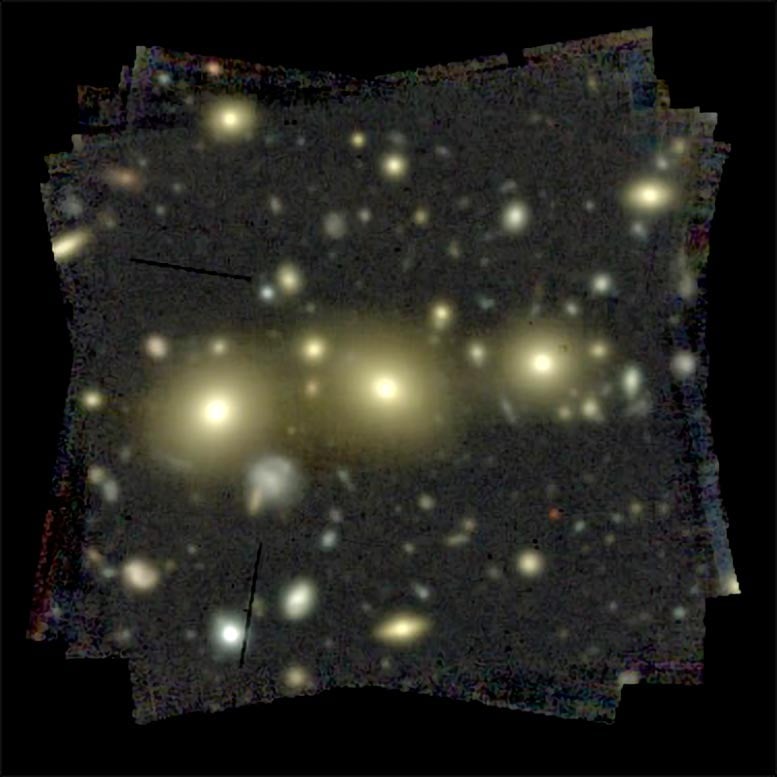
The team observed 22 middle-aged galaxies (looking back some four billion years in the past due to their great distance) in extraordinary detail, using the European Southern Observatory’s Very Large Telescope in Chile. It enabled them to create more complex models that better captured the diversity of galaxies in the universe.
“In the past, people built simple models that had too many simplifications and assumptions,” says Derkenne.
“Galaxies are complicated, and we have to model them with freedom or we’re going to measure the wrong things. Our models ran on the OzStar supercomputer at Swinburne University, using the equivalent of about 8,000 hours of desktop computing time.”
Impact Beyond Astronomy
Derkenne is now applying her astronomy expertise to complex data for the Australia Public Service.
“Astronomy sets you up really well to understand big data,” she says. “The real world is messy, and we don’t always have all the data. No one is there to tell you the answers or if you’re wrong or right. You need to accumulate data and analyze until you find something that works.”
The project used MUSE (Multi Unit Spectroscopic Explorer) on the VLT to analyze the galaxies from the MAGPI survey (Middle Ages Galaxy Properties with Integral field spectroscopy). MUSE collects spectral data cubes in which every single pixel is actually a spectrum.
“The MAGPI project is a great example of how training workshops and collaborative space within ASTRO 3D have utilized Australia’s strategic partnership with the European Southern Observatory,” says ASTRO 3D Director Professor Emma Ryan-Weber.
“The complex data from the ESO Very Large Telescope has not only solved a long-standing problem in Astronomy, but also enabled young scientists, such as Dr. Caro Derkenne, a platform on which to launch their careers to solve real-world problems,” she says.
Reference: “The MAGPI Survey: Evidence against the bulge-halo conspiracy” by C Derkenne, R M McDermid, G Santucci, A Poci, S Thater, S Bellstedt, J T Mendel, C Foster, K E Harborne, C D P Lagos, E Wisnioski, S Croom, R-S Remus, L M Valenzuela, J van de Sande, S M Sweet and B Ziegler, 10 August 2024, Monthly Notices of the Royal Astronomical Society.
DOI: 10.1093/mnras/stae1836
The co-authors are from the International Centre for Radio Astronomy Research (ICRAR) in Western Australia, University of Durham, University of Vienna, the Australian National University, University of New South Wales Sydney, University of Sydney, Ludwig-Maximilians-Universität, and University of Queensland.
Never miss a breakthrough: Join the SciTechDaily newsletter.
Follow us on Google and Google News.
6 Comments
One question that I haven’t heard much about and could answer some unknowns . Do black holes have the same effect on dark matter or dark energy as to how light cannot escape the black hole gravity ?
Or, is dark matter more like a magnetic field that “perturbes” and merges the galaxies in close proximity…? And does dark matter “flow and flex” like earth’s magnetic field does when perturbed by solar wind…?
“An international team of astronomers has debunked the theory that stars and dark matter inexplicably compensate for each other in galaxies…”
What a bizarre statement, yet it’s par for the course for relativity flacking.
Q: How does one logically jump from a conclusion of time dilation velocities existing in SR’s twin’s paradox, which is based on velocity-based Lorentz transforms deriving from lightspeed being the fastest rate for information flow (PS: no such thing as Lorentz time contraction), to the notion that gravitational redshift/blueshift means time dilation/contraction as opposed to, say, mere light distortion?
A: Superior breeding, that’s the ticket. Just kidding. The answer is it takes lots and lots of regularly scheduled gravity field scarecrow kiddie outreach programming from paid media sources eager to assist in to mastering this topic with all of its vital military importance.
.
Helps to pretend that acceleration is the same thing as velocity, for sure. I mean it’s not for everyone, it’s just for the people of the true gravitas.
There has to be a way of deciding whether a criticism of general relativity is serious enough to warrant a global def-con military response mode with hacks and drones, instead of the default reprogramming approaches most often characterizable as childish ridicule taking unearned credit for pretending to know how GPS works without admitting GPS is regularly recalibrated.
It’s ultimately about enforcing the counter-intellectual conceit that gravity cannot affect the speed of light in a vacuum. Maybe a well-fanged avatar would help.