

A new study highlights the key role the Southern Ocean plays in the Earth’s climate system.
Around 12,000 years ago, the last Ice Age drew to a close, global temperatures climbed, and the early Holocene began. During this period of warming, human communities gradually shifted toward more permanent settlements. A new study published in Nature Geoscience highlights how the Southern Ocean around Antarctica played a key part in this major climatic transition.
The research, led by Dr Huang Huang of the Laoshan Laboratory in Qingdao with contributions from GEOMAR geochemist Dr Marcus Gutjahr, traces how Antarctic Bottom Water (AABW) changed across the Southern Ocean over the past 32,000 years.
“We wanted to understand how the influence of Antarctic Bottom Water, the coldest and densest water mass in the global ocean, changed during the last deglaciation, and what role it played in the global carbon cycle,” says Huang, who completed his PhD at GEOMAR in 2019 and now works as a scientist in Qingdao, China.
Sediment cores reveal the origin of deep-water masses
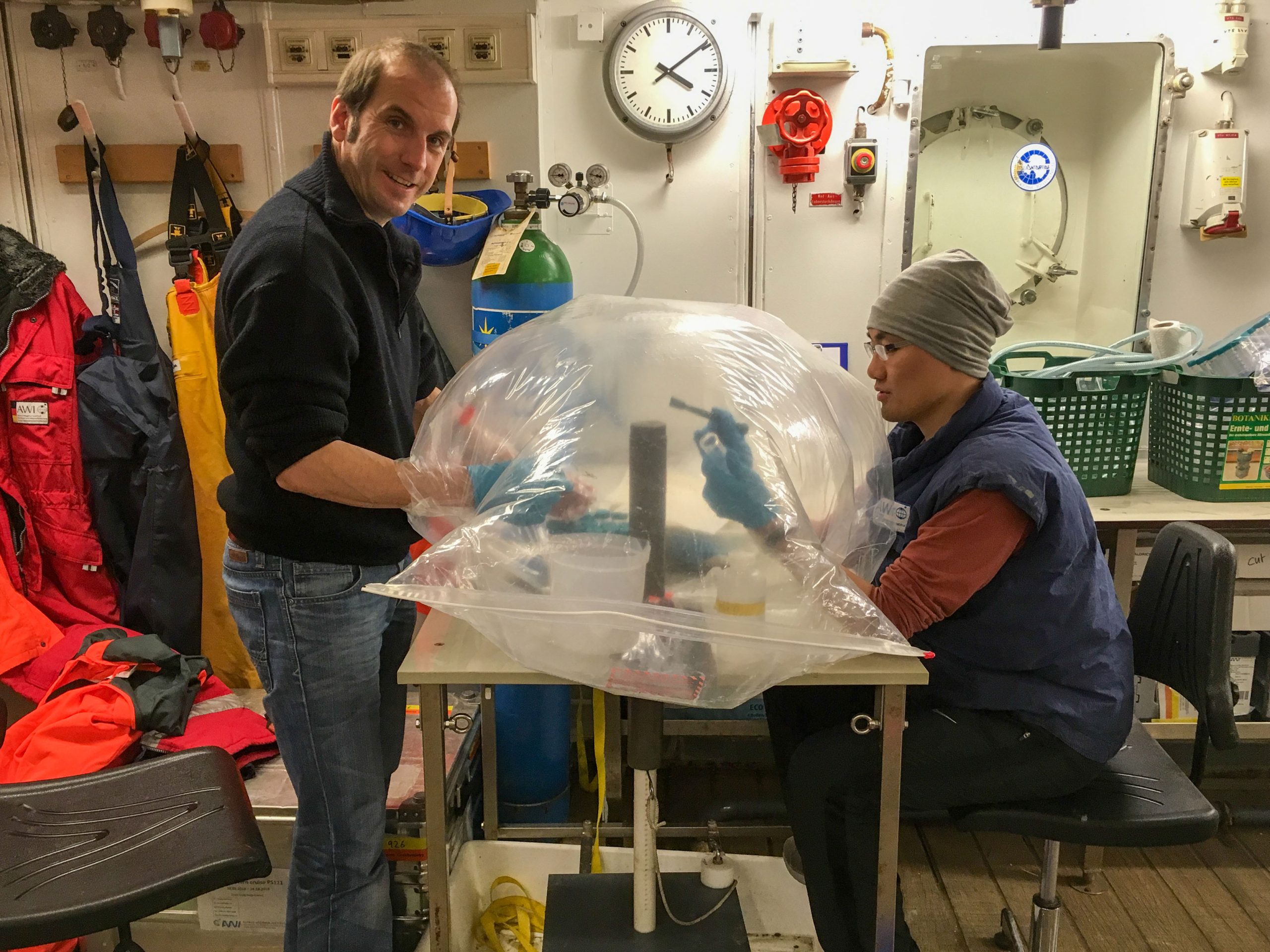
To explore this question, the team examined nine sediment cores collected from the Atlantic and Indian sectors of the Southern Ocean. The samples came from depths ranging between 2,200 and 5,000 meters, equivalent to roughly 7,200 to 16,400 feet, and were taken from locations spread across the region. By analyzing the isotopic makeup of the trace metal neodymium, which enters sediments from the surrounding seawater, the researchers were able to map how Antarctic Bottom Water expanded and contracted over tens of thousands of years.
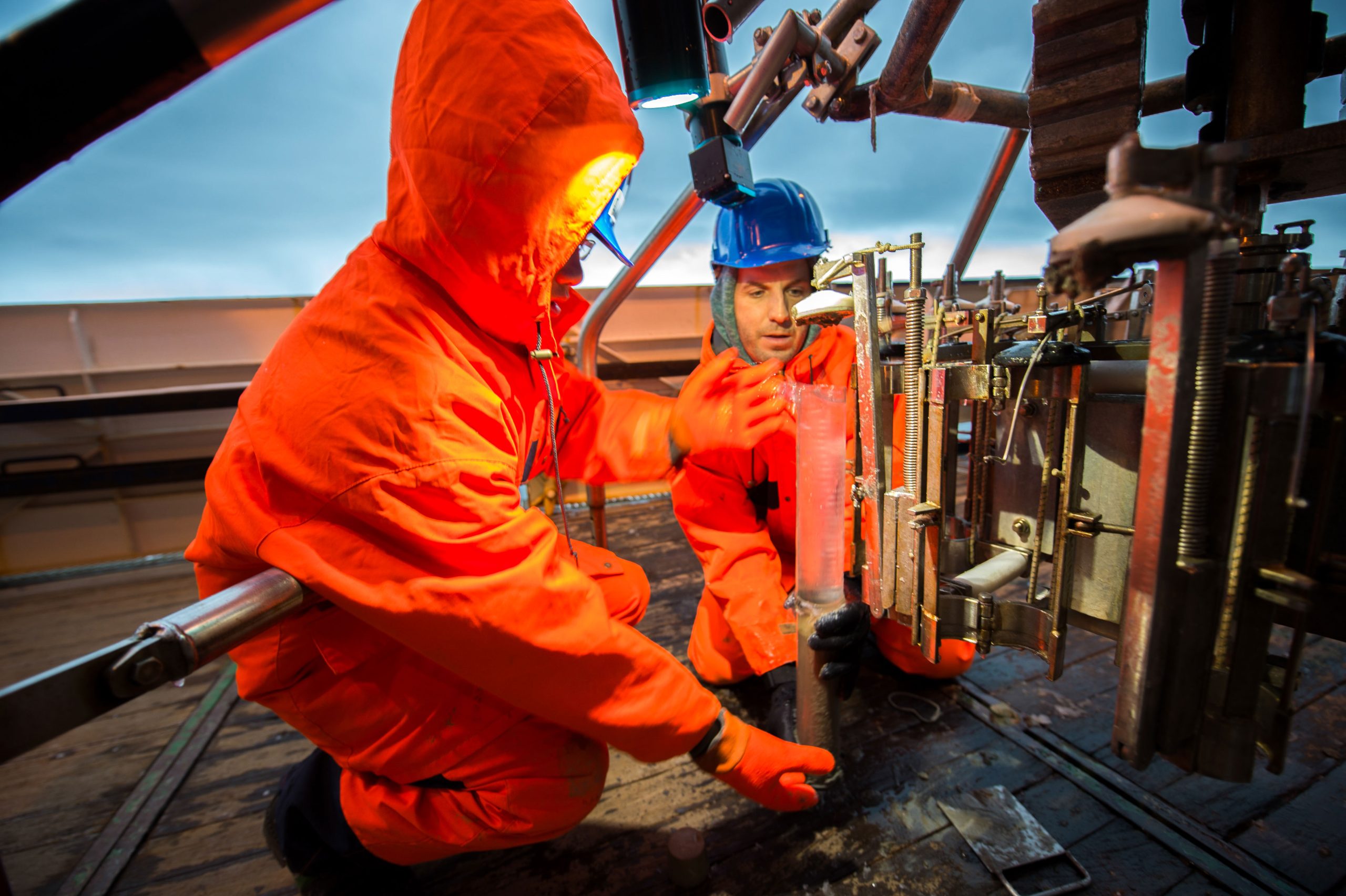
“Dissolved neodymium and its isotopic fingerprint in seawater are excellent indicators of the origin of deep-water masses,” explains Dr Marcus Gutjahr. “In earlier studies, we noticed that the neodymium signature in the deep South Atlantic only reached its modern composition around 12,000 years ago. However, sediments from the last Ice Age showed values that are not found anywhere in the Southern Ocean today. Initially, we thought the method was flawed or that there was something wrong with the sediment core. But the real question was: What could generate such a signal? Such an exotic isotopic signature can only develop when deep water remains almost motionless for extended periods. In such circumstances, benthic fluxes – chemical inputs from the seafloor – dominate the isotopic imprint in marine sediments.”
Two phases of expansion and their role in releasing carbon dioxide
During the last Ice Age, the deep water that currently forms around Antarctica as an extremely cold and dense mass was much less widespread. In its place, much of the deep Southern Ocean was occupied by carbon-rich water that came from the Pacific – a glacial forerunner of today’s Circumpolar Deep Water (CDW). The study identifies CDW as carbon-rich because it moves slowly through the deep ocean with very limited exposure to the surface. As a result, large amounts of dissolved carbon stayed trapped in the ocean, which helped maintain low atmospheric CO2 levels.
As the planet warmed and the ice sheets melted between about 18,000 and 10,000 years ago, the volume of Antarctic Bottom Water expanded in two distinct phases. These phases coincided with known warming events in Antarctica. As vertical mixing in the Southern Ocean increased, the carbon that had been stored in the deep ocean was able to return to the atmosphere.
“The expansion of the AABW is linked to several processes,” explains Gutjahr. “Warming around Antarctica reduced sea-ice cover, resulting in more meltwater entering the Southern Ocean. The Antarctic Bottom Water formed during this transitional climate period had a lower density due to reduced salinity. This late-glacial AABW was able to spread further through the Southern Ocean, destabilizing the existing water-mass structure and enhancing exchanges between deep and surface waters.”
Until now, many studies have assumed that changes in the North Atlantic, including the formation of the North Atlantic Deep Water (NADW), were the dominant drivers behind shifts in deep-water circulation in the South Atlantic. However, the new data indicate that northern influences were more limited than previously thought. Instead, the displacement of a glacial, carbon-rich deep-water mass by newly formed Antarctic Bottom Water is thought to have played a central role in the rise of atmospheric CO2 at the end of the last Ice Age.
Southern Ocean heat storage and Antarctic ice loss
“Comparisons with the past are always imperfect,” says Gutjahr, “but ultimately it comes down to how much energy is in the system. If we understand how the ocean responded to warming in the past, we can better grasp what is happening today as Antarctic ice shelves continue to melt.”
Due to its size alone, the Southern Ocean plays a significant role in regulating the Earth’s climate. Over the past five decades, waters deeper than roughly 1,000 meters around Antarctica have warmed significantly faster than most other parts of the global ocean. In order to understand how these changes affect the ocean’s capacity to absorb and release carbon dioxide, physical and biogeochemical processes must be monitored over long periods and integrated into climate models.
“I want to properly understand the modern ocean in order to interpret signals from the past,” Gutjahr says. “If we can trace how Antarctic Bottom Water has changed over the last few thousand years, we can assess more accurately how rapidly the Antarctic Ice Sheet may continue to lose mass in the future.”
Paleoclimatic data obtained from sediment cores are indispensable for this, offering insights into past climates that were warmer than today and helping to improve projections of future climate change.
Reference: “Expansion of Antarctic Bottom Water driven by Antarctic warming in the last deglaciation” by Huang Huang, Marcus Gutjahr, Yuanyang Hu, Frerk Pöppelmeier, Gerhard Kuhn, Jörg Lippold, Thomas A. Ronge, Shuzhuang Wu, Patrick Blaser, Lester Lembke-Jene, Samuel L. Jaccard, Yimin Luo and Jimin Yu, 1 December 2025, Nature Geoscience.
DOI: 10.1038/s41561-025-01853-7
Never miss a breakthrough: Join the SciTechDaily newsletter.
Follow us on Google and Google News.
1 Comment
“As a result, large amounts of dissolved carbon stayed trapped in the ocean, which helped maintain low atmospheric CO2 levels.”
…
“As vertical mixing in the Southern Ocean increased, the carbon that had been stored in the deep ocean was able to return to the atmosphere.”
…
“Instead, the displacement of a glacial, carbon-rich deep-water mass by newly formed Antarctic Bottom Water is thought to have played a central role in the rise of atmospheric CO2 at the end of the last Ice Age.”
…
Huang et al. appear to be making a good case for temperature driving CO2, rather than the other way around and it seems to agree with the Antarctic ice core record from Law Dome that shows temperatures changing before atmospheric CO2 did.
One of the authors remarks, “If we can trace how Antarctic Bottom Water has changed over the last few thousand years, we can assess more accurately how rapidly the Antarctic Ice Sheet may continue to lose mass in the future.” No. That is the wrong conclusion. If temperature is driving atmospheric CO2, better understanding will allow us to predict CO2 concentrations and changes better, but it isn’t telling us why the temperature is changing.