

Researchers at the Large Hadron Collider tested whether top quarks, the most massive known elementary particles, comply with Einstein’s theory of relativity.
Despite theories suggesting potential deviations at high energies, the experiments confirmed that Lorentz symmetry remains intact, offering no evidence of variation in particle behavior due to the experiment’s orientation or the time of day.
Lorentz Symmetry and Relativity
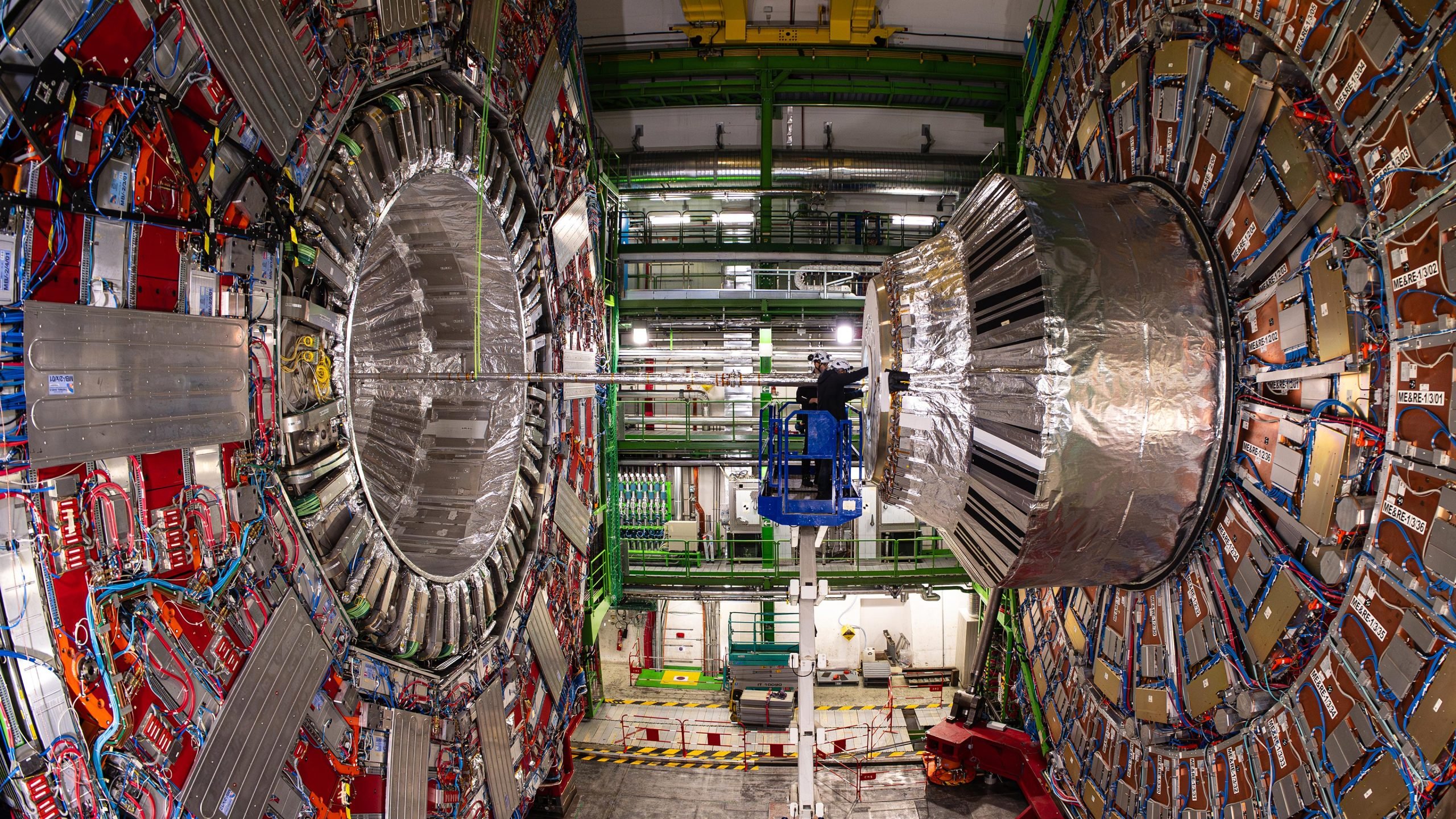
In a groundbreaking study at the Large Hadron Collider (LHC), the CMS collaboration has investigated whether top quarks follow the rules of Einstein’s special theory of relativity.
Einstein’s special relativity, along with quantum mechanics, forms the foundation of the Standard Model of particle physics. A key principle of this theory is Lorentz symmetry, which states that experimental results should remain the same regardless of the experiment’s speed or orientation in space.
Testing Relativity at High Energies
While special relativity has consistently proven accurate, some theories — such as certain models of string theory — suggest that it might break down at extremely high energies. In such cases, experimental results could start to depend on the experiment’s direction in space-time. Although signs of this Lorentz symmetry breaking might appear at the energy levels reached by the LHC, previous studies at the LHC and other colliders have found no evidence of it so far.
In its recent study, the CMS collaboration searched for Lorentz symmetry breaking at the LHC using pairs of top quarks – the most massive elementary particles known. In this case, a dependence on the orientation of the experiment would mean that the rate at which top-quark pairs are produced in proton-proton collisions at the LHC would vary with time.
Methodology and Time-Dependent Analysis
More precisely, since Earth rotates around its axis, the direction of the LHC proton beams and the average direction of top quarks produced in collisions at the center of the CMS experiment also change depending on the time of the day. As a consequence, and if there is a preferential direction in space-time, the top-quark-pair production rate would vary with the time of the day. Hence, finding a deviation from a constant rate would amount to discovering a preferential direction in space-time.
The new CMS result, which is based on data from the second run of the LHC, agrees with a constant rate, meaning that Lorentz symmetry is not broken and Einstein’s special relativity remains valid. The CMS researchers used the result to set limits on the magnitude of parameters that are predicted to be null when the symmetry holds. The limits obtained improve by up to a factor of 100 upon results from a previous search for Lorentz symmetry breaking at the former Tevatron accelerator.
Implications and Future Research
The results pave the way for future searches for Lorentz symmetry breaking based on top-quark data from the third run of the LHC. They also open the door to scrutiny of processes involving other heavy particles that can only be investigated at the LHC, such as the Higgs boson and the W and Z bosons.
Reference: “Searches for violation of Lorentz invariance in top quark pair production using dilepton events in 13 TeV proton-proton collisions” by The CMS Collaboration, 23 August 2024, Physics Letters B.
DOI: 10.1016/j.physletb.2024.138979
Never miss a breakthrough: Join the SciTechDaily newsletter.
Follow us on Google and Google News.
16 Comments
The results pave the way for future searches for Lorentz symmetry breaking based on top-quark data from the third run of the LHC.
WHY? WHY?WHY?
Special Relativity borrowed two seemingly unjustifiable hypotheses from classical mechanics. These are as follows:
1) The time-interval (time) between two events is independent of the condition of motion of the body of reference.
2) The space-interval (distance) between two points of a rigid body is independent of the condition of motion of the body of reference.
The physical essence of the two hypothese is spacetime synchronization.
Ask the researchers:
Is there a faster speed than spacetime synchronization in physical reality?
Subatomic particles in the quantum world often defy the familiar rules of the physical world. The fact repeatedly suggests that the familiar rules of the physical world are pseudoscience. In the familiar rules of the physical world, two sets of cobalt-60 can form the mirror image of each other by rotating in opposite directions, and can receive heavy rewards.
Please witness the grand performance of some so-called academic publications (including PRL, Nature, Science, etc.). https://scitechdaily.com/microscope-spacecrafts-most-precise-test-of-key-component-of-the-theory-of-general-relativity/#comment-854286. Some so-called academic publications (including PRL, Nature, Science, etc.) are addicted to their own small circles and have long deviated from science. They hardly know what ashamed is.
You have no understanding of Physics. The two things you listed are incorrect, and moreover those supposed assumptions are not hypotheses. Special Relativity is not your theory – you cannot mistepresent someone else’s theory regardless of whether or not you agree with it.
Thank you for browsing. I recommend a book to you.
(https://www.ibiblio.org/ebooks/Einstein/Einstein_Relativity.pdf). Page 36.
Thank you. I recommend that you read it.
A sentence for you:
Reading and learning require not only the eyes, but also the brain to think.
Your understanding of the laws of physics is telling the public through facts that some so-called academic publications (including PRL, Nature, Science, etc.) are deeply sinful.
Please answer the questions:
1. Are geometric shapes imagination or physical reality?
2. What is the spacetime background of the universe?
Regarding the first question, ponder this: were spheres intended to make triangles? If you arrange them as closely together as possible, the pattern they make is always a triangle. So, is this by design, by chance, or simply an illusion?
What one researcher see or touch about an elephant will be different, and what different researchers see or touch will be even more different. It is a scientific phenomenon, not the essence of nature. Scientific research guided by correct theories can enable researchers to think more.
Spins create all things and shape the world, including human thinking.
What the observer sees or touches, does not change the fact that fact that it is still an elephant. The observers interpretation simply reveals their bias.
As for my previous comment; if something must happen, it’s by design; if it may happen, it’s by chance; if it’s ‘a potato chip that looks like Elvis’, it’s an illusion.
By the way, don’t let the trolls hacking on TVT get you down. If this era were one thousand years ago, they’d be defending the Earth-centric universe model.
Thank you!
So-called academic publications (including PRL, PNAS, Nature, Science, etc.) firmly believe that two sets of cobalt-60 can form the mirror image of each other by rotating in opposite directions, and shuld receive heavy rewards. This is an open and blatant insult to science.
I don’t care who wins.
It’s not like I’ve invested any money in Einstein or the other bloke.
Must be someone’s God; certainly a godlike gift to a genocideal species; don’t we all give loaded guns to our infant children to play with?
They give just a cubic square of theory’s as theory only..
Thank you for that stunning display of your state of education.