

A bold new era in space science has begun: ESA and OHB have officially partnered to launch LISA, the world’s first space-based gravitational wave observatory.
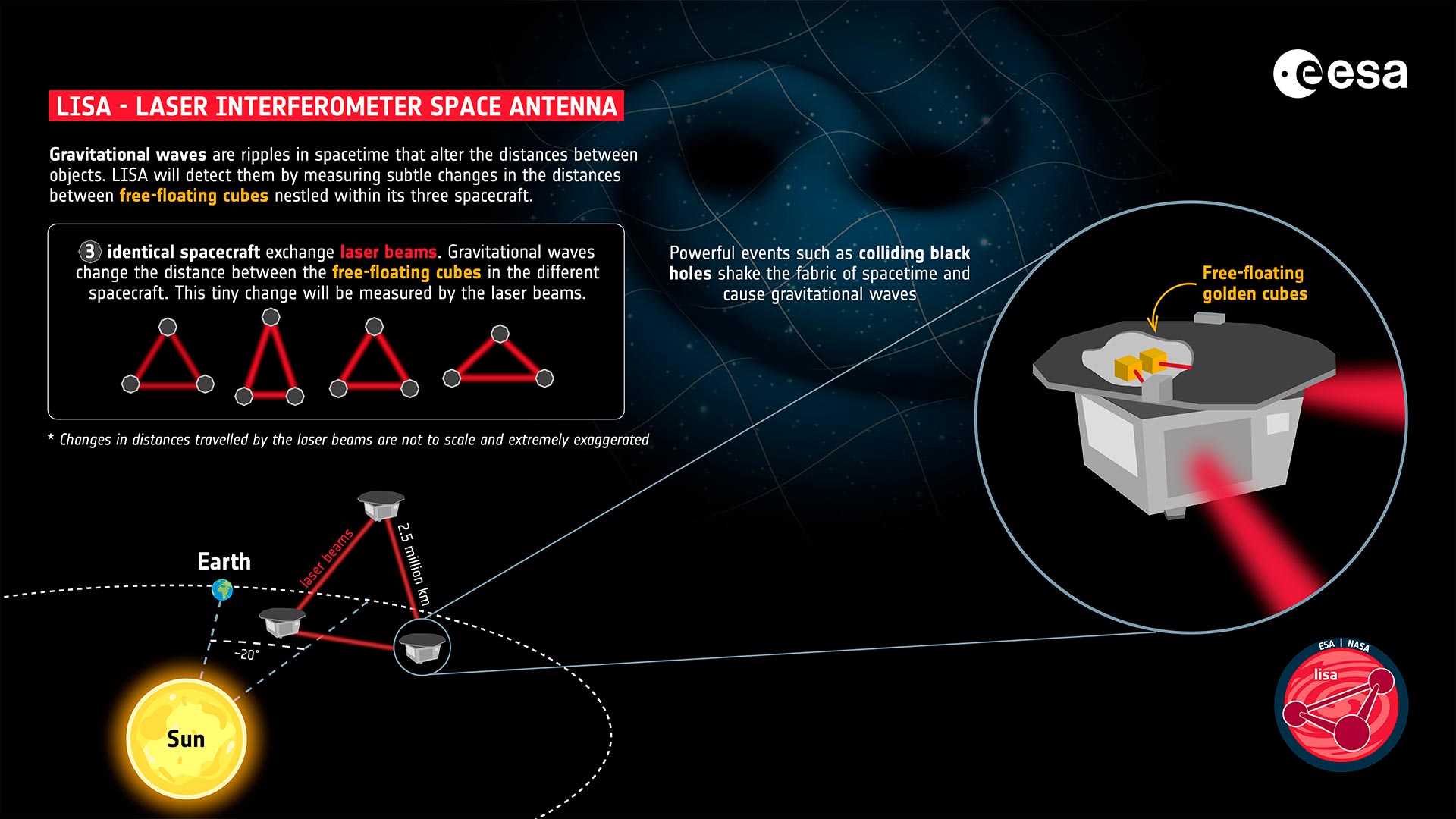
Flying three spacecraft in a triangle 2.5 million km apart, LISA will “listen” to ripples in spacetime from the most cataclysmic events in the cosmos, like colliding black holes. It’s not just a technological marvel, but a gateway to exploring hidden aspects of the Universe and challenging the very laws of physics.
ESA and OHB Launch LISA Project to Detect Gravitational Waves
On June 17, the European Space Agency (ESA) and OHB System AG officially signed an agreement to build LISA—the Laser Interferometer Space Antenna. This groundbreaking mission will be the first observatory in space designed to detect gravitational waves, the subtle ripples in spacetime created by colossal events like the collision and merger of supermassive black holes.
The announcement took place at the International Paris Air Show in France, marking the official start of LISA’s industrial development. With this milestone complete, OHB will now work closely with the LISA team to finalize the spacecraft design and begin construction.
Opening a New Window Into the Dark Universe
“We are immensely proud that ESA and the scientific community entrust us to implement this groundbreaking science mission. Together with our partners, we stand ready to bring LISA to life – pioneering our ability to ‘surf gravitational waves’ and enabling us to see our Universe in a new way,’ says Chiara Pedersoli, CEO of OHB System AG.

“I’m delighted to celebrate the contract signing today with our partners at OHB who will lead on the implementation of this truly ambitious endeavour. LISA represents many years of pioneering technology developments, hope and belief of our scientific community, and steadfast support from our ESA member states. As the first space mission designed to capture gravitational waves, LISA will open a brand-new window on the dark Universe and test the known laws of physics to their extreme,” adds Prof. Carole Mundell, ESA’s Director of Science.
“When it is flying, LISA will also represent the triumph of precision engineering and international cooperation on a new scale, and place Europe at the forefront of space technology and fundamental science.”
LISA’s Unique Role in Uncovering the Universe’s Secrets
LISA is a large-class mission to detect elusive ripples in spacetime. From its vantage point in space, LISA will capture gravitational waves of lower frequencies than is possible from Earth, uncovering events of a different scale – all the way back to the dawn of time.
This will enable scientists to trace how massive black holes merge and grow across cosmic ages, explore the fundamental nature of gravity, and study the rate at which the Universe expands.
In our own galaxy, LISA will give us new insights into the formation and evolution of tens of thousands of compact binary star systems, and advance our understanding of stellar-origin black holes.
Engineering Marvel: A Space-Based Triangular Observatory
To achieve this feat, LISA is designed to be a constellation of three spacecraft. They will fly in a triangular formation, trailing Earth in its orbit around the Sun. Each side of the equilateral triangle will span 2.5 million km, more than six times the Earth-Moon distance.
Flying a trio of spacecraft over such large distances has never been attempted before. And as if that were not difficult enough, the spacecraft will exchange laser beams with each other over their vast separation.
2035 Launch Plan and Intricate Cube Technology
The launch of the three spacecraft is planned for 2035, on an Ariane 6 rocket.
Each spacecraft carries a pair of solid gold-platinum cubes, so-called test masses (slightly smaller than Rubik’s cubes), free-floating in special housings. Gravitational waves will cause tiny changes in the distances between the golden cubes in the different spacecraft.
To capture the spacetime ripples, the mission will track these tiny shifts using the uniquely sensitive yardstick of laser interferometry – hence the mission’s name Laser Interferometer Space Antenna.
This technique requires shooting laser beams from one spacecraft to the other and then superimposing their signal to determine changes in the masses’ distances down to a few billionths of a millimeter or shifts of less than the diameter of a helium atom, over a distance of 2.5 million km.
Precision Instruments From Across Europe
The LISA mission, led by the European Space Agency (ESA), is a global collaboration that brings together ESA, its member countries, NASA, and a worldwide team of scientists known as the LISA consortium.
Construction of the spacecraft is underway by a top-tier industrial team, with OHB System AG leading the effort alongside Thales Alenia Space.
Several ESA member states are supplying key components that make this pioneering mission possible. Italy and Switzerland are providing the ultra-precise free-floating test masses, which are shielded from all external forces. Germany, the United Kingdom, France, the Netherlands, Belgium, Denmark, and the Czech Republic are contributing advanced systems that can detect minuscule changes in distance with picometre precision. Spain is delivering the Science Diagnostics Subsystem, a suite of sensitive instruments designed to monitor the spacecraft’s environment and performance.
Together, these contributions form the cutting-edge toolkit LISA needs to listen to the deepest vibrations of the Universe.
Never miss a breakthrough: Join the SciTechDaily newsletter.
Follow us on Google and Google News.
1 Comment
NOTE 2506240339_Source1. Analyzing
_1.
ESA plans to capture gravitational waves in space using a triangular spacecraft millions of kilometers away through LISA to uncover the secrets of the universe that we don’t know yet.
With three spacecraft placed inside a triangle 2.5 million km away, the LISA will “sense” the spatio-temporal wavelengths caused by some of the universe’s most destructive events, such as black hole collisions. LISA is not just a technical marvel, but a gateway to explore hidden aspects of the universe and challenge the laws of physics.
_3-1. How do I detect gravitational waves?
With its 2035 launch plan, a new era of space science has begun. ESA and OHB have officially partnered to create the Laser Interferometer Space Antenna (LISA), the world’s first space-based gravitational wave observatory
On June 17, the European Space Agency (ESA) and OHB System AG officially signed a construction contract.
The groundbreaking mission will be the first space observatory designed to detect gravitational waves, subtle wavelengths of space-time produced by huge events such as collisions and mergers of supergiant black holes.
The three spacecraft are scheduled to launch on an Ariane 6 rocket in 2035. Each spaceship contains a pair of gold-platinum cubes, so-called test masses (slightly smaller than the Rubik’s cube), that are floating freely in its special housing. Gravitational waves produce microscopic changes in the distance between the gold cubes of each spaceship.
-】]The detection of gravitational waves reacts on three xyz spacecraft spare.value.nk to detect microscopic oscillations through each qpeoms cubic and hang them on the interferometer, so the wave can be almost similar to the value obtained by the dark energy in the qcell. Hmm.
Gravitational waves produce the acceleration of spin angular motion through msbase.bar . Huh.
The formation of msbase.gallaxy by gravitational waves in the universe is understood by the qpeoms interferometer..what??
_3-2.
The technology requires firing laser beams from one spacecraft to another and then overlapping the signals to identify changes in mass distance of a billionth of a millimeter over a distance of 2.5 million km or movements smaller than the diameter of helium atoms.
≈≈=========
Source 1.
https://scitechdaily.com/esa-is-building-a-massive-space-antenna-to-listen-to-the-dark-universe/