
Close Menu
    Facebook X (Twitter) Instagram
    SciTechDaily
    • Biology
    • Chemistry
    • Earth
    • Health
    • Physics
    • Science
    • Space
    • Technology
    Facebook X (Twitter) Pinterest YouTube RSS
    SciTechDaily
    Home»Space»Fermi Views Gamma Rays from Solar Flares on the Far Side of the Sun
    Space

    Fermi Views Gamma Rays from Solar Flares on the Far Side of the Sun

    By Francis Reddy, NASA's Goddard Space Flight CenterJanuary 31, 2017No Comments4 Mins Read
    Facebook Twitter Pinterest Telegram LinkedIn WhatsApp Email Reddit
    Share
    Facebook Twitter LinkedIn Pinterest Telegram Email Reddit

    New research from NASA’s Fermi Gamma-ray Space Telescope reveals high-energy light from solar eruptions located on the far side of the sun, which should block direct light from these events. This apparent paradox is providing solar scientists with a unique tool for exploring how charged particles are accelerated to nearly the speed of light and move across the sun during solar flares.

    “Fermi is seeing gamma rays from the side of the sun we’re facing, but the emission is produced by streams of particles blasted out of solar flares on the far side of the sun,” said Nicola Omodei, a researcher at Stanford University in California. “These particles must travel some 300,000 miles (480,000 kilometers) within about five minutes of the eruption to produce this light.”

    Omodei presented the findings on Monday, January 30, at the American Physical Society meeting in Washington, and a paper describing the results will be published online in The Astrophysical Journal on January 31.


    On three occasions, NASA’s Fermi Gamma-ray Space Telescope has detected gamma rays from solar storms on the far side of the sun, emission the Earth-orbiting satellite shouldn’t be able to detect. Particles accelerated by these eruptions somehow reach around to produce a gamma-ray glow on the side of the sun facing Earth and Fermi. Watch to learn more.

    Fermi has doubled the number of these rare events, called behind-the-limb flares, since it began scanning the sky in 2008. Its Large Area Telescope (LAT) has captured gamma rays with energies reaching 3 billion electron volts, some 30 times greater than the most energetic light previously associated with these “hidden” flares.

    Thanks to NASA’s Solar Terrestrial Relations Observatory (STEREO) spacecraft, which were monitoring the solar far side when the eruptions occurred, the Fermi events mark the first time scientists have direct imaging of beyond-the-limb solar flares associated with high-energy gamma rays.
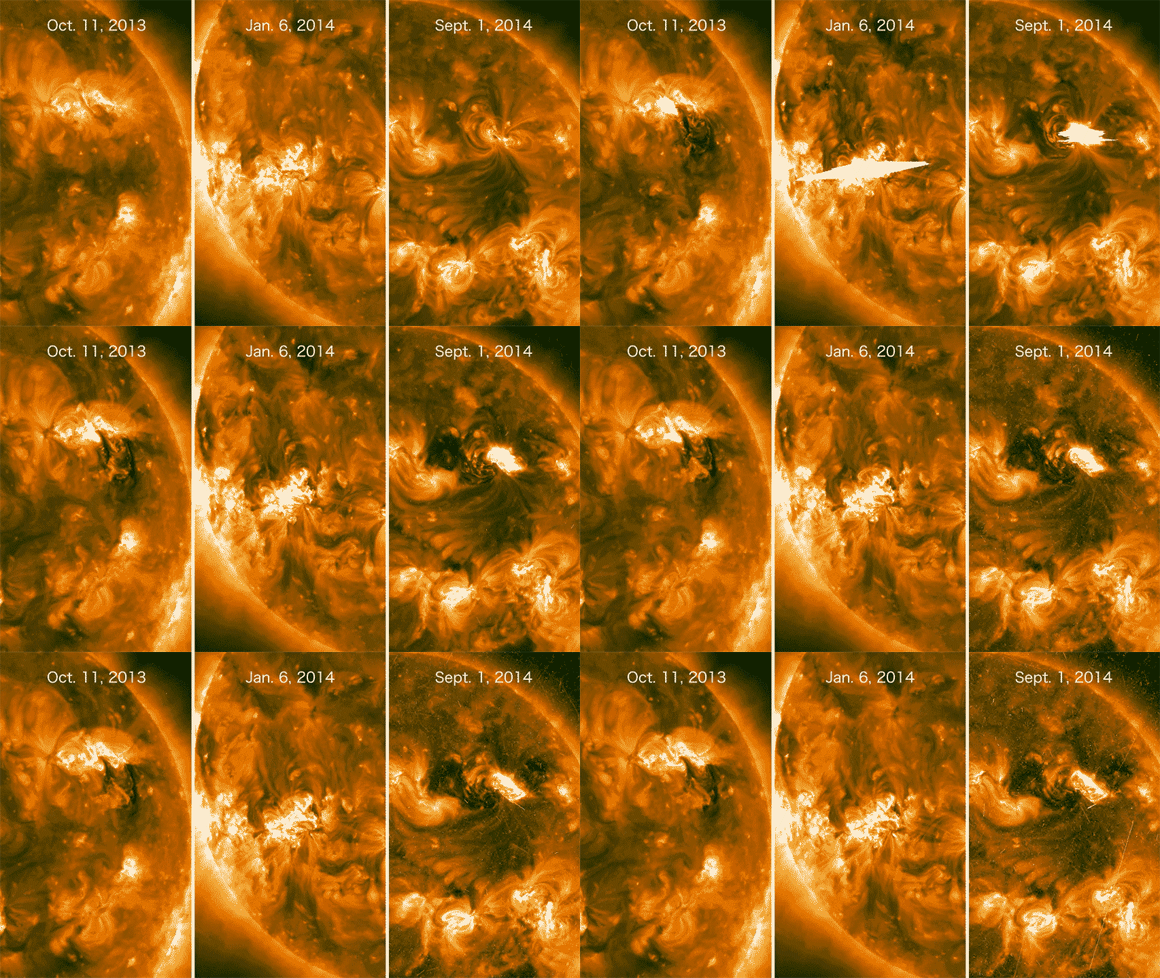
    Fermi Sees Gamma Rays from 'Hidden' Solar Flares
    These solar flares were imaged in extreme ultraviolet light by NASA’s STEREO satellites, which at the time were viewing the side of the sun facing away from Earth. All three events launched fast coronal mass ejections (CMEs). Although NASA’s Fermi Gamma-ray Space Telescope couldn’t see the eruptions directly, it detected high-energy gamma rays from all of them. Scientists think particles accelerated by the CMEs rained onto the Earth-facing side of the sun and produced the gamma rays. The central image was returned by the STEREO A spacecraft, all others are from STEREO B.

    “Observations by Fermi’s LAT continue to have a significant impact on the solar physics community in their own right, but the addition of STEREO observations provides extremely valuable information of how they mesh with the big picture of solar activity,” said Melissa Pesce-Rollins, a researcher at the National Institute of Nuclear Physics in Pisa, Italy, and a co-author of the paper.

    The hidden flares occurred October 11, 2013, and January 6 and September 1, 2014. All three events were associated with fast coronal mass ejections (CMEs), where billion-ton clouds of solar plasma were launched into space. The CME from the most recent event was moving at nearly 5 million miles an hour as it left the sun. Researchers suspect particles accelerated at the leading edge of the CMEs were responsible for the gamma-ray emission.

    Large magnetic field structures can connect the acceleration site with distant part of the solar surface. Because charged particles must remain attached to magnetic field lines, the research team thinks particles accelerated at the CME traveled to the sun’s visible side along magnetic field lines connecting both locations. As the particles impacted the surface, they generated gamma-ray emission through a variety of processes. One prominent mechanism is thought to be proton collisions that result in a particle called a pion, which quickly decays into gamma rays.
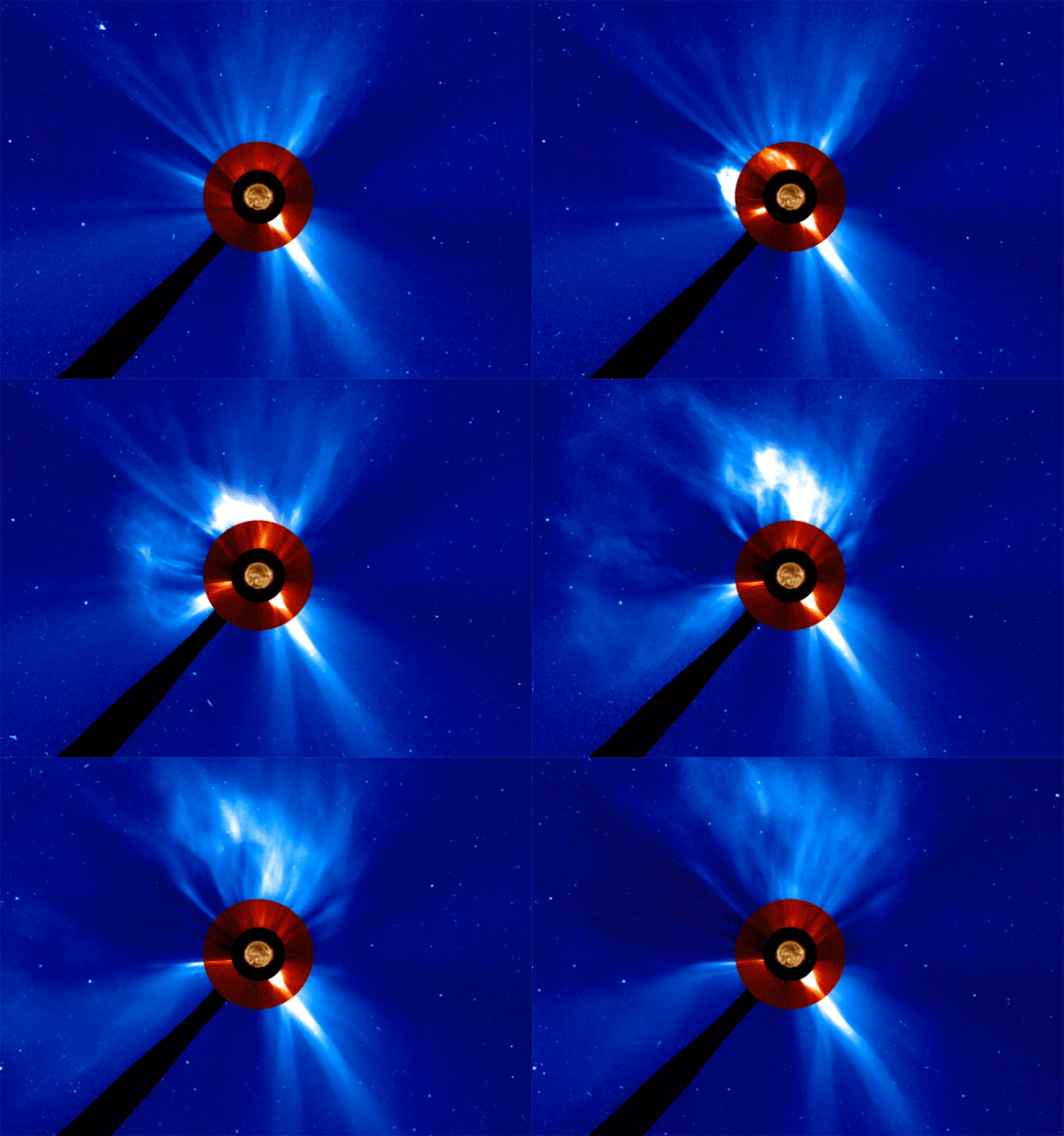
    Fermi Views Gamma Rays from 'Hidden' Solar Flares
    Combined images from NASA’s Solar Dynamics Observatory (center) and the NASA/ESA Solar and Heliospheric Observatory (red and blue) show an impressive coronal mass ejection departing the far side of the sun on September 1, 2014. This massive cloud raced away at about 5 million mph and likely accelerated particles that later produced gamma rays Fermi detected.

    In its first eight years, Fermi has detected high-energy emission from more than 40 solar flares. More than half of these are ranked as moderate, or M class, events. In 2012, Fermi caught the highest-energy emission ever detected from the sun during a powerful X-class flare, from which the LAT detected high­energy gamma rays for more than 20 record-setting hours.

    NASA’s Fermi Gamma-ray Space Telescope is an astrophysics and particle physics partnership, developed in collaboration with the U.S. Department of Energy and with important contributions from academic institutions and partners in France, Germany, Italy, Japan, Sweden, and the United States.

    Never miss a breakthrough: Join the SciTechDaily newsletter.
    Follow us on Google and Google News.

    Astronomy Cosmology Solar Flares Sun Telescope
    Share. Facebook Twitter Pinterest LinkedIn Email Reddit

    Related Articles

    NASA’s Solar Dynamics Observatory Detects Solar Flare Pulses at Sun and Earth

    First Detailed Analysis of Weak Lensing Dark Matter Peaks

    NASA’s SDO Reveals Images of X4.9-Class Solar Flare

    NASA’s Solar Dynamics Observatory Views Two New Solar Flares

    NASA Spacecraft Observe Magnetic Reconnection in Action

    Fermi’s Motion Captured by Vela Pulsar Video

    Hi-C Captures the Highest-Resolution Images Ever of the Sun’s Corona

    First Images From Project 1640

    Fermi Detects the Highest-Energy Light Ever Associated With an Eruption on the Sun

    Leave A Reply Cancel Reply

    • Facebook
    • Twitter
    • Pinterest
    • YouTube

    Don't Miss a Discovery

    Subscribe for the Latest in Science & Tech!

    Trending News

    One of the Universe’s Largest Stars May Be Getting Ready To Explode

    Scientists Discover Enzyme That Could Supercharge Ozempic-Like Weight Loss Drugs

    Popular Sweetener Linked to DNA Damage – “It’s Something You Should Not Be Eating”

    Ancient “Rock” Microbes May Reveal How Complex Life Began

    Researchers Capture Quantum Interference in One of Nature’s Rarest Atoms

    “A Plague Is Upon Us”: The Mass Death That Changed an Ancient City Forever

    Scientists Discover Game-Changing New Way To Treat High Cholesterol

    This Small Change to Your Exercise Routine Could Be the Secret to Living Longer

    Follow SciTechDaily
    • Facebook
    • Twitter
    • YouTube
    • Pinterest
    • Newsletter
    • RSS
    SciTech News
    • Biology News
    • Chemistry News
    • Earth News
    • Health News
    • Physics News
    • Science News
    • Space News
    • Technology News
    Recent Posts
    • Scientists Raise Concerns Over Newly Recognized Pollutant Found Everywhere in the Air
    • New Study Challenges 40-Year Puzzle About Childhood Body Fat
    • 20-Year Study Finds Daily Multivitamins Don’t Extend Lifespan
    • Landmark Study Links Never Marrying to Significantly Higher Cancer Risk
    • Revolutionary Imaging Technique Unlocks Secrets of Matter at Extreme Speeds
    Copyright © 1998 - 2026 SciTechDaily. All Rights Reserved.
    • Science News
    • About
    • Contact
    • Editorial Board
    • Privacy Policy
    • Terms of Use

    Type above and press Enter to search. Press Esc to cancel.