
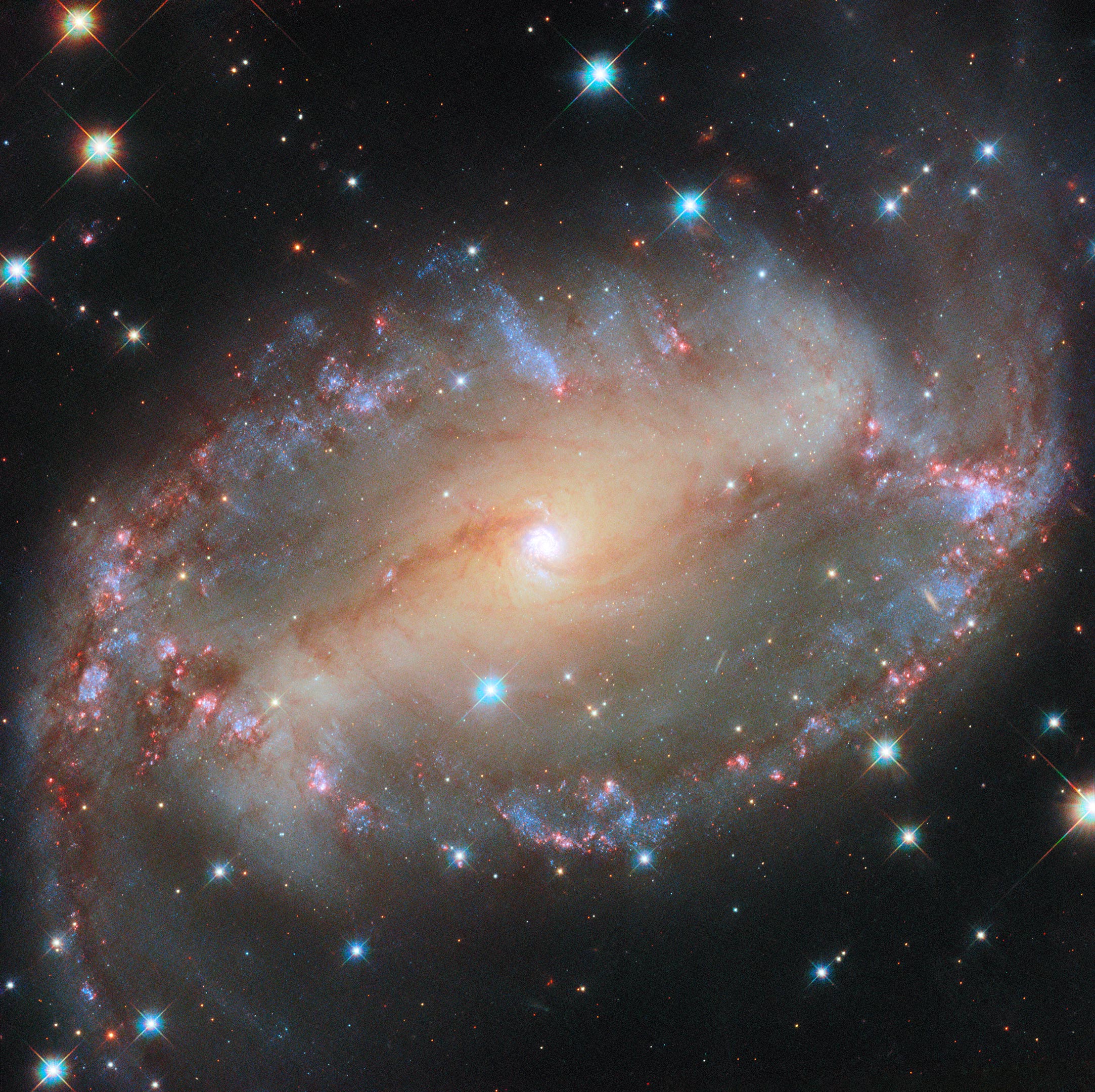
Hubble, Webb, and ALMA telescopes collaboratively explore the spiral galaxy NGC 2566, revealing its structure and star-forming processes, and enhancing knowledge of galactic dynamics and star life cycles.
This new Hubble Space Telescope’s image features the spiral galaxy NGC 2566, located 76 million light-years away in the constellation Puppis. A striking bar of stars stretches across its center, with spiral arms extending from both ends. From our vantage point, the galaxy’s tilted orientation makes its disc appear almond-shaped, resembling a cosmic eye.
While NGC 2566 seems to gaze at us, astronomers look right back, observing it closely using Hubble’s powerful instruments. They focus on the galaxy’s star clusters and star-forming regions, particularly young stars only a few million years old. These stars shine brightly in ultraviolet and visible light, making them ideal targets for Hubble’s sensors. By analyzing this data, researchers can estimate the ages of stars in NGC 2566, reconstructing its star formation history and the dynamic exchange of gas between forming stars and surrounding clouds.
Several other astronomical observatories have examined NGC 2566, including the James Webb Space Telescope. The Webb data complement this Hubble image, adding a view of NGC 2566’s warm, glowing dust to Hubble’s stellar portrait. At the long-wavelength end of the electromagnetic spectrum, NGC 2566 has also been observed by the Atacama Large Millimeter/submillimeter Array (ALMA). ALMA is a network of 66 radio telescopes that work together as one to capture detailed images of the clouds of gas in which stars form. Together, Hubble, Webb, and ALMA provide an overview of the formation, lives, and deaths of stars in galaxies across the Universe.
Never miss a breakthrough: Join the SciTechDaily newsletter.
Follow us on Google and Google News.
1 Comment
C memo 2412170140 Source 1. Analyzing_【】
1.
The Hubble Space Telescope captured this photo of the spiral galaxy NGC 2566 located in the constellation of Pupis, which is approximately 76 million light years away. The galaxy features a central star rod and spiral arms, giving it an almond-shaped appearance due to its tilt.
_[1] In my theory, galaxies are msbase. I noticed them at the end of a long wavelength tens of millions of light years away from Hubble’s gaze. My other Hubble mode gaze is recently viewed as dexterlee.br .ain. In the brain, put the cream on the danophagus from both hands under the arms. This is the act of the brain moving both hands, and in those hands, the brain sees the focus of meeting whether it is an object or a long-wavelength radio wave. According to another of my definitions, the long-short wave is a spiral of two or more galaxies rotating into a chiral galaxy.
This could be the creation of dl.br .ain’s arbitrary movement. The theory that sees this as looking at the universe with our thoughts becomes similar to the Big Bang theory. The universe may be standardized in the way humans try to understand it, so there may be a universe with a different [*]human principle. This appears in my cosmology as br.ain.sms.lms.vix.ain. Uh-huh.
_[*]For example, the cosmological constant, which represents the energy density of a vacuum, is about 120 wins of 10, but this is much smaller than the natural quantum mechanical value. The human principle explains that the magnitude value of the cosmological constant meets the conditions for forming a natural environment suitable for the birth of intelligent life. In order to create an appropriate space environment for stars or galaxies, the size of the cosmological constant has been fine-tuned to this value.
[**]It is hard to say that the discrepancy in Hubble’s constant happened by accident. This suggests the possibility that important elements are missing from the cosmic model. This emphasized the need for creative theoretical studies such as early dark energy, unusual dark matter properties, and new particle physics.
_[**]The Hubble constant is also known as the speed-distance law. Redshift is caused by cosmic expansion that occurs during the time light originating from a light source (源) reaches an observer, and its amount is proportional (approximately) to the retraction speed of the light source. In short, the retraction speed of an external galaxy is proportional to the distance to the external galaxies.
2.
Hubble, Webb, and ALMA telescopes collaborate to explore the spiral galaxy NGC 2566 to reveal its structure and star formation process and enhance knowledge of galaxy dynamics and its life cycle.
Images from this new Hubble Space Telescope feature the spiral galaxy NGC 2566 located in the constellation of Pupis, 76 million light-years away. A noticeable rod of the star extends in the center, and spiral arms extend from both ends. [2]From our perspective, the tilted direction of the galaxy is similar to the eye of the universe, with the disk appearing almond-shaped.
_[2]The human eye is two, and the gaze is deadlocked when looking at the movements of the two hands, creating a focal point. There, the brain looks at observations or productions and thinks at various angles or manipulates hands. Br.ain uses two or more senses to see or move objects, or to have feelings and take them in various information in the desired direction. That is the definition of the universe by the principle of humanity, and the Hubble constant is the value of qvix.0,2 resulting from error deviation. Huh.
The appearance of NGC 2566 as seen by cosmology or Hubble may also be just an image msbase4.672 graphic, as defined by LeeDexer.br .ain. Uh-huh.
3.
While NGC 2566 appears to be staring at us, astronomers look right back, taking a closer look using Hubble’s powerful instrument. They focus on clusters and star formation regions in the galaxy, especially young stars that are only millions of years old. These stars are ideal targets for Hubble sensors because they glow brightly in ultraviolet and visible light. Researchers can analyze the data to estimate the age of the star in NGC 2566 and reconstruct the dynamic gas exchange between the star formation history and the forming stars and the surrounding clouds.
Several other observatories, including the James Webb Space Telescope, have examined NGC 2566 .Webb data complemented this Hubble image, adding the warm, glowing dust of NGC 2566 to Hubble’s star portrait. At the end of the long wavelength of the electromagnetic spectrum, NGC 2566 has also been observed in the Atacama Large Millimeter/Submillimeter Array (ALMA). ALMA is a network of 66 radio telescopes that work together to capture detailed images of star-forming gas clouds. Together, Hubble, Webb, and ALMA give an overview of the star formation, longevity, and death in the Milky Way galaxy of the universe.
ㅡㅡㅡㅡㅡㅡㅡㅡㅡㅡㅡㅡㅡㅡ
Source 1.
https://scitechdaily.com/galactic-gaze-a-cosmic-eye-watching-from-76-million-light-years-away/
Galaxy’s Eyes: The Eyes of the Universe from 76 million light years away
Source 2.
https://m.dongascience.com/news.php?idx=68894