

A sweeping cosmic census from the James Webb Space Telescope has unveiled nearly 1,700 galaxy groups—marking the deepest and largest survey of its kind.
Peering back 12 billion years, this research opens a window into the chaotic youth of the universe, revealing how galaxies evolved from irregular, star-forming structures to the majestic spirals and ellipticals we see today. These galaxy “families” merge, interact, and grow in complexity, influenced by dark matter and colossal black holes. Scientists are now tracing their growth across eons to understand how the universe’s grand architecture came to be.
Time Travel Through the Cosmos
An international team of astronomers has made a groundbreaking discovery using the James Webb Space Telescope (JWST): the largest sample of galaxy groups ever detected. This new cosmic catalog, compiled from a region of the sky known as COSMOS-Web, offers an exciting and detailed look into how galaxies form, grow, and cluster across the vast history of the universe.
These new observations take us on a journey through time, revealing galaxies as they appeared between 12 billion and 1 billion years ago. The study, published on May 19 in Astronomy and Astrophysics, includes nearly 1,700 galaxy groups. One striking image (see image at top of page) from the research, featuring a galaxy cluster over 6 billion light years away, was recently selected as the European Space Agency’s “Picture of the Month.”
Record-Breaking Discovery of Proto-Clusters
“We’re able to actually observe some of the first galaxies formed in the universe,” says Ghassem Gozaliasl of Aalto University, and head of the galaxy groups detection team who led the study. “We detected 1,678 galaxy groups or proto-clusters – the largest and deepest sample of galaxy groups ever detected – with the James Webb Space Telescope. With this sample, we can study the evolution of galaxies in groups over the past 12 billion years of cosmic time.”
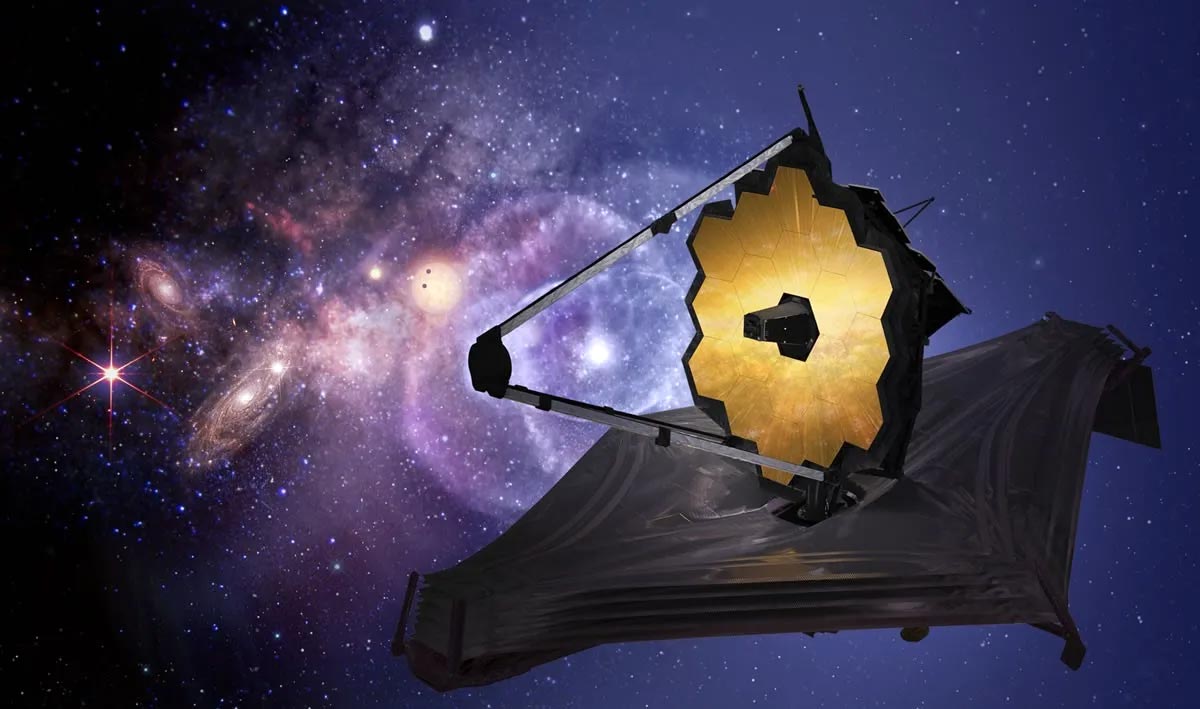
The James Webb Space Telescope, which began operations in 2022, is the most powerful space telescope ever built. Its remarkable resolution and sensitivity let scientists observe the faintest galaxies ever recorded—some of them a billion times dimmer than what the human eye can see. And because light takes time to travel across space, these distant galaxies offer a direct look into the early universe, showing us how galaxies looked and behaved billions of years ago.

Credit: ESA/Webb, NASA & CSA, G. Gozaliasl, A. Koekemoer, M. Franco, and the COSMOS-Web team
Dark Matter, Black Holes, and Galactic Evolution
Galaxy groups and clusters are rich environments filled with dark matter, hot gas, and massive central galaxies that often host supermassive black holes, explains Gozaliasl. “The complex interactions between these components play a crucial role in shaping the life cycles of galaxies and driving the evolution of the groups and clusters themselves. By uncovering a more complete history of these cosmic structures, we can better understand how these processes have influenced the formation and growth of both massive galaxies and the largest structures in the universe.”
Galaxies aren’t scattered evenly throughout the universe. Instead, they cluster in dense regions connected by filaments and walls, forming a vast structure known as the cosmic web. Truly isolated galaxies are rare — most reside in galaxy groups, which typically contain anywhere from three to a few dozen galaxies, or in larger galaxy clusters, which can include hundreds or even thousands of galaxies bound together by gravity. Our own Milky Way is part of a small galaxy group known as the Local Group, which includes the Andromeda Galaxy and dozens of smaller galaxies.
Galactic Families and Their Transformations
“Like humans, galaxies come together and make families,” explains Gozaliasl. “Groups and clusters are really important, because within them galaxies can interact and merge together, resulting in the transformation of galaxy structure and morphology. Studying these environments also helps us understand the role of dark matter, feedback from supermassive black holes, and the thermal history of the hot gas that fills the space between galaxies.”
Because the new catalog includes observations that span from one billion to twelve billion years ago, scientists can compare some of the earliest structures in the universe with relatively modern ones to learn more about galaxy groups and how they evolve. Studying the history of galaxy groups can also help astronomers understand how the giant, brightest group galaxies (BGGs) at their centres form through repeated mergers — an area explored in depth across several of Gozaliasl’s recent publications.
From Chaotic Beginnings to Galactic Order
“When we look very deep into the universe, the galaxies have more irregular shapes and are forming many stars. Closer to our time, star formation is what we refer to as ‘quenched’ – the galaxies have more symmetric structures, like elliptical or spiral galaxies. It’s really exciting to see the shapes changing over cosmic time. We can start to address so many questions about what happened in the universe and how galaxies evolved,” says Gozaliasl.
Reference: “The COSMOS-Web deep galaxy group catalog up to z = 3.7” by Greta Toni, Ghassem Gozaliasl, Matteo Maturi, Lauro Moscardini, Alexis Finoguenov, Gianluca Castignani, Fabrizio Gentile, Kaija Virolainen, Caitlin M. Casey, Jeyhan S. Kartaltepe, Hollis B. Akins, Natalie Allen, Rafael C. Arango-Toro, Arif Babul, Malte Brinch, Nicole E. Drakos, Andreas L. Faisst, Maximilien Franco, Richard E. Griffiths, Santosh Harish, Günther Hasinger, Olivier Ilbert, Shuowen Jin, Ali Ahmad Khostovan, Anton M. Koekemoer, Maarit Korpi-Lagg, Rebecca L. Larson, Jitrapon Lertprasertpong, Daizhong Liu, Georgios Magdis, Richard Massey, Henry Joy McCracken, Jed McKinney, Louise Paquereau, Jason Rhodes, Brant E. Robertson, Mark Sargent, Marko Shuntov, Masayuki Tanaka, Sina Taamoli, Elmo Tempel, Sune Toft, Eleni Vardoulaki and Lilan Yang, 19 May 2025, Astronomy & Astrophysics.
DOI: 10.1051/0004-6361/202553759
Never miss a breakthrough: Join the SciTechDaily newsletter.
Follow us on Google and Google News.
3 Comments
Fascinating read! SciTech Daily consistently does a great job highlighting cutting-edge research in a way that’s accessible without oversimplifying. It’s always exciting to see how rapidly science and technology are advancing — from breakthroughs in health and energy to discoveries in space and AI. Looking forward to seeing how these developments translate into real-world applications.
It strikes me that our instruments can’t see back beyond 12 billion light years……….
NOTE 2506050700_Source1. Analyzing【
_[3]A more stable view as the universe evolves. 1. The sample chiral full.oms symmetry is being resembled. The black hole vixer and the neutron star vixer share gravity and electromagnetic force in msbase.galaxy.
Of course, the weak force, the strong force, and the great unification tensor exist in the qpeoms quantum world. Uh-huh.
View 1.specimen
sample 1.vix.a’6//vixx.a(b1,g3,k3,o5,n6)
b0acfd|0000e0
000ac0|f00bde
0c0fab|000e0d
e00d0c|0b0fa0
f000e0|b0dac0
d0f000|cae0b0
0b000f|0ead0c
0deb00|ac000f
ced0ba|00f000
a0b00e|0dc0f0
0ace00|df000b
0f00d0|e0bc0a
Of course, asymmetry has also evolved, making small particles like giant primes from the dark energy quasi_ms to the qcell local point. Uh-huh.
Of course…symmetric msbase also evolved through repeated mergers of large, bright clusters of galaxies (BGGs) in the center of the galaxy cluster, forming a multiverse with dark energy of the dark matter system msoss bogey 4. Oh, my.
≈≈≈=========
Source 1.
https://scitechdaily.com/galactic-time-machine-nasas-webb-reveals-12-billion-years-of-galaxy-evolution/
1.
Galaxy Time Travel: NASA Webb Unveils 12 Billion Years of Galaxy Evolution
This new image of the month taken by the James Webb Space Telescope contains an astounding number of galaxies. The objects in the image span an astounding variety of distances, from stars in the Milky Way, marked with diffraction spikes, to galaxies billions of light years away.
An extensive space survey conducted by the James Webb Space Telescope has revealed approximately 1,700 clusters of galaxies. It is the deepest and largest survey of its kind.
1-1.
The study, which dates back to 12 billion years, opens a window into the chaotic youth of the universe, showing how galaxies evolved from the irregular star-forming structures to the majestic spiral and elliptical galaxies we see today. These galactic “groups” merge, interact, and become more complex under the influence of dark matter and giant black holes. Scientists are now tracking the growth of galaxies over a long period of time to understand how the grand structure of the universe came about.
1-3. Time travel through space
A team of international astronomers has made a groundbreaking discovery using the James Webb Space Telescope (JWST). This is the largest sample of galaxies in history. This new list of universes, collected from the sky domain known as COSMOS-Web, provides an interesting and detailed view of how galaxies form, grow, and converge across the vast cosmic history.